
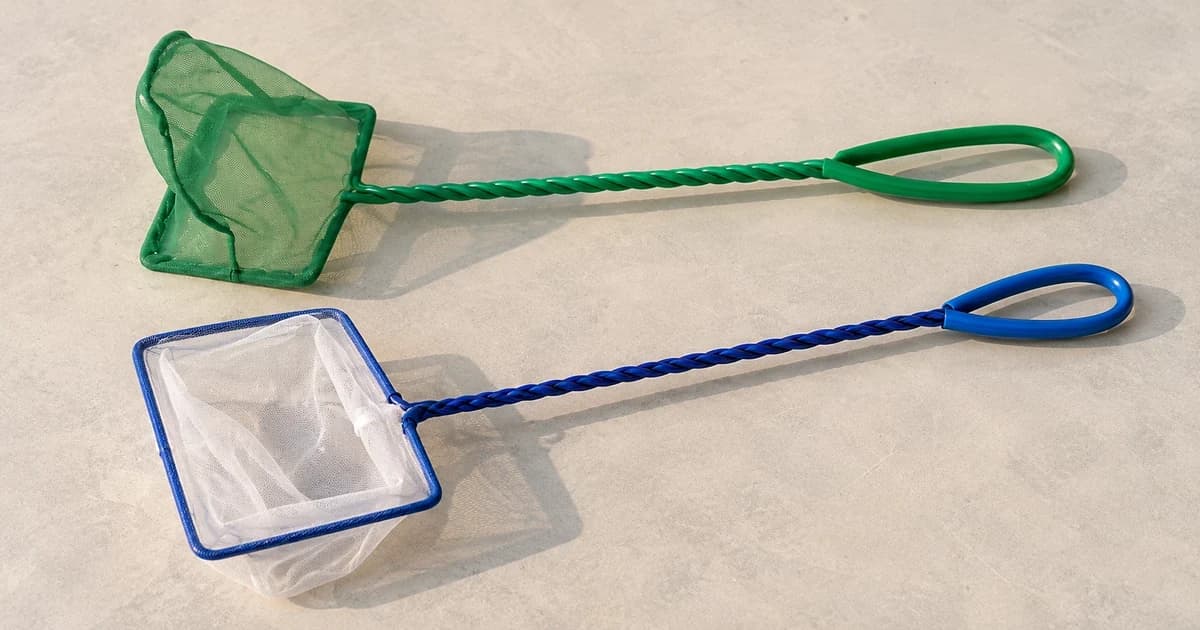
To choose an aquarium fish net, compare the head opening, pocket depth, mesh description and usable reach separately. Then check those specifications against the task and the access available in your aquarium. A larger size label or a longer-looking handle does not answer all of those questions.
Start with an identifiable model and its maker's specification. The examples below show why net size, handle length, an extension range and packing dimensions belong in different fields.
Record the task and the available access
Write down what you need the tool for, the animals involved and the particular part of the aquarium you need to reach. Record the opening through which the head must pass and any fixed obstructions along that route. A head that passes through the top opening may still be awkward to position between decorations.
Keep species suitability as a separate question. These equipment specifications do not establish a universal net width for a given fish length or prove that a particular mesh is suitable for every animal. Obtain the relevant species and model guidance before relying on an unresolved suitability claim.
Give each dimension its own meaning
| Specification | What to establish | What it does not establish by itself |
|---|---|---|
| Head opening | The opening's shape and stated dimensions | Mesh pocket depth or usable handle reach |
| Pocket depth | The stated depth of the net bag | A head-opening measurement or a universal fish-size allowance |
| Mesh description | The exact maker's designation and any stated aperture | A shared numerical definition of “fine” across brands |
| Handle or extension | Which part is measured and the documented adjustment range | Permission to treat every overall-length field as handle length |
| Packing dimensions | The size of the packaged item | The assembled tool's working reach |
Leave a field unresolved when the product page does not define it.
Compare three named examples without mixing their fields
Seachem's Fish Nets range lists standard handles as 12 inches and long handles as 16 inches. Its nominal net-size options and separate fine-mesh versions are additional choices. A 3-inch net-size label is therefore not the standard handle's length.
Keep the selected size, handle version and mesh version together in your record. The page recommends a fine-mesh option for more delicate species, but does not provide a numerical mesh aperture or a universal animal-suitability test. Do not assign an aperture to the word “fine.”
Fluval's Canada English page for Betta Telescopic Fish Net 14870 states a net opening of 7.3 x 7.3 cm and a net depth of 7 cm. It separately lists “Extendable” as 14.6–34.25 cm.
Preserve those labels when comparing the model. Do not rename the opening, pocket depth or extension field as the same measurement. Clarify exactly what the extension field measures if your choice depends on usable handle reach. The page's protective-fin and escape or entanglement wording does not establish a measured result for your animal.
EHEIM's rapidCleaner fishnet 10x8cm, product 3591010, is described as suitable for EHEIM rapidCleaner. The page explicitly labels its 1.5 cm depth, 27.5 cm height and 12 cm width as packing dimensions.
That 27.5 cm packing height is not a stated handle length or installed reach. Establish whether you are comparing a complete handled net or an accessory requiring the corresponding equipment. The named compatibility statement does not approve an unidentified handle or another brand's attachment.
Finish with a model-specific comparison record
For each candidate, keep the exact model, source page, head opening, pocket depth, mesh designation and handle or extension wording on one line. Mark whether a handle is included and identify any required compatible equipment. Add the access constraint or missing measurement that could change your decision.
Compare aquarium fish nets using that record. A candidate is easier to assess when its stated fields answer your actual access and equipment questions.