
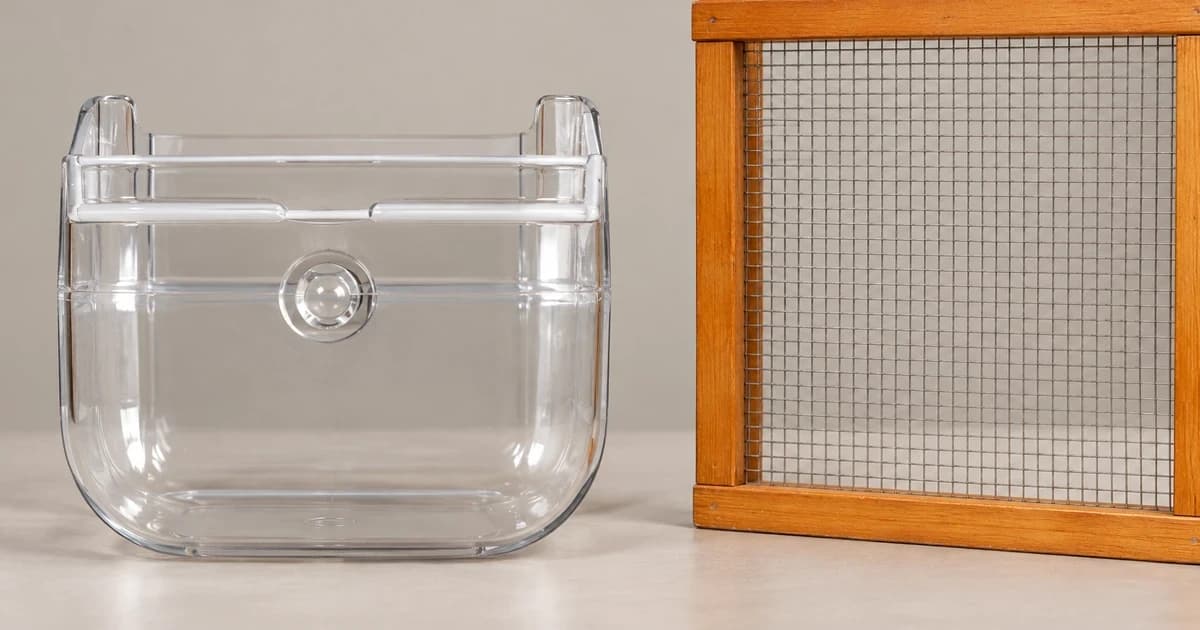
To clean bird food and water dishes, identify what actually comes out of the feeding station, then follow the care instructions for each removable part. A washable container does not automatically make its holder, cage attachment or neighboring components washable in the same way. Finish by checking how the container returns to its support before refilling it.
This guide covers that equipment workflow, with the Omlet Geo feeder and drinker as one specific example. It does not provide a disinfectant recipe or assess a bird's diet.
Separate the container from its support
Before emptying anything, identify the food container, water container and the structure that holds each one. Keep their instructions together, but distinguish the parts: a bowl that lifts out, a reservoir with a lid and a holder fixed to cage bars present different access questions.
For the Omlet Geo feeder and drinker, Omlet says the food and water containers sit in the central unit without clips. That is a useful removal detail for this design. It does not mean a different hanging feeder should be pulled free without releasing its own fastener.
If the part resists the removal method in its instructions, stop and resolve the mismatch. Do not turn a cleaning task into an improvised repair. Check whether you are handling the removable container or pulling on the support it sits in.
Match the cleaning permission to the exact component
Set out the removed components and establish the permitted method before choosing equipment or a cleaning product. Include lids and separate inserts in that check; looking like the same plastic is not an instruction.
Omlet's Geo support FAQ permits dishwasher cleaning for the Geo plastic parts, including the bath. Keep that permission tied to those components.
The same FAQ gives a limit of “60 degrees” without explicitly stating a temperature unit in the retained page. Confirm the unit and suitable program with Omlet before choosing a numeric machine setting; do not assume Celsius or Fahrenheit.
For another product, the useful questions are specific: Is this particular component removable? Is hand washing required, or is machine washing permitted? Which cleaning agent, rinsing and drying instructions apply?
Remove residue using the permitted method
RSPCA Australia's enclosure guidance treats removal of organic material as the aim of cleaning and says feeding-dish materials must suit the bird species. Those are separate questions: a care method does not establish that an unidentified dish is suitable for a particular bird.
Empty the container, then carry out its approved cleaning process. Inspect accessible food-contact surfaces and the edges where residue collects. If material remains in an area you cannot reach by the allowed method, resolve that access problem before treating the job as complete. Do not add an unapproved soak or dismantle a sealed section to finish faster.
Complete any rinsing and drying required by the chosen product instructions. This researched guide supplies no universal detergent, disinfectant, dilution, contact time or drying interval.
Check the return to the feeding station
Use the prescribed assembly and seating method. Confirm that each container is in its intended position and that a lid, insert or fastening has not been left unresolved. Keep a questionable component out of service while arranging an appropriate alternative; a familiar appearance does not resolve an uncertain attachment.
Before refilling, you should be able to identify which parts were cleaned, which instructions applied and how the containers were returned. For replacement comparisons, our bird food dishes category is a starting point; obtain the actual product's component and care information before choosing.