
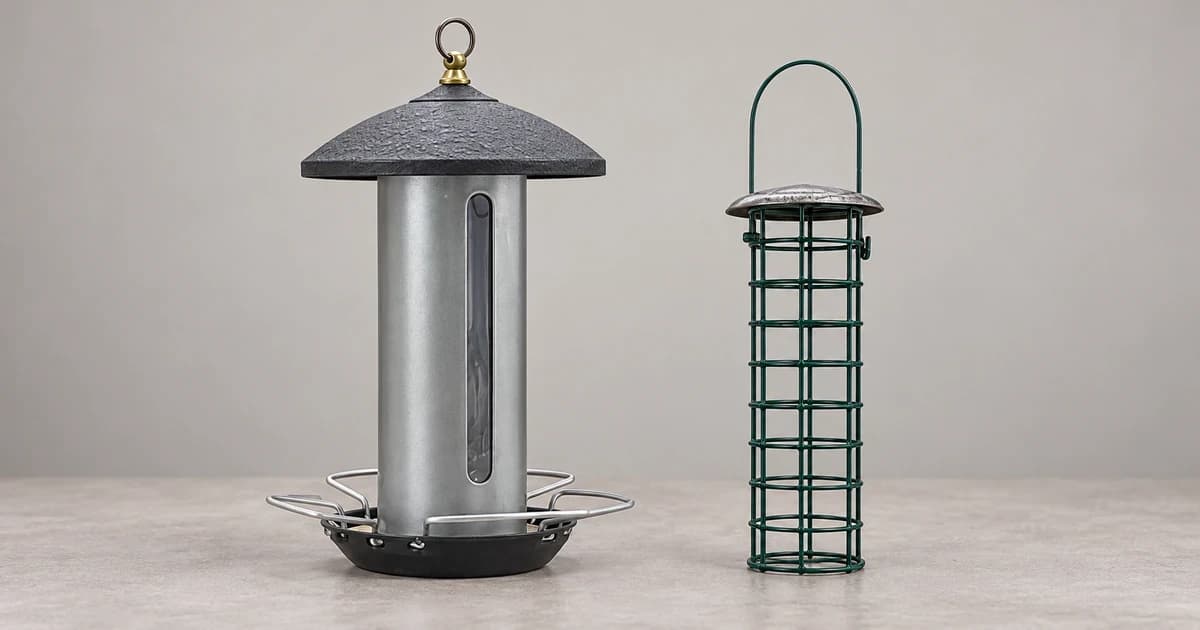
To hang a bird feeder, match the feeder's intended hanging point, the hanger and the supporting structure before choosing the final position. Then check the space around the feeder and whether you can remove or refill it by its normal method. Hanger length, installed height and clearance are three different measurements.
The examples below show why those distinctions matter. They do not supply a universal hook connection, branch size or load rating for an unidentified installation.
Identify the whole hanging arrangement
Begin with the exact feeder and its instructions. Identify its designated hanging point and any supplied hanger. Then identify the intended support: for example, a particular bracket, hook or tree attachment. A ring on the feeder and a hook above it are only two parts of the arrangement; the connection between them still needs an approved method.
Obtain the applicable load information for the arrangement you will actually use, including the feeder when filled. A description such as “strong” does not resolve the question.
Choose the hanger length without treating it as height
Jacobi Jayne's Hang-Right is one example: the maker lists 12-inch, 24-inch and 36-inch options and explicitly identifies those measurements as wire lengths. They are not published distances from the ground to the installed feeder.
Sketch the intended position before selecting a length. Mark where the support connection will be, where the feeder body will hang and what is beside it. Consider the actual attachment route described in the instructions. Do not assume a length printed on an accessory translates directly into the same vertical drop.
If the maker has not explained how the accessory connects to your feeder and support, ask that specific question. Do not invent a cable loop, knot or clip arrangement from a product photograph.
Allow the clearance required by your feeder's mechanism
For the Brome Squirrel Buster Standard, Brome specifies at least 18 inches/47 cm of clearance around the feeder. Its explanation concerns the weight-triggered outer shroud: a nearby foothold could let a squirrel reach the feeding area without putting its weight on that mechanism.
This is the manufacturer's stated pair of measurements for that model's clearance. It is not a mounting height or a rule for every feeder, and following it here is not a tested guarantee of squirrel exclusion.
Check your own model's requirements against the proposed position. Moving the hanging point higher does not automatically remove a nearby obstruction. Conversely, buying a longer hanger does not establish that the resulting position meets the feeder's clearance requirements. Reconsider the whole arrangement when either measurement changes.
Keep ordinary removal and refill access
Jacobi Jayne recommends a quiet, sheltered, accessible branch or hook location for its Hanging Treat Dish. The same product has a tray that twists off for removal. That gives owners a concrete access question: will the intended position leave room to use this tray's normal removal method?
Apply the access question to your actual feeder's design. A feeder that opens at the top presents a different maintenance task from one with a removable dish. Identify which part needs to move and where it must pass; do not substitute an improvised disassembly method because the chosen location blocks access.
Complete the specified connection and recheck the position
Follow the actual equipment's assembly and attachment instructions, including its required closures. Resolve an unclear hanging point, support condition or incompatible connection before use. This guide does not replace those instructions with a test in which you add weight until something moves.
Once correctly installed, compare the position with your plan: the feeder hangs from the intended point, the required surrounding space is available and its normal maintenance route remains accessible. Recheck these observations after changing the hanger or moving the support. Keep the part names and instructions with your notes so a later change does not silently create a different arrangement.
Our wild bird feeders category provides an equipment starting point. Confirm the selected product's own hanging, support and clearance requirements before deciding which accessories it needs.