

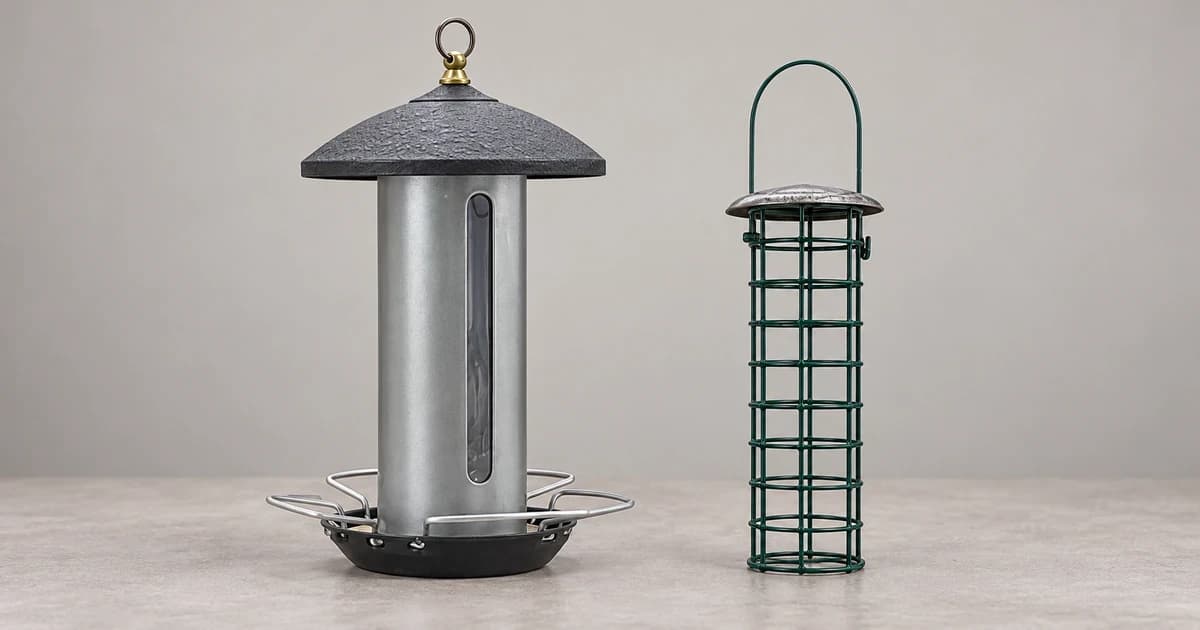
Knowing how to hang a bird feeder starts with matching the feeder's designated bail or loop, the hanging accessory, and the overhead branch or bracket before settling on a spot. In a practical how to hang a bird feeder clearance hanger length check, keep three measurements separate—hanger wire length, installed height above ground, and surrounding clearance—and verify that you can still reach and remove the feeding tray for routine refills.
The three named manufacturer examples below show why those four space checks cannot be collapsed into a single number, and why they do not establish a universal branch diameter or load rating for an unverified support.
Identify the whole hanging arrangement and load scope
Start with the exact feeder manual to confirm its built-in hanging ring or bail and any included hook. Then check the overhead support—such as a pole arm, wall bracket, or tree limb—and the connector linking them. Always verify that the support hardware is rated for the feeder's fully filled weight rather than relying on a generic “heavy-duty” adjective, and confirm that an extension hook or cable is designed to mate with both your feeder bail and overhead support before hanging.
Four distinct measurements and access paths to map before hanging
Use the spatial breakdown below so accessory wire lengths, height above ground, squirrel-shroud clearance, and bottom-dish removal routes are never confused with one another:
| Spatial Zone | What This Dimension Measures | Named Product Specification | Boundary to Preserve |
|---|---|---|---|
| 1. Hanger wire length | The physical length of the hanging accessory itself from end to end. | Jacobi Jayne Hang-Right lists 12-inch, 24-inch, and 36-inch options and explicitly defines them as wire lengths. | Wire length is not the distance from the feeder to the ground, and does not automatically equal vertical drop if routed over a wide limb. |
| 2. Support-to-ground installed height | Vertical distance from the ground to the hung feeder base once attached to your branch or pole. | Depends on your specific overhead branch/hook elevation minus the combined drop of the hanger and feeder body. | Changing hanger length changes where the feeder hangs vertically, but does not automatically clear horizontal branches or fences beside it. |
| 3. Surrounding mechanism clearance | Unobstructed open space around the feeder body so animals cannot reach ports from a nearby perch without triggering the mechanism. | Brome Squirrel Buster Standard specifies at least 18 inches / 47 cm of clearance around the feeder for its weight-triggered outer shroud. | That 18 inches / 47 cm pair is Brome's surrounding-clearance specification for the Squirrel Buster Standard—not a mounting height above ground and not a rule for every feeder. |
| 4. Refill & tray removal route | The clear hand, lid, or bottom-tray path needed to open, detach, and clean the feeder in place. | Jacobi Jayne Hanging Treat Dish uses a lower dish that twists off for removal in a sheltered, accessible spot. | A bottom twist-off dish requires rotational and downward hand clearance below the dome, whereas a top-fill tube feeder needs vertical lid room above. |
Choose hanger length without treating it as ground height
On the Jacobi Jayne Hang-Right page, the 12-inch, 24-inch, and 36-inch choices describe the length of the wire hanger itself. Sketch your overhead branch or bracket first and mark where the lower hook will sit before picking a length.
Follow the accessory's documented attachment method rather than improvising knots, wire loops, or daisy-chained S-hooks from a product photo.
Allow the surrounding clearance required by your feeder's mechanism
For the Brome Squirrel Buster Standard, Brome states that the feeder requires at least 18 inches / 47 cm of clearance around the feeder. Its product explanation ties that distance directly to the weight-activated outer shroud: if a branch, post, or wall sits closer, a squirrel can brace on that foothold and reach the seed ports without placing its weight on the closing shroud.
Keep those 18 inches / 47 cm paired with the Brome Squirrel Buster Standard's surrounding clearance—they do not represent distance from the lawn, nor do they constitute an independently tested guarantee of squirrel exclusion.
Preserve normal removal and twist-off dish access
Jacobi Jayne advises hanging its Hanging Treat Dish Bird Feeder on a quiet, sheltered, accessible branch or hook, and notes that the feeding tray twists off the base for cleaning and refilling.
Before finalizing a spot, trace the exact hand movement your feeder requires: whether lifting the entire unit off the hook, flipping open a top cap, or twisting a dish counter-clockwise underneath. Never hang a feeder where branches or railings force you to tip seed out or pry parts apart at an angle.
Complete the connection and recheck after any change
Assemble latches, hanger hooks, and baffles strictly according to each item's manual—never test an uncertain branch or hook by hanging extra weight on it until it bends. Whenever you swap a hanger length or move the feeder to a new limb, re-verify all four zones in the table above. You can compare feeder styles in our wild bird feeders category and check each model's specific hanging and clearance instructions before ordering accessories.