
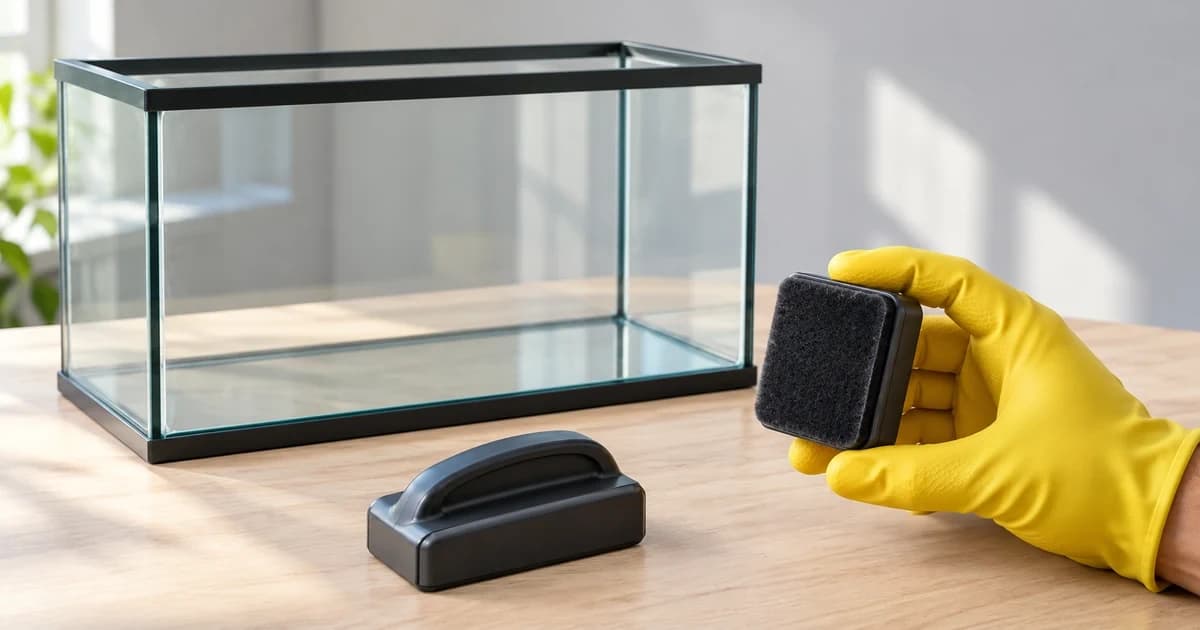
A magnetic aquarium cleaner is a pair of coupled parts, but choosing one starts with the aquarium panel and the exact cleaning surfaces. Record the panel material, its thickness and shape, then check the maker's permission for the cleaner, pad and any fitted blade. A floating inner half or a strong grip does not establish that the assembly belongs on your tank.
This guide helps you make that record and read several named instructions. It does not identify an unlabelled cleaner from its colour or prove that a particular pad will leave every panel unmarked.
Start with the panel you will actually clean
Find the aquarium's model information before choosing a tool. Write down whether the working panel is glass or acrylic, whether it is flat or curved, and the specified thickness of that panel. Keep the units beside the number. A gallon capacity, a tank's outside dimensions or the apparent thickness of its trim is a different measurement.
Flipper's current finder directs users to the actual panel thickness and, when trim covers the edge, to the aquarium maker's specification. Use that route if the edge cannot be read clearly; do not pry apart the rim or guess from a similar tank. A visible edge can help with a measurement, but appearance alone is not a confirmed material identification.
Next, record the cleaner's full model and version. Look for a permitted material, a thickness range or maximum, and the specified pad or blade. Match all of those fields. A product intended for one panel does not acquire permission for the other panels, an acrylic overflow or a curved front just because the magnets attract through them.
Read model differences before treating parts as interchangeable
| Named source | What its information establishes | What remains a separate check |
|---|---|---|
| Flipper Pico Black product page | The listed model is for glass up to 6 mm and has a scrubber side and a replaceable scraper. | The page's glass specification does not confirm an acrylic blade choice or permission for a particular curved panel. |
| Mag-Float acrylic range | The maker lists distinct acrylic products with item numbers and panel-thickness limits. | Use the correct item and its attachments; the general range heading does not convert a glass pad into an acrylic pad. |
| Tunze Care Magnet manual, May 2025 | The family has individual glass-thickness ranges and different blade and float arrangements. | The manual expressly does not recommend acrylic use. An earlier limited-use sentence is not an endorsement to experiment. |
The current Pico Black description and the Mag-Float acrylic product list are examples to compare, rather than instructions for every similarly shaped cleaner. Read the actual label and supplied instructions before selecting a replacement surface. Keep a part's name or number with the assembly record so it cannot be confused with a spare from another model.
Keep conflicting curved-panel guidance unresolved
Flipper's separate size guide describes upsizing for a bowfront. Its current homepage finder instead directs curved fronts toward Pico, while the Pico Black product page specifies glass and a thickness maximum without explaining curved-panel use. Those pages do not give one consistent instruction for every current model.
Keep the answer with its date. Do not combine the size-guide upsizing example with the homepage finder recommendation, or substitute a larger magnet while the model question is unanswered.
The same approach applies when a page makes a broad compatibility statement but the named product is narrower. A useful question is, “Does this exact version, with this pad or blade, have instructions for this panel?” That is more precise than asking whether the brand generally works on aquariums.
Inspect the two contact surfaces before coupling
Identify the part meant to touch the inside panel and the outer sliding surface. With the halves separated as their instructions require, look across the whole contact area, including corners and any blade seating. Check for visible particles, embedded grit, loose pad edges or a displaced attachment. Keep that inspection separate from the outside handle's appearance.
The Pico page specifically warns about trapped sand near the sand line. If the inner part reaches substrate, pause and retrieve it by the documented method before resuming. Floating is a retrieval feature on specified assemblies; it does not show that the working surface stayed clean. Likewise, an “anti-scratch” description is not evidence that grit is absent.
Use the maker's directions to clean or replace the actual surface. Do not add a household scouring pad, metal blade, cleaning chemical or improvised attachment because it appears to fit. If an edge has moved or a surface cannot be inspected, resolve the part question before placing it against the panel.
Follow one complete model's placement and movement
For a concrete example, the Tunze Care Magnet manual starts the inner part high on the pane, brings the outer part toward it slowly and describes steady lengthwise movement. Read its strong-magnet warnings, keep fingers out of the contact gap and use its specified blade and booster arrangement. This example belongs to the named family, rather than every floating scrubber.
For your cleaner, find its own placement and movement instructions before starting. Confirm how the inner part is retrieved if coupling separates. A twist-to-change-sides design, a blade-focused tool and a flat pad may have different procedures; do not transfer a flipping action between them.
Plan a clear working area on the permitted panel where you can observe both parts. If the inner half stops following, reaches substrate or shows an unexpected obstruction, stop moving the handle and inspect the assembly. Continuing to drag it is not a substitute for checking the cause. Avoid making a cleaning route through an unverified seam, corner or different panel material.
After the session, follow the model's directions for removal, surface care and storage. Some makers describe leaving their particular assembly attached to the aquarium; that does not establish immersion or storage permission for an unknown cleaner. Keep the item instructions rather than inventing a universal rinse, soak or blade-replacement schedule.
A short record is enough: aquarium model and panel; cleaner version; fitted surface or part number; permission source and date; observed condition; and any answer still needed. Record visible debris or an attachment problem without calling the session a scratch test or proof of compatibility.
Pawlivy's algae scrapers and magnetic cleaners category is a place to compare available equipment records. A category listing does not verify the exact maker instructions, panel match or present stock for your assembly. Use those records alongside the actual item documentation, with unresolved fields left open.
For this task, the useful outcome is a documented panel-and-tool match and an inspectable working surface. Our editorial policy explains how source-based guidance is presented.