
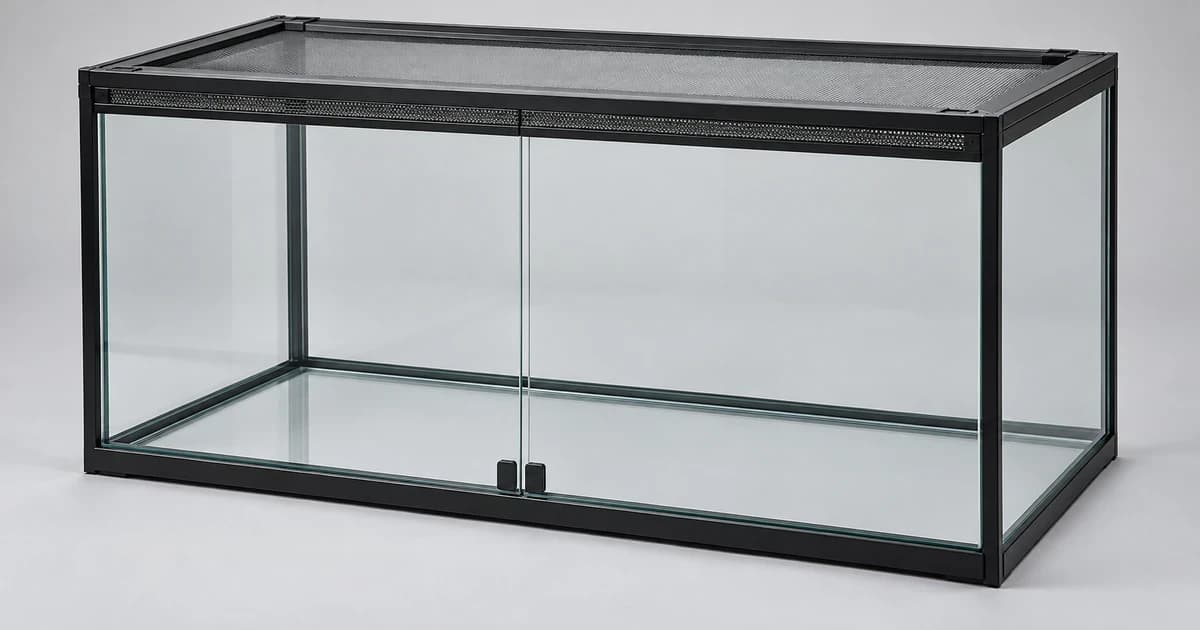
To clean a reptile tank, separate three jobs: removing visible waste, treating marks on a panel and disinfecting the habitat. Match each action to the enclosure material, the exact product instructions and the animal's care requirements. A cleaner's name or the appearance of a glass box cannot fill in missing directions.
Start with the item you intend to clean, rather than a universal empty-and-scrub routine. The named glass-cleaning example below provides a practical sequence for one product. The wider checklist helps you identify which parts of your own job need different instructions before you begin.
Choose the job before choosing a cleaner
| Your intended job | Identify first | Instruction to have ready |
|---|---|---|
| Remove visible waste | The affected surface, substrate or removable item | The species' care guidance and that item's cleaning directions |
| Address a mark on the panel | The panel material, any coating and the type of mark | A permitted product and its complete application method |
| Disinfect an item or enclosure | The exact item and the intended disinfectant | Its applicable label, including any preparation, dilution, contact time and rinsing requirements |
Keep those jobs separate in your notes. A mark that remains after one task is a question to investigate, not a reason to improvise a stronger mixture. Likewise, a clear panel is an observation about its appearance; it is not a record of which disinfecting instructions were followed.
Choose a cleanup location before carrying supplies there
The US CDC's reptile and amphibian guidance explains that their environments can carry germs even when the animals look clean and healthy. Keep their equipment out of areas where food is prepared, stored, served or eaten.
CDC recommends cleaning supplies outside the home if possible, away from gardens and food or drinking-water sources. If that is not possible, use a laundry sink or bathtub. After using a bathtub, thoroughly clean and disinfect it before others use it. Pour tank water and other wastewater from reptile or amphibian habitats down the toilet, rather than sinks or drains. Wash hands with soap and running water after handling equipment or cleaning the habitat.
Make that location part of the job plan. Identify where you will work and how you will handle the resulting wastewater before moving a tank or its contents. This location guidance does not establish how to lift a particular enclosure or transfer its animal.
Check the exact surface and the complete product directions
Find the enclosure's maker and model, then identify the item you are addressing: a panel, seal, background, floor covering or accessory. Keep the material description from its documentation.
Read the current label for the product in your hand. Write down any stated surface restrictions and preparation, application, rinsing or completion conditions. A missing dilution or contact time is an unanswered field; this guide does not supply a substitute number.
Resolve animal-care and equipment questions separately. Obtain the appropriate species-specific arrangements and the relevant equipment instructions before work that depends on them. There is no universal transfer container, holding period, electrical dismantling method or return-to-enclosure time in the sources used here.
A named mineral-mark method: Exo Terra PT2668
Exo Terra Terrarium Glass Cleaner PT2668 is described as a mineral-deposit gel for calcium and lime stains. For this named product, the maker gives this sequence:
- Apply the gel using a paper towel or a dry, clean cloth on the listed glass, plastic or other smooth surface.
- Leave it on the treated surface for a few minutes.
- Work the stain lightly with a clean cloth, using a circular motion from its outside toward its centre.
- Rinse with water and dry with a clean cloth.
- Repeat the procedure if the stain persists.
That application list does not verify permission for an unknown coating, seal, background or electrical part. The mineral-stain procedure is not evidence of disinfection or permission to leave an animal in place.
Use this example only when the actual product and surface requirements match. A different cleaner needs its own directions; matching the general words “terrarium cleaner” does not make its procedure interchangeable.
Keep a species-specific schedule attached to its source
The RSPCA's bearded dragon guidance, for Pogona vitticeps, says to spot-clean animal waste as soon as it appears. It also describes cleaning that vivarium once a month with a reptile-safe disinfectant, followed by thorough rinsing. That monthly advice belongs to the named bearded dragon guidance; it does not establish a timetable for every reptile, enclosure material or bioactive setup. The page does not supply a disinfectant dilution or contact time.
For your own enclosure, keep the species, habitat arrangement and applicable care source beside any scheduled task. If the guidance and your actual setup do not match, get species-specific advice instead of borrowing a calendar from another animal's care page.
Finish with a record of what you actually did
| Record | Useful detail | Leave unresolved when unknown |
|---|---|---|
| Item and surface | Enclosure model and the specific part addressed | Unidentified material or coating |
| Product and instructions | Exact product, label or page, and steps actually followed | Missing permission or application condition |
| Observed result | Visible material removed, remaining marks or an unexpected change | Any unverified explanation for that change |
| Next action | A future operation whose requirements are incomplete |
Describe observations plainly. If a mark remains, record where it is and what method was used. Do not turn a visually clear panel into a claim that sanitation, compatibility or animal welfare was tested.
Pawlivy's glass terrariums and terrarium cleaners categories provide equipment records to compare with the documentation for your own items. A listing does not confirm current stock or permission to apply a particular product. Our editorial policy explains the distinction between source-based guidance.