
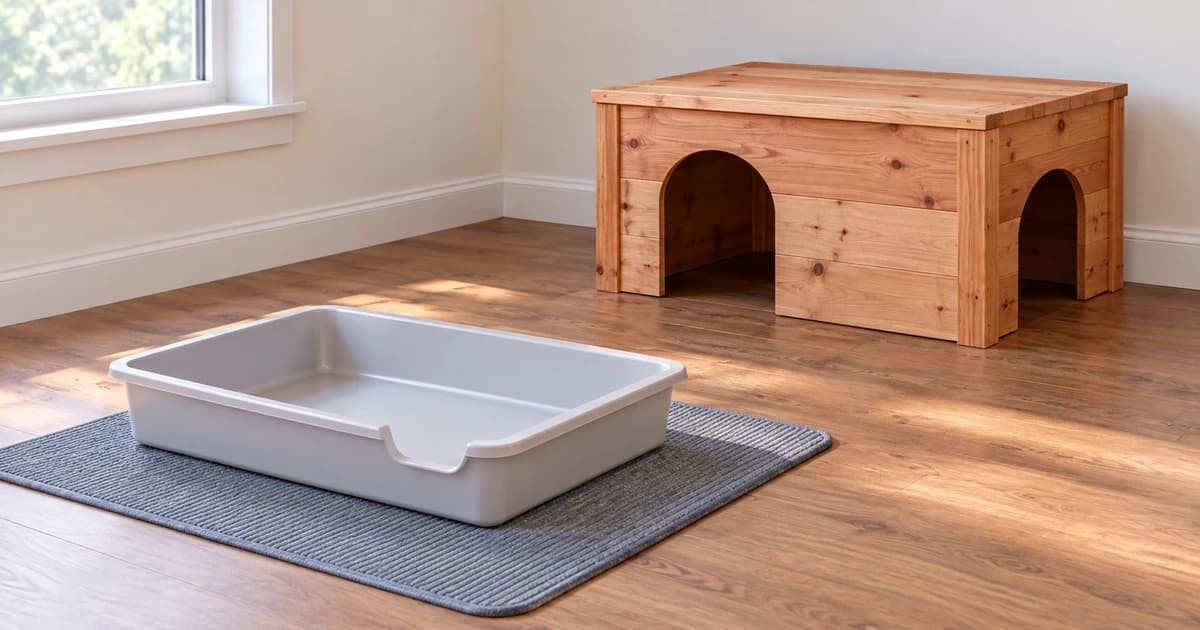
Start rabbit litter training by finding where your rabbits already choose to toilet, then put a comfortably accessible litter tray there. Blue Cross and PDSA both recommend this location-led approach. A tray provides a place to manage waste; buying one does not establish that it fits your rabbits or that they will use it reliably.
The practical job is to arrange the tray, keep checking it and observe what happens. Preserve space for movement and places to retreat throughout. An accident is information about the current setup, not a reason to force a rabbit into the pan or promise that a different product will solve the problem.
Observe the location before choosing the corner
Look at where waste actually appears during ordinary daily checks. Blue Cross suggests finding the preferred toilet location and placing the tray there; PDSA likewise starts with the favourite toileting area. Write down the spot rather than assuming that the corner nearest a door or easiest for you to reach is the rabbit's choice.
Once the location is clear, consider how a pan will sit there. It should be reachable without blocking the route between resting, feeding and exercise areas. This is a layout check, not an instruction to chase, carry or hold a rabbit in a particular position. Keep the sleeping and feeding arrangements available while you assess the toilet area.
Check the pan as an object, not a training promise
Blue Cross's rabbit housing guidance says the tray should let the rabbit fit comfortably. It does not supply one universal tray measurement. Check the usable interior, entrance and intended position against the particular rabbit rather than relying on a product title that lists several small-animal species.
Before use, check whether the pan rests steadily, whether the entry is accessible and whether a removable floor or grate is part of that model. A drawer, grid or cage buckle in a listing does not by itself establish rabbit suitability.
The small-pet litter pan category is a place to compare these details. A category match is not a measurement, an inventory promise or evidence that the rabbit will prefer that design.
Do not flatten different litter recommendations into one rule
The three welfare sources used here do not describe litter materials identically. Their precise wording matters when checking a label:
| Source | What its guidance says | Boundary for this setup |
|---|---|---|
| Blue Cross | Names newspaper with rabbit-friendly litter, including Megazorb or Aubiose, and advises against cat or wood-based litter. | Do not read a generic cat-litter label as its approval. |
| PDSA | Calls for bunny-safe litter in the tray. Its bedding section describes wood-based, dust-extracted cat-litter pellets and requires checking for dust and silicone. | The bedding recommendation does not establish that every wood pellet or cat litter is suitable. |
| Rabbit Welfare Association and Fund | Describes non-clumping bedding, excludes clay-based and pine materials, and gives particular examples. | Do not replace those exclusions with a broad claim about all wood or all cat litter. |
These are source-specific recommendations, not a single interchangeable ingredient list. If the exact product label and its composition do not resolve the choice, seek rabbit-specific guidance for that product before using it. Do not infer a material verdict from the photograph, a seller's species list or the fact that another household uses it.
Keep training within an adequate living arrangement
RWAF's indoor housing advice describes starting in a more limited area and extending access after reliable tray use. The same page specifies an enclosed living area with a ground footprint of at least 3 m by 2 m and a height of 1 m. Its litter-training paragraph does not cancel that space guidance.
PDSA's home guidance also describes substantial living space for a pair and an exercise area available at all times. Do not turn “a smaller area” into a tiny training cage, or remove required movement and shelter to make tray use easier to count.
If additional household rooms are introduced later, their preparation and supervised access still matter. More reliable use in the established area can guide that decision, but it does not prove that every new room, floor or corner is ready. Keep a place to hide and a workable route to the tray as the arrangement changes.
Check daily and separate clean supplies from waste
PDSA calls for daily tray cleaning. Blue Cross recommends checking the environment and bedding each day and removing soiled material. Build that inspection into ordinary care, including checking the tray's position and whether its entry has become obstructed.
PDSA suggests an extra hay rack next to the tray as one possible way to encourage use. That is optional layout guidance, not a reason to preserve soiled feeding material. Keep clean feeding supplies distinct from waste, and continue the rabbits' ordinary food and water access.
This guide does not prescribe keeping urine or droppings, mixing a disinfectant, or a chemical cleaning recipe. Blue Cross's separate suggestion to retain some unsoiled familiar bedding during housing cleaning should not be turned into advice to keep waste in the toilet area.
Use a short observation record
- Record where waste appeared and whether it was inside the tray.
- Note the tray position, clear entry and usable interior.
- Record daily removal of soiled material and any change in the setup.
- Before opening another prepared area, check how consistently the established tray is being used.
This record helps distinguish a location change from a different pan or material. It cannot diagnose why an accident happened, establish a fixed success deadline or measure a product's training effect. If use remains inconsistent, recheck the actual arrangement rather than repeatedly forcing the rabbit to interact with the tray.
Source-based guidance and equipment details are discussed under Pawlivy's editorial policy; individual rabbits and exact product instructions still determine the practical checks.