
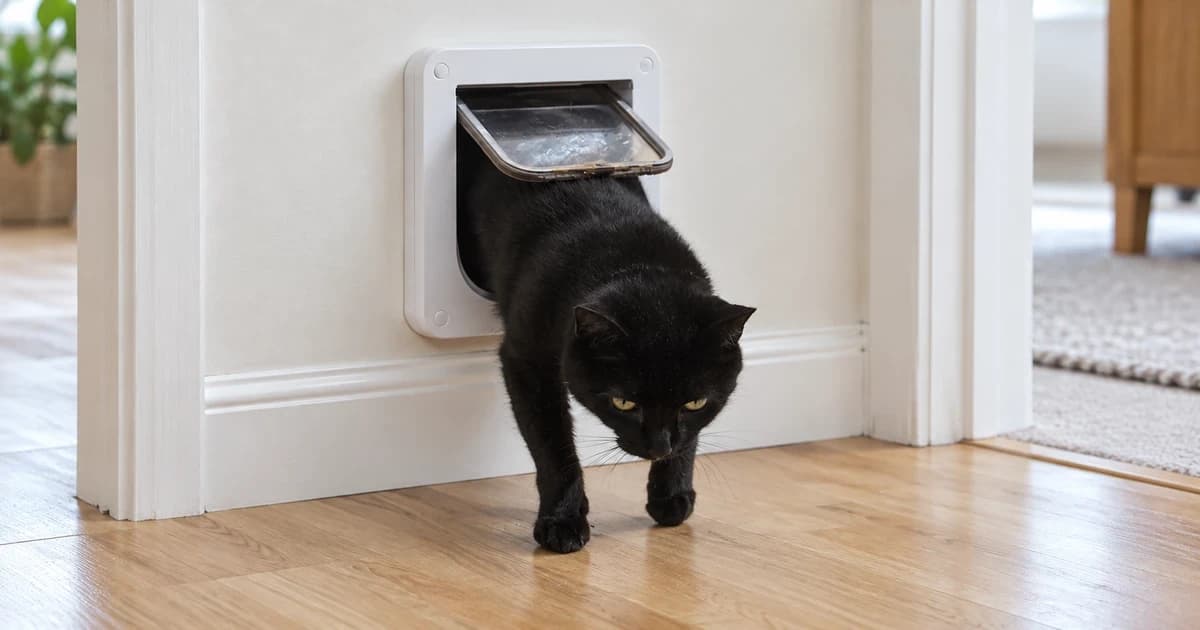
To train a cat to use a cat flap, begin with a clear passage in a configuration the manufacturer permits. Encourage your cat to walk completely through, practice the return journey separately, then introduce the flap's sound and physical contact in manageable steps. Let the response you see decide when to move on.
Keep an alternative route available. Looking through the opening, touching the leaf and getting the whole body to the other side are different achievements. You do not need to push your cat through, hold it against the door or make the flap its only way out.
Confirm what this particular flap allows
Find the model name and its instructions before changing anything. Check that the installed passage is ready to use, both sides are accessible and the permitted access state allows the direction you want to practice. Cutting the door, correcting an installation and enrolling a collar key or microchip are separate jobs.
Do not improvise a prop, string or adhesive, remove batteries or assume that switching an electronic flap off makes it freely passable. A lock, sensor and swinging leaf can have different roles.
For example, PetSafe's Big Cat Door instructions describe open, partly open and normal-leaf stages. That named-model sequence does not establish a holding method for a different electronic or multi-flap door.
Sure Petcare's cat-flap guide also notes that holding a selective-access flap open can let other cats through. Account for that change during supervised practice; an open flap is not demonstrating identity recognition. Restore the normal configuration according to its instructions afterward.
Let your cat investigate the opening
Choose a quiet opportunity when you can observe both sides. Leave space to approach and move away, and avoid standing across the exit. Let your cat look at the frame, sniff near it or walk past without being placed at the opening.
A familiar treat or toy can encourage investigation if your cat wants it. Offer it where the cat can choose to approach; do not pull it away repeatedly to make the cat reach farther. If your cat stays back, leave the exercise at investigation rather than picking the cat up and inserting its head.
Cats Protection's kitten example starts with an open passage and rewards approaching before encouraging passage in both directions. The useful sequence is approach, crossing and return. It does not give every cat a deadline for accepting the door.
Watch a complete crossing, then work on the return
With the passage in its permitted introduction configuration, call from the other side or offer the familiar reward beyond the opening. Keep your body and hands out of the route. Let the cat decide whether to follow.
If your cat looks through or puts its head inside, acknowledge that investigation without asking for more immediately. A complete crossing means the cat has brought its body, hindquarters and tail through and can stand or move freely on the other side. Wait to see that rather than counting a nose through the frame as a completed trip.
PetSafe's Big Cat Door guide rewards complete passage and explicitly says not to pull or push the cat through. If the cat backs away, leave the route open and let it retreat. Do not reach through to pull a collar, guide the hindquarters or prevent a reversal.
Practice the return journey as its own opportunity. The approach, view of the room, floor beyond the opening and your position may differ. Keep the same permitted leaf configuration initially so you can observe direction separately from leaf contact. One willing outward trip does not show that the cat will return through a closed flap.
Keep the human-door alternative available even when the cat chooses it. You can offer another easy flap opportunity later without trapping the cat on one side or blocking its preferred route.
Introduce the sound separately from contact
After willing crossings in both directions, notice how your cat responds to the leaf moving. In PetSafe's cat-door guide, hearing a slowly closed flap is a separate step before the leaf is gradually lowered.
Only demonstrate normal movement if your model's instructions permit it. Keep the cat clear of the moving leaf and let it move farther away. Do not force a locked leaf, operate an unfamiliar powered part by hand or release the leaf onto the cat.
Describe the response plainly: the cat watched, approached again, stepped back or left. A step back is a reason to reduce the challenge or pause, not to repeat the sound until the cat stops moving.
Sure Petcare's unfamiliar-product advice separates getting used to appearance from moving electronic parts and says never to force use. Its switched-off advice concerns named SureFlap products; it is not a universal power-setting instruction.
Change the leaf condition one step at a time
If the manufacturer permits a staged introduction, use that procedure to move from the clear passage toward ordinary leaf contact. Keep the practice direction and surrounding space familiar while changing the leaf condition.
Observe whether the cat approaches, touches the leaf and completes passage voluntarily. If it stops at contact, return to a permitted easier configuration or pause. Do not press the leaf against its head or use a treat to keep it wedged halfway through.
Then revisit the other direction. The cat may have to push from a different starting position or encounter a different face of the leaf. Record what actually happened in each direction before adding another change.
For an unidentified door or a model with no documented intermediate configuration, do not invent a halfway-open stage. Ask its manufacturer how to progress. Repeated refusal at the same physical point also deserves a check of the passage and installation instructions before more encouragement.
Keep a short record of the conditions
This blank record helps you separate a new direction, a new sound and a new contact condition. Fill it with observations, not a target number of crossings.
- Model and permitted configuration: ______
- Direction and space on each side: ______
- Leaf condition or sound introduced: ______
- What the cat chose: approached / looked through / touched / fully crossed / retreated / other ______
- Next opportunity: same condition / easier permitted condition / pause and check instructions ______
Use the record to identify the next small question: can the cat return through the same opening, hear the leaf without leaving, or cross with its normal contact? There is no universal number of sessions or success day. Stop when the cat disengages and resume with an opportunity it can choose.
Compare mechanisms before changing equipment
If you are comparing pet doors or smart doors, check the actual opening, leaf arrangement, access mechanism and manufacturer's introduction instructions. A collar-key description is not proof of implanted-microchip compatibility or a motor that moves the leaf.
Choose equipment using verified model information, then keep physical passage practice separate from identity enrollment and access programming. The aim here is to observe a voluntary trip in both directions with the actual permitted leaf condition, while leaving your cat free to take another route.