
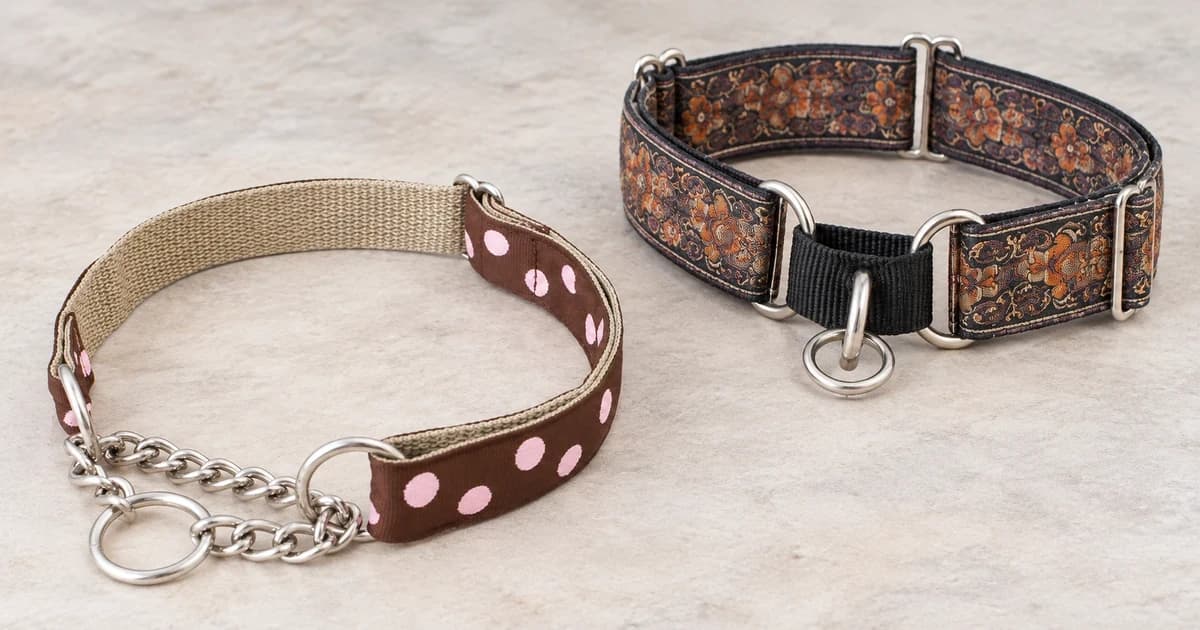
A martingale is a dog collar with a larger neck loop and a smaller control loop. Tension at the intended leash connection makes the control loop draw the collar smaller within its adjusted range; releasing that tension lets it loosen again. The smaller loop can be webbing or chain, so a martingale does not always look like a chain collar.
The design addresses backing out of a collar. It does not establish a comfortable fit, guarantee against escape or replace help with a dog who pulls strongly. Start by understanding the actual equipment rather than treating the word “no-slip” as a result you have tested.
Recognize the two loops and their different jobs
The larger loop surrounds the neck. The smaller loop connects its ends and carries the intended leash attachment. Ruffwear's martingale explanation describes this limited-cinch arrangement and distinguishes chain and webbing versions. Identify the adjustment slide and fastening arrangement separately from the leash connection.
A ring is not automatically interchangeable with every other ring. Some equipment has a separate place for identification tags. For example, PetSafe's cited Martingale Collar instructions specify rectangle rings for tags and distinguish them from the D-ring. That is a named product instruction, not a tag-placement rule for every model.
Find the matching instructions before attaching a leash or moving tags.
Understand why head and neck shape matter
A collar that fits around the neck can still pass over the head when a dog backs away. Ruffwear discusses dogs with heads narrower than their necks, including greyhounds and whippets, as a reason people consider the design. Breed examples explain the problem; they do not prove that every dog of that breed needs a martingale.
Look at the individual dog and the situation in which equipment slips. Repeatedly tightening an unfamiliar collar is not a reliable way to resolve the question.
Separate limited cinching from a safety guarantee
“Limited” describes the adjusted mechanism, not an absence of neck pressure. The Edmonton Humane Society's three-page guide warns that incorrect fit can choke or harm a dog. It recommends a harness when substantial pulling puts excessive pressure on the neck and says martingales should never be used deliberately to choke, harm or startle.
Do not use leash jerks as a test of the collar's function. If a dog pulls hard, appears uncomfortable or repeatedly escapes equipment, pause and seek individual advice. A hardware change alone does not teach comfortable walking or explain the dog's response.
How to put on a martingale collar: identify the opening style first
| Construction you identify | Instruction to look for |
|---|---|
| A collar without an opening buckle | The maker's method for loosening, passing over the head and readjusting. |
| A collar with a buckle | The intended buckle opening, closure and adjustment checks. |
| Webbing or chain control loop | The intended leash connection and the model's fitted range. |
| Several rings or a separate tag attachment | Which connection serves each purpose. |
Do not transfer a measurement, ring-spacing rule or finger count from an unrelated collar. PetSafe publishes behind-the-ears measurements and hardware-contact instructions for its cited model.
Plan supervised use and inspect the actual hardware
The Edmonton guide identifies catching and tangling hazards and advises removing martingales when the dog is unsupervised. PetSafe separately says its cited collar is not recommended for tie-out use. These warnings matter even if the collar appears comfortable while you are beside the dog.
Check fabric for fraying and an applicable plastic buckle for cracks, as the Edmonton guide advises. Follow the maker's guidance when equipment is damaged or does not close as intended. A photograph of intact-looking hardware is not a strength test or evidence that your own equipment is serviceable.
Use the name to ask better questions
When exploring martingale collars, identify the model, opening style, control loop, fitting instructions and intended connections. Confirm those details before use. The category groups a type of equipment; it does not establish an individual dog's fit or authenticate a maker's safety claims.
You should finish with a clearer understanding of the mechanism and the questions still requiring individual advice. Comfortable, supervised use depends on the real collar and dog together, rather than a reassuring product name.