Knowing how to teach a dog to fetch starts with building the individual pieces before adding a throw: voluntary interest in a suitable toy, picking it up, moving back toward you and releasing it calmly. Begin right beside your dog and reward small successes. A dog that chases a rolling object has not necessarily learned the return part, and a dog that declines the game should never be forced to participate.
The American Kennel Club's fetch guide starts with holding a toy close by and gradually increases the distance. You can follow that progression without setting a deadline or turning every attempt into a high-speed chase.
Prepare an easy starting point
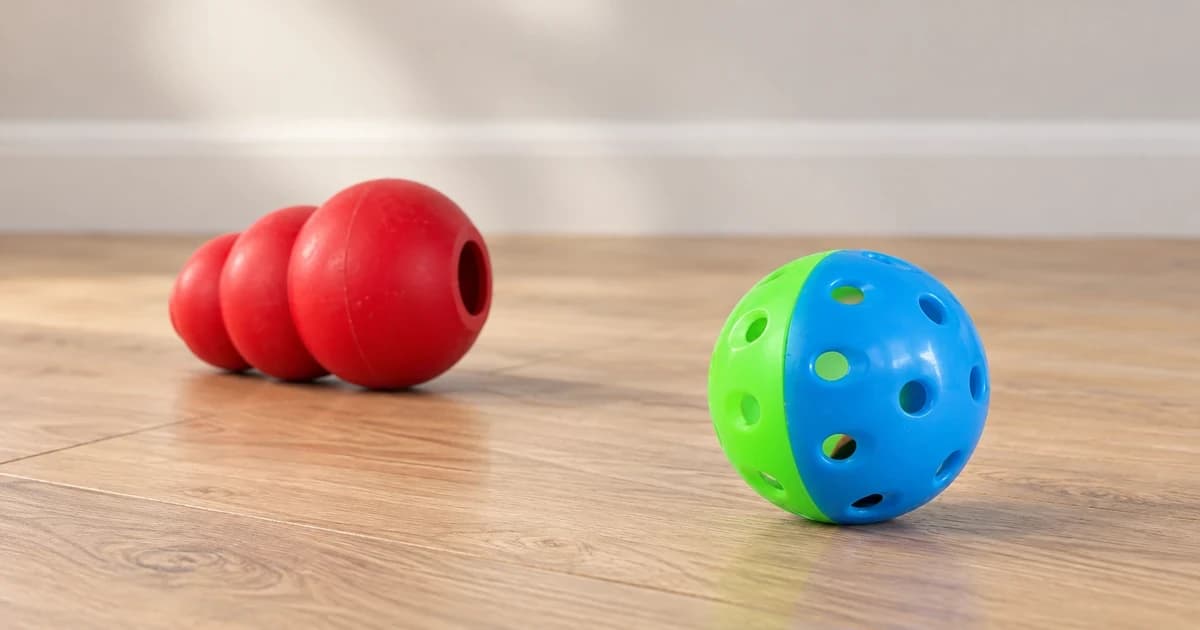
Choose an object your dog willingly investigates and can comfortably carry. Check the intended use and size guidance on the packaging, inspect the surface, and remove anything with loose parts. Never use an object small enough to swallow. Browse dog toys or structured rope and tug toys for shapes that are easy for your dog's mouth to grip rather than assuming every dog prefers a standard ball; a category label alone does not establish individual suitability.
Start in a familiar indoor room or quiet hallway with enough floor space for a few comfortable steps. Keep an appropriate food reward ready, counting it within your dog's daily allowance. Use a consistent marker—such as a brief "yes" or a clicker—to pinpoint the exact moment of a successful action before delivering the treat.
1. Reward voluntary contact and a brief hold
Present the toy at chest level without pushing it into your dog's mouth. Mark and reward voluntary curiosity, such as nosing the surface. As your dog grows confident, reward open-mouth contact and a brief lift or hold. Increase the expectation gradually instead of holding back rewards until the full retrieve happens.
Step back to an easier criterion if interest fades or the dog repeatedly drops the item immediately. Introduce a hold cue only once the dog offers that brief grip reliably. The goal is a relaxed, repeatable hold rather than a rigid number of seconds.
2. Transfer the pickup to the floor
Set the toy directly on the floor between your feet or half a step away. Mark and reward a voluntary lift from the floor. If your dog only sniffs the toy after the change in position, reward that investigation once or twice and build back up to the lift. Blue Cross's retrieve guidance similarly breaks investigation, holding and floor pickup into distinct stages worked at the dog's own pace.
When lifting the toy from the floor becomes smooth, pair the action with a single cue such as "get it." Avoid repeating the cue while the dog hesitates; instead, move the toy closer to reset an easy success.
3. Add a short return and a close-range exchange walkthrough
Once floor pickup is reliable, connect pickup, a two-step return and a calm trade in one continuous close-range sequence:
- Set and cue at one pace: Place the toy one step in front of you, cue the pickup, and take a single inviting step backward as the dog lifts it.
- Mark the turn toward you: As soon as your dog takes one or two steps in your direction with the toy in mouth, mark the movement and present a treat right at your knees.
- Trade without tugging at the mouth: Hold the treat steady near the dog's nose and wait for the mouth to open naturally, or pair the drop with your established release cue. Battersea's play advice highlights dropping or exchanging a returned toy so excitement stays manageable.
- Insert a brief pause before the next rep: Wait two seconds after the dog finishes the treat before placing the toy again, or transition the retrieve into teaching your dog to put toys away into a low basket once hand-level drops are consistent.
| What happens when learning how to teach a dog to fetch | How to make the next attempt easier |
|---|---|
| Dog watches the toy but does not pick up | Return to rewarding nose investigation or hand-level presentation right beside you. |
| Dog picks up the toy but walks away | Shorten the distance to a single step and reward the first head turn back toward you. |
| Dog returns with the toy but clamps down | Practice calm food exchanges at a standstill instead of reaching for or pulling at the toy. |
| Dog walks off and disengages | End the session calmly and offer rest or a different activity. |
4. Introduce gentle sends and clear pauses
A placed toy teaches the core retrieve mechanics without throwing. When you do add motion, slide or underhand-toss the toy just two or three steps away along the floor and avoid high arches that encourage twisting jumps. Blue Cross cautions against repetitive high-speed chasing with abrupt turns and hard stops. Let the toy come to a stop first if your dog gets overly frantic around moving objects.
Pause the session whenever your dog struggles to respond, pants heavily, or shows stiffness. For dogs with joint or health restrictions, check with your veterinarian about suitable play movements. Dogs Trust's enrichment guidance emphasizes matching play to individual health, physical ability, preferences and rest needs.