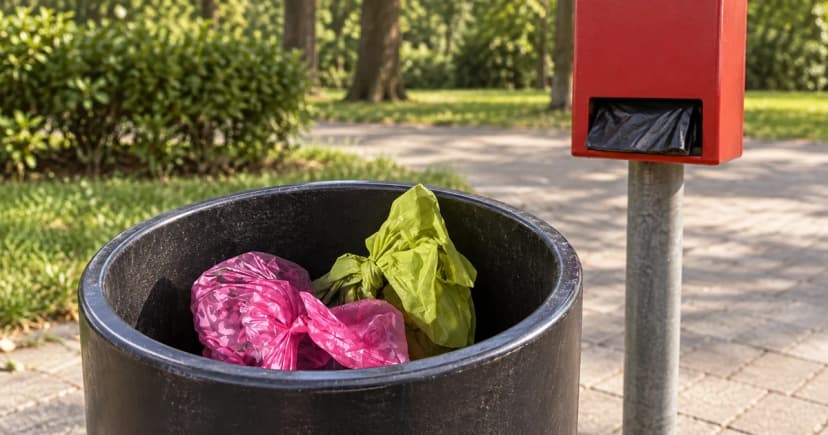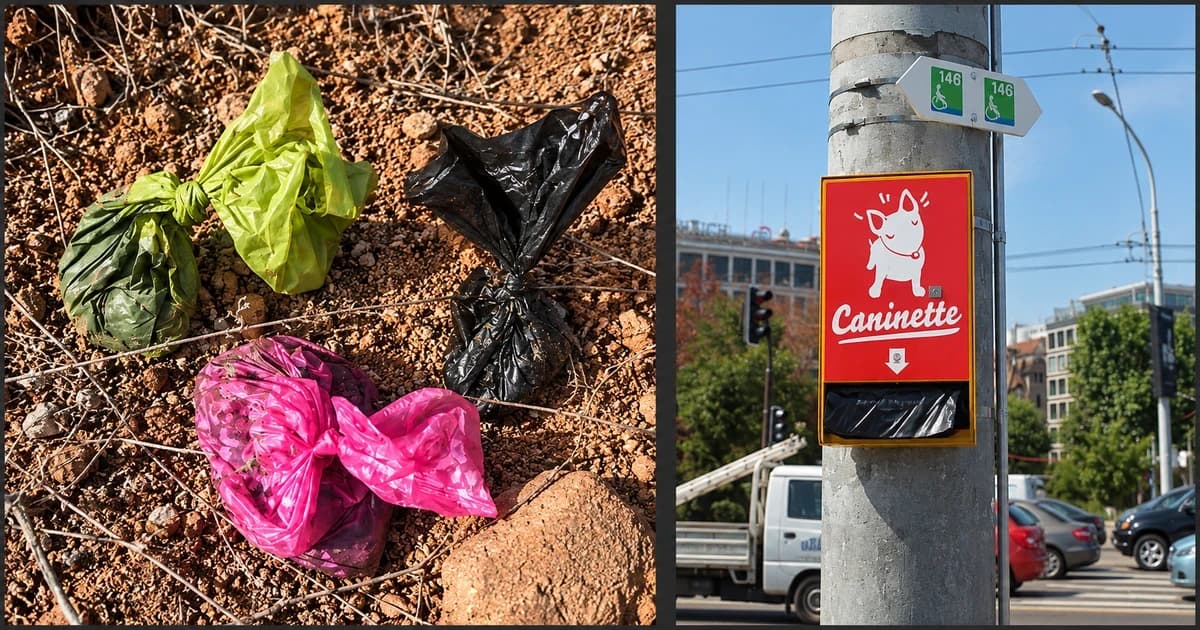
Knowing how to use dog poop bags covers the entire cleanup sequence from the pavement to the sink: check that your bag has no holes, slip it over your hand like a glove to pick up the waste, invert the plastic cuff over your hand, knot the top tightly, carry the sealed bag to a locally accepted trash bin, and wash your hands with soap and running water. Leaving a tied bag beside a trail or assuming a compostable label permits green-bin disposal leaves the task unfinished.
1. Prepare an intact bag before the walk
Always carry your own dog poop bags rather than counting on a park dispenser being stocked. Before stepping out, pull one bag loose and check that the seam is intact and large enough to leave tying room above the waste. If you carry rolls in a clip-on dog poop bag holder, you can follow our poop-bag dispenser loading guide to thread the core smoothly before heading outdoors.
Never lick your fingers or touch the bag to your mouth to separate the opening. If your dog pulls hard or cannot stay calm while you bend down, ask a second person to hold the leash rather than improvising an unsafe tie-out.
2. Follow the four-step glove-and-inversion hand sequence
Municipal stormwater outreach—such as Dover, New Hampshire's pet-waste instructions—describes the inside-out glove method so your skin never touches the waste directly:
| Inversion step | Where your hands go | How the bag moves | Check before moving to the next step |
|---|---|---|---|
| 1. Sleeve the open bag | Slide your picking hand completely inside the open bag like a mitten or glove; keep your other hand outside near the top cuff. | The closed bottom of the bag covers your fingers and palm as a clean plastic barrier. | Confirm there are no splits or pinholes in the plastic over your fingers; switch to a fresh bag immediately if torn. |
| 2. Cup and lift the waste | Use your bagged hand to cup around the waste and lift it cleanly off the ground or grass. | The plastic layer stays between your fingers and the waste while you hold it securely in your palm. | Leave several inches of empty bag material above your knuckles so the cuff can invert without spilling. |
| 3. Invert the cuff over your hand | With your clean outside hand, grasp the top cuff edge and pull it down and over your bagged fingers as you withdraw your picking hand. | The bag turns inside out around the waste, trapping the stool at the bottom of the pouch while the clean inner surface becomes the outside. | Verify that your picking hand slid out cleanly and that all waste sits below the neck of the bag. |
| 4. Twist and seal the top | Use both hands on the clean upper neck of the bag to twist the headspace and tie a firm overhand knot or secure the tie handles. | The knotted neck closes the barrier so odor and contents cannot escape during transport. | If the bag tore or could not close around the load, double-bag the entire bundle inside a second intact bag right away. |
3. Check local disposal rules vs. municipal examples
Disposal rules are set by your local municipality or waste utility, not by packaging slogans. Even when buying compostable dog poop bags, check local waste acceptance rules first—our dog-waste bag claims guide explains why material labels and municipal bin rules are separate questions. Use the comparison below to distinguish published city examples from what you must verify locally:
| Disposal question | Published municipal example (for reference) | What to verify in your own municipality |
|---|---|---|
| Which bin accepts bagged dog waste? | Seattle Public Utilities (example city) directs all bagged pet waste into regular trash—not yard waste or food compost bins—even if the bag is labeled compostable. | Check your city waste authority's website or trailhead signs to confirm whether bagged waste must go in landfill trash or a dedicated pet-waste station. |
| Can you use a roadside residential bin? | Seattle Public Utilities specifies using a public trash receptacle or your own household bin, noting that using a neighbor's bin requires their permission. | Carry the sealed bag until you reach an authorized public bin or your own home trash can rather than dropping it in private bins or leaving it on the ground. |
| What about storm drains and yard hosing? | Dover, NH stormwater guidance (example city) prohibits placing loose waste or filled bags into storm drains or hosing waste toward street gutters. | Keep all pet waste and bags out of street grates, ditches, and waterways, and bag backyard waste routinely as part of household cleanup. |
4. Finish with soap-and-water handwashing
A plastic bag is not a substitute for hand hygiene. The CDC's healthy-pets guidance for dogs instructs washing hands thoroughly with soap and running water after picking up dog poop—even after using a bag—and always before eating or drinking. When soap and running water are not immediately available on a walk, the CDC notes using a hand sanitizer with at least 60% alcohol until you reach a sink to wash properly.