

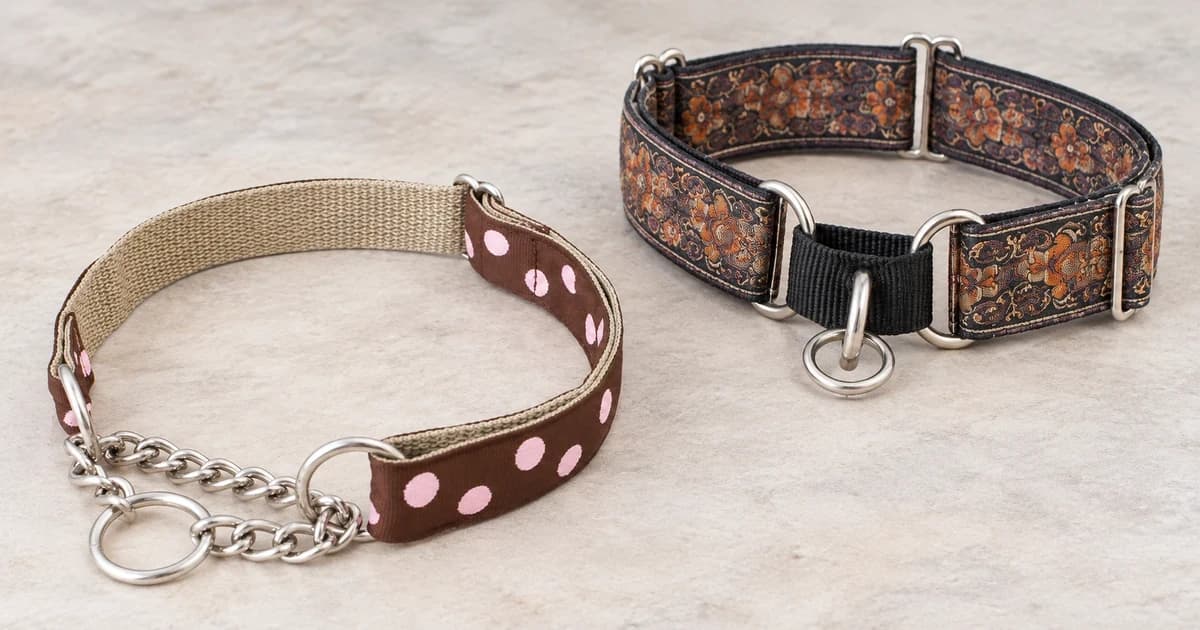
If you are asking what is a martingale collar, it is a two-loop dog collar built from a larger neck loop that rests around the dog's neck and a smaller control loop that carries the leash D-ring. When tension is applied to the leash ring, the smaller control loop draws the two ends of the neck loop closer together within its adjusted range; when tension eases, the loop relaxes again. Because the control loop can be made of flat webbing or metal chain, a martingale does not always look like a chain collar.
This two-loop mechanism helps reduce the chance of a dog backing out of a loose collar on walks, yet the mechanism alone does not guarantee a proper fit, prevent every escape, or eliminate neck pressure if a dog lunges. Start by identifying each loop and ring on your specific collar rather than treating a "no-slip" label as an automatic safety guarantee.
Recognize the two loops and their different jobs
The larger loop encircles the dog's neck and holds the length-adjustment slide (plus a side-release buckle on buckled versions). The smaller control loop bridges the two ends of the neck loop and holds the D-ring meant for the leash clasp. Ruffwear's martingale collar guide explains how this limited-cinch layout works and compares fabric-webbing and chain control loops. Always distinguish the neck-loop adjustment hardware from the control-loop leash ring before clipping on a lead.
Rings on a martingale collar are not interchangeable across brands or models. Some collars provide a dedicated attachment point for ID tags so tags do not interfere with the cinching control loop or get clipped to the leash by mistake. For instance, PetSafe's Martingale Collar product guide specifies attaching ID tags to the rectangle rings and clipping the leash only to the D-ring on the smaller loop. Keep that instruction tied to that named PetSafe model, and check the diagram for your own collar before attaching a leash or moving ID tags.
| Part or hardware ring | Mechanical role in the two-loop design | Model-specific check before use |
|---|---|---|
| Larger neck loop & adjustment slide | Rests around the dog's neck and sets the collar's resting circumference and maximum cinched stop. | Follow the specific model's sizing and adjustment steps; do not copy a finger-count or ring-gap rule from another brand. |
| Smaller control loop & leash D-ring | Made of webbing or chain; pulls the ends of the neck loop closer when the leash is taut on the D-ring, then loosens when slack returns. | Clip the walking leash only to the ring designated for leash attachment in that collar's instructions. |
| Connecting rings / dedicated tag ring (model-dependent) | Joins the neck loop to the control loop, or provides a separate spot for ID tags on named models (such as the rectangle rings on the cited PetSafe Martingale Collar). | Never clip a leash to a tag ring or side connecting ring, as doing so bypasses or distorts the control-loop action. |
Understand why head and neck shape matter
A standard flat collar that sits comfortably around the neck can still slip forward over the ears if a dog backs away and their head is narrower than their neck. Ruffwear notes sighthounds such as greyhounds and whippets—as well as dogs who back up when startled—as common reasons owners look at martingale designs. Those breed examples illustrate the skull-to-neck geometry; they do not mean every dog of that breed requires a martingale or cannot wear a well-fitted harness.
Evaluate your individual dog's body shape and walking behaviour, and consult a qualified trainer or veterinary professional if you are unsure whether a martingale collar or a properly fitted harness suits them better.
Separate limited cinching from a safety guarantee
"Limited cinch" describes how the two rings stop at an adjusted point—not an absence of force on the throat. The Edmonton Humane Society's three-page martingale resource (PDF) warns that an overtightened martingale can choke or injure a dog, recommends switching to a harness whenever strong pulling places heavy pressure on the neck, and states that martingales must never be used to jerk, choke, or startle a dog.
Never yank the leash to test how far the control loop closes. If your dog pulls hard, coughs, or repeatedly tries to back out of walking gear, pause and work with a reward-based professional rather than tightening the neck loop further.
How to put on a martingale collar: identify the opening style first
When checking how to put on a martingale collar, first inspect whether the larger neck loop is a continuous slip-on loop or includes a buckle:
| Construction you identify | Instruction to look for |
|---|---|
| A collar without an opening buckle | The published method for loosening the slide, slipping the larger loop over the head, and readjusting it on the neck. |
| A collar with a buckle | The intended buckle opening, closure check, and neck-loop adjustment steps. |
| Webbing or chain control loop | The designated leash D-ring and how the two connecting rings should sit when adjusted for that model. |
| Several rings or a separate tag attachment | Which ring holds the walking leash and which ring (if any) is permitted for ID tags. |
Do not apply a generic ring-gap measurement across unrelated collars. For example, PetSafe publishes specific behind-the-ears measurement and ring-contact steps for its own named collar, which belong to that model's manual.
Plan supervised use and inspect the actual hardware
The Edmonton Humane Society resource highlights snagging and strangulation risks when a control loop catches on crates, fences, or another dog's jaw or paw, advising owners to remove martingale collars whenever the dog is left unsupervised. PetSafe likewise states that its Martingale Collar must not be used for tie-outs. Keep those boundaries in place even when the collar fits comfortably on supervised walks.
Inspect webbing for frayed stitching and check any plastic buckle for cracks before each walk, as the Edmonton guide recommends. Retire any collar with worn webbing or a weak clasp rather than relying on how intact it looks from a distance.
Use the name to check model details before buying
When browsing martingale collars, check the exact model's opening style (slip-on vs. buckled), control-loop material, sizing chart, and ring diagram before putting it on your dog. A category page groups collars by mechanism; safe, comfortable use always depends on matching the individual collar's manual to your dog under active supervision.