
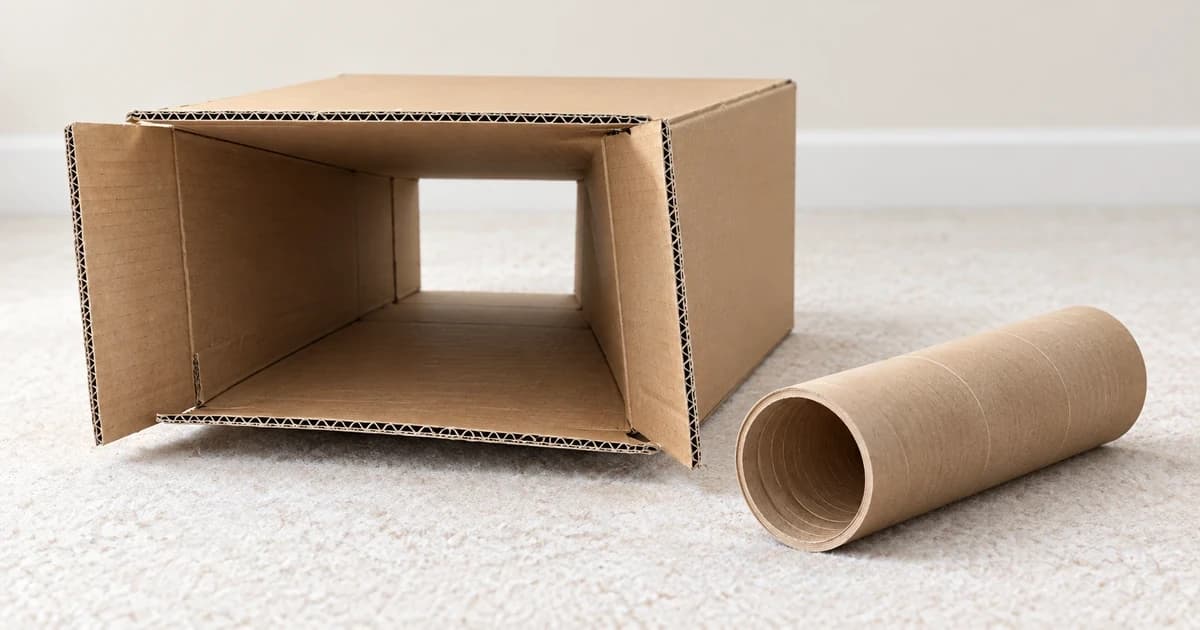
Rabbits may enjoy items that let them forage, chew, hide, tunnel or dig. The best starting point is a choice of rabbit-appropriate opportunities with room to approach and move away. A toy that interests one rabbit may be ignored by another. Check the actual item, its materials and its openings instead of relying on a “small pet” label.
This guide concerns enrichment equipment and non-edible toy choices. It does not prescribe a diet, promise a health result or verify any photographed cardboard as chemically safe. Simple objects still need careful selection and supervision.
Choose an opportunity, not a popularity claim
The RSPCA's rabbit enrichment guidance describes several natural behaviors and emphasizes freedom and choice. Its examples include cardboard boxes, tubes, plain paper and digging opportunities. It also advises leaving enough space to move away from a new object.
Start with what your rabbit already chooses to do. Does the rabbit explore openings, pull at suitable cardboard or search through a familiar forage area? Those observations can guide which opportunity you offer next. They do not establish that the same material or product will suit every rabbit.
| Opportunity | Item to investigate | Checks before offering it |
|---|---|---|
| Foraging | A shallow tray or suitable cardboard tube used with the rabbit's normal feeding arrangement | Accessible contents, suitable material and an opening that does not become blocked; no extra food allowance implied. |
| Chewing and manipulating | Plain cardboard, paper or documented untreated chew material intended for rabbits | No staples, tape, unknown glue or unsuitable coating; inspect for damage and detachable pieces. |
| Hiding and tunneling | A low box or tunnel with an entrance and an exit | Both openings accessible to this rabbit, an unobstructed route and enough surrounding room to retreat. |
| Digging | A ground-level box or tray with a rabbit-appropriate filling | Documented suitable contents, adequate room and supervision when introduced; no soil or filler is approved by its name alone. |
The table organizes source-supported choices. It is not a tested product ranking, a recipe or a universal size chart.
Cardboard boxes need a usable route through
PDSA's rabbit toy suggestions include boxes with two holes and cardboard tubes containing hay. The RSPCA likewise calls for an entrance and an exit in hiding places. A box with one visible front hole is not proof that there is an unobstructed second route.
Inspect the inside and both openings before offering the item. Remove packaging attachments and check for exposed staples, tape, heavy dyes or unknown glue. Do not treat “cardboard” as a complete material declaration: coatings, labels and assembly can change what is present.
Keep the item at ground level for this simple choice. A platform introduces separate questions about height, footing, structure and the individual rabbit. You do not need to make an enrichment item more challenging by raising it or suspending it with string.
Our small-pet tunnel category includes mixed species listings. A hamster- or mouse-named tunnel is not established as suitable for a rabbit, and even a rabbit-named listing still needs usable opening and material information. The category is a place to investigate those details, not a species or fit guarantee.
Chew choices require more than a wood name
PDSA discusses untreated rabbit-suitable branches, while the RSPCA advises avoiding treated, painted, varnished or chemically processed wood. A natural-looking stick or an “organic” title cannot supply those answers.
Look for the exact material, intended species and care or use instructions. If you cannot establish the source or treatment, choose a different documented option. Do not apply one source's named wood example to every branch, bamboo product, flavored chew or mixed-species listing.
When examining small-pet chew toys, keep the same distinction. A broad species tag does not prove rabbit suitability, and a chew label does not make an item edible. Pawlivy has not tested the ingredients or treatment of the listed products.
Introduce an item with an easy way to decline
Blue Cross's small-pet enrichment page has a specific Rabbits section describing space, tunnels and a cardboard box with an entrance and an exit. Its hamster wheels and other species' activities are separate advice. Do not transfer them into a rabbit toy selection simply because the page covers several animals.
Offer a manageable choice without filling the exercise area with objects. Leave clear space around each item, including room to turn and move away. The RSPCA recommends watching closely when introducing something new and removing it if the rabbit appears frightened or stressed.
Allow a hiding place to remain a retreat. Do not trap the rabbit inside or pull the rabbit out to make it interact. If an item is repeatedly avoided, reconsider its placement or choose another suitable opportunity rather than insisting on participation.
Recheck condition as well as interest
The RSPCA advises regular inspection for sharp edges, broken pieces and other developing hazards. An object that looked suitable when introduced may change through chewing, wear or contamination. Remove an item that is damaged or whose condition you cannot assess, and replace it with an appropriate option.
Keep enough choices for the rabbits sharing the space without making them compete for one object. Toys also do not replace suitable housing, exercise or rabbit companionship. If behavior changes concern you, or a rabbit is injured or seems unwell, contact your veterinarian rather than treating another toy as the solution.
Our contribution is a rabbit-specific selection process based on the linked welfare sources. See our editorial policy for how source-based guidance and illustrations are described.