

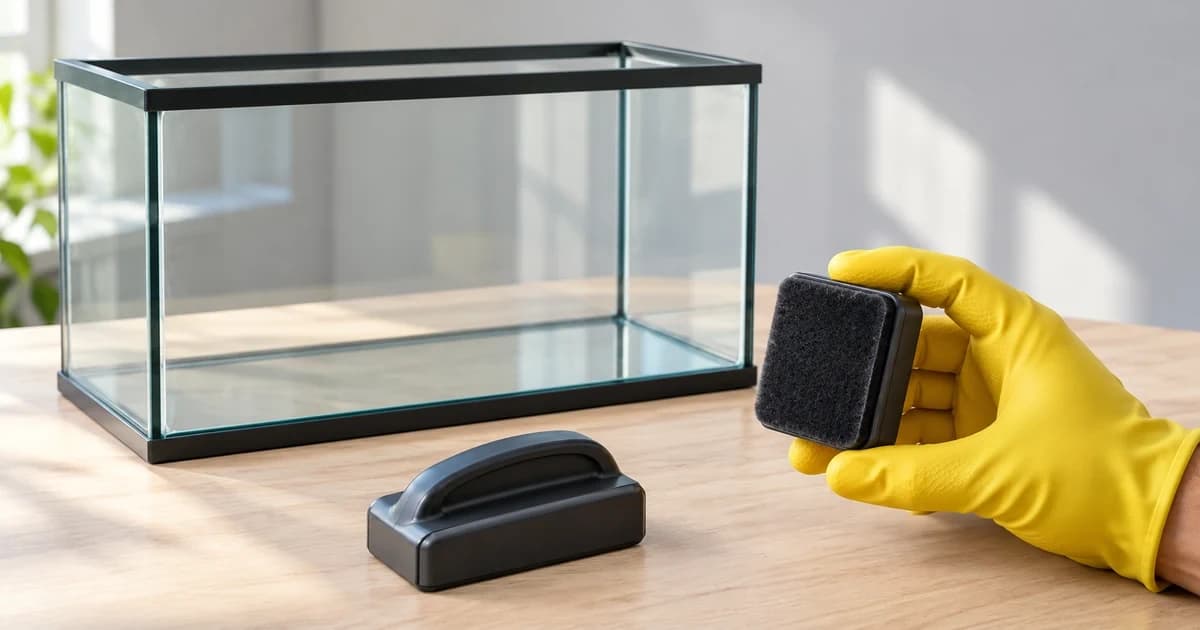
Selecting and using an aquarium magnetic cleaner starts with verifying two tank facts before magnets ever touch the viewing pane: whether your panel is glass or acrylic, and the exact wall thickness in millimeters or inches. Because acrylic scratches easily under glass-rated blades or pads—and magnet strength must match wall thickness—a floating inner half or a strong pull across the glass does not prove that a tool is safe for your tank.
Step 1: Match your tank panel to the cleaner's published rating
Before comparing products in Pawlivy's algae scrapers and magnetic cleaners category, record your tank's panel material, flat vs. curved shape, and exact wall thickness (measured at an exposed edge or taken from the aquarium manufacturer's specification sheet, as Flipper's product finder recommends when plastic trim covers the glass edge). Then check all four fields against the cleaner's manual:
| Model & source document | Permitted panel material | Published panel thickness limit | Cleaning surface & unresolved scope limits |
|---|---|---|---|
| Flipper Pico Black 2-in-1 product page | Glass only (per product page specification). | Up to 6 mm (1/4 in) glass thickness. | Includes a scrubbing pad side and a replaceable scraper blade; the product page does not specify an acrylic blade option or confirm curved-panel operating rules. |
| Mag-Float Acrylic range page | Acrylic (only for the specific item numbers listed on the acrylic line page). | Varies by specific Mag-Float acrylic model number (e.g., up to 3/16 in, 3/8 in, or 5/8 in). | Uses acrylic-specific cleaning surfaces; never use a glass-designated Mag-Float pad or metal blade on an acrylic tank. |
| Tunze Care Magnet manual x0222.8888 (May 2025) | Glass (manual expressly states it is not recommended for acrylic panes). | Model-specific glass ranges (e.g., Care Magnet nano 6–10 mm, long 10–15 mm, strong 15–20 mm). | Uses dual plastic/stainless-steel blades with gap spacing between magnet body and pane; do not treat older limited-use notes as permission for acrylic tanks. |
Important callout: conflicting guidance on curved and bowfront panels
Step 2: Confirmed-compatible operating workflow (from inspection to storage)
Once you have confirmed that your cleaner model, pad, and fitted blade match your flat glass or acrylic panel thickness, follow this four-stage operating sequence:
- Inspect both contact surfaces for grit before coupling: Separate the wet and dry halves and examine the inner scrubbing pad, blade edge, and outer felt/pad in good light. Make sure zero sand grains, snail shells, or hard calcified particles are embedded in the pad—trapped grit turns any magnet cleaner into a glass or acrylic scratcher.
- Place the inner half high on the pane and couple slowly (Tunze May 2025 manual example): Hold the wet half against the upper portion of the viewing panel well above the substrate, and bring the outer handle toward it gradually rather than letting the magnets snap together across the glass. Keep your fingertips strictly out of the gap between the two magnets.
- Glide in steady lengthwise strokes and stay clear of the sand line: Move the outer handle smoothly along the panel so the inner half follows without chattering or detaching. As the Flipper Pico guide warns, stop above the gravel or sand bed so the magnet never dips into the substrate. If the inner piece drops onto the bottom or touches sand, lift it out of the tank and rinse both contact surfaces thoroughly before re-coupling. (Keep viewing-panel wiping separate from substrate maintenance—to remove detritus from the tank floor, use a dedicated siphon and follow our guide on how to clean aquarium gravel.)
- Remove, rinse, and store according to your model's manual: After wiping the pane, follow your specific unit's removal and storage instructions. Do not leave a blade-equipped magnet parked indefinitely in saltwater or freshwater unless its manual explicitly permits continuous immersion, and store separated magnets with their protective spacer in place.
Quick compatibility & session checklist
- Tank panel recorded: Glass vs. acrylic confirmed, flat vs. curved noted, and exact millimeter/inch wall thickness verified.
- Cleaner & attachment matched: Exact model number, thickness rating, and glass- vs. acrylic-rated pad/blade confirmed from the manual.
- Pre-use grit check passed: Both inner and outer contact pads/blades inspected and free of sand or hard debris before coupling.
- Sand-line boundary respected: Magnet kept above the substrate throughout the pass and stored per model directions.
See our editorial policy for how we cite manufacturer manuals and preserve unresolved specification conflicts.