Laser pointers can create problems for cats: a beam must never be aimed at an animal, and a moving dot gives a cat nothing physical to catch. If you are deciding what to buy, a catchable toy is the more conservative choice. If you already use a laser, enthusiasm during the chase does not by itself show that the game suits your cat.
The decision involves separate questions about the device, the room and your cat's response. A careful beam setup does not solve an uncatchable-target problem, and offering a toy afterward does not establish that a laser is safe for the eyes.
Keep beam safety separate from play behavior
The FDA's consumer laser guidance says never to direct a laser at a person or animal. It also warns that mirrors, polished metal and other reflective surfaces can redirect a beam. A label that calls something a toy should not be your entire safety check.
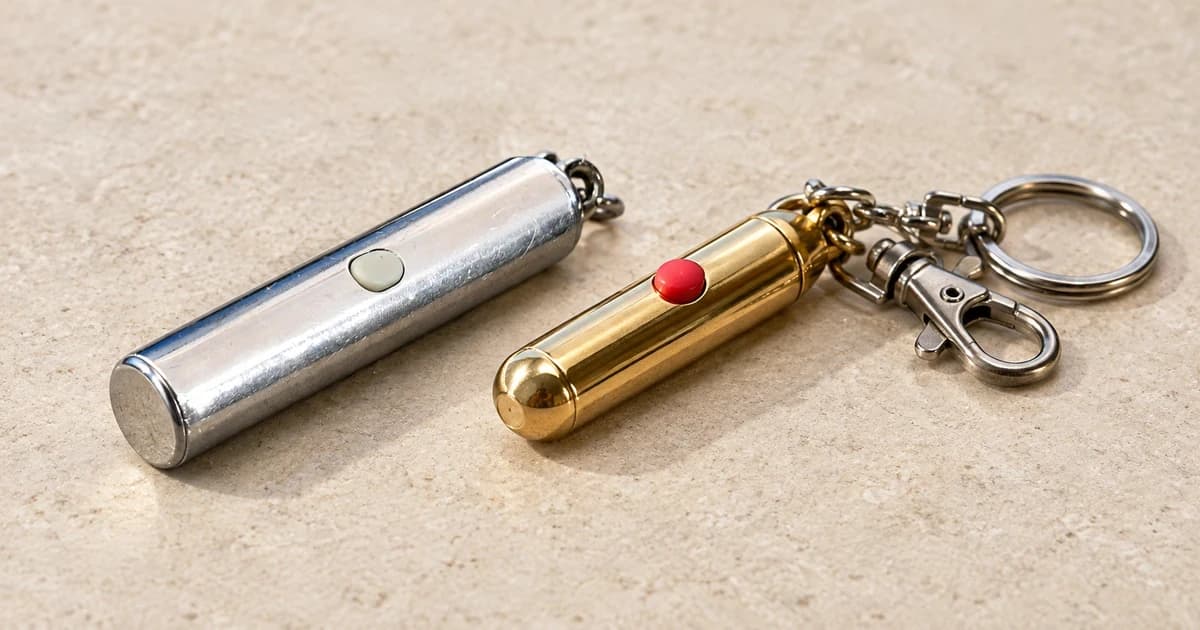
Read the actual device labeling and instructions rather than relying on an online title or the apparent brightness of its spot. If its identity or specifications are unclear, skip it. The FDA's Class 1 recommendation on that page concerns children's toy lasers; it is not a tested threshold for playing with every cat. Nor is a stated power or class an invitation to aim at the face.
If you think a beam reached your cat's eyes, stop using the device and contact your veterinarian for advice about that exposure. If you notice an eye change, such as increased blinking, keeping an eye closed or a change in vision, seek veterinary advice promptly. PDSA advises contacting a vet for eye problems and immediately for eye pain. Looking at the eye at home cannot establish whether an injury occurred.
The cat can chase the dot but cannot grasp it
That limitation is the reason Battersea does not recommend laser pointers for cat play. Its behavior team favors toys that allow the cat to catch and handle the target, and warns that a game without that opportunity can be frustrating.
Other veterinary advice is less restrictive. PetMD's laser-pointer guide permits conditional use while emphasizing eye avoidance, manageable movement and something physical to catch. It also cautions against directing the spot high on a wall, where a cat might attempt an unsafe jump.
These recommendations do not give us a universal verdict for each individual cat. They do give an owner a useful choice: you can provide a moving target with a wand or small toy, without first asking your cat to pursue light. Our preference for that option is an editorial judgment based on the catchable-target concern, rather than a claim that all laser sessions cause harm.
Does laser play cause compulsive behavior?
A 2021 study by Lori Kogan and Emma Grigg analyzed 618 cat-guardian survey responses. More frequent light-pointer play was associated with more reports of several repetitive behaviors, including chasing lights or shadows and staring at lights or reflections. Overgrooming was not associated with frequency in this survey.
The study was cross-sectional and relied on guardians' descriptions and recollections. Its definition of light-pointer play also included pen lights and flashlights. It did not establish that laser use came before the behaviors, prove that it caused a compulsive disorder, or identify a safe frequency or duration. A cat pursuing an occasional reflection is not, on this evidence alone, a diagnosis.
The results support paying attention to what happens beyond the game. They do not justify assigning your cat a numerical risk, assuming every light-chasing cat has a disorder, or claiming that a physical toy at the end prevents one.
Use a decision check before the next game
| What you notice or cannot verify | Practical next step |
|---|---|
| Unclear device identity, labeling or instructions | Choose a physical toy rather than guessing about the laser. |
| You cannot keep the beam away from animals, people and reflective surfaces | Do not use it in that setting. |
| The chase sends the cat toward a high wall, clutter or a difficult landing | Stop that game; choose an accessible physical target and a clear space. |
| The cat keeps searching for the dot or repeatedly focuses on reflections afterward | Put the laser away. Record the context and whether another activity redirects the cat; ask your vet if the pattern persists or disrupts ordinary activities. |
| The cat is uninterested or disengages | Let the session end and try another toy on a different occasion. |
| An eye exposure or eye change concerns you | Stop and contact your veterinarian; do not test the eye by shining more light at it. |
This is a choice and observation checklist, not a diagnostic test. An automatic timer does not answer the room and behavior questions for you. We would not choose unattended laser play when an owner cannot see where the beam travels or how the cat responds.
Choose an alternative with a tangible target
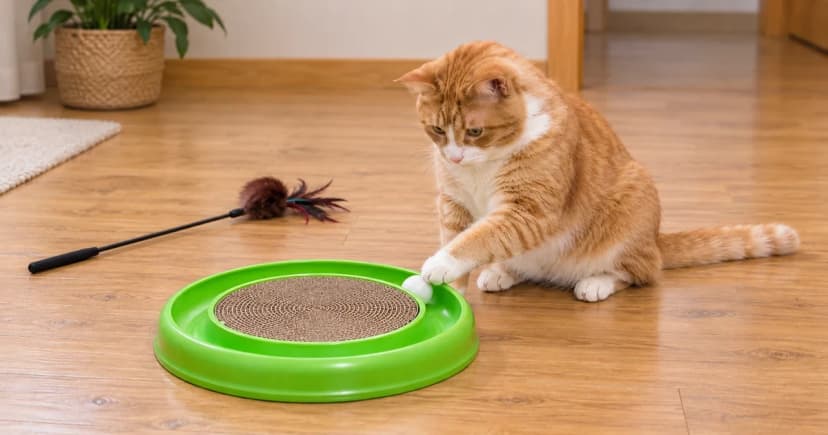
Start with what you want the cat to be able to do. Wand and teaser toys let a person move a target and allow catches. Look at the attachment and cord as well as the handle: can you supervise the entire session and put it away afterward? Battersea warns against leaving string or fishing-rod toys accessible when you are absent because cats can become tangled.
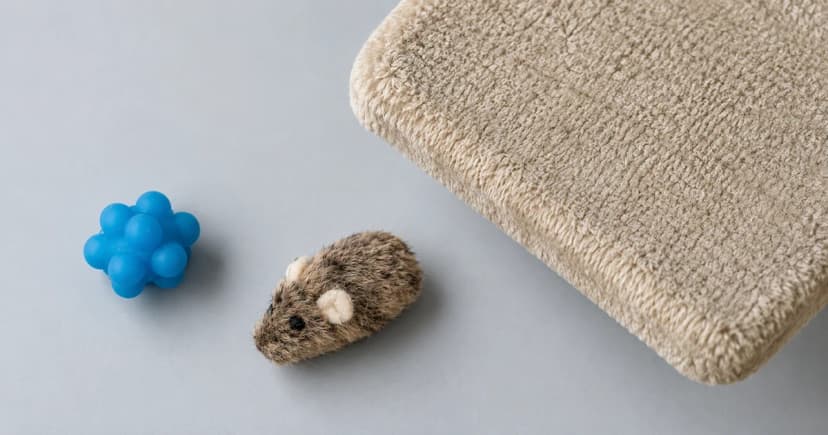
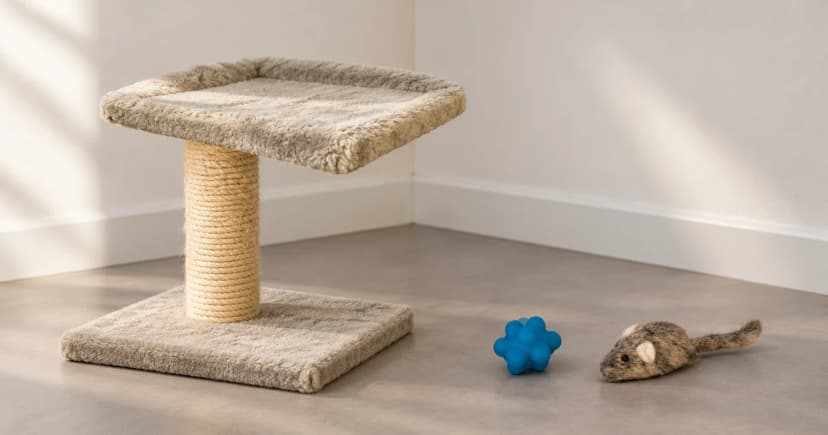
For a target the cat can hold and handle, compare plush mice and kicker toys. Choose an individual toy's size and construction for your cat and follow its instructions; a category name does not guarantee suitability. If neither type appeals, explore other cat toys and enrichment options and observe what draws interest without forcing a chase.
If you choose to continue laser play despite these concerns, have a physical toy ready and offer it for a catch when the light game ends. That is a commonly recommended modification, not proven protection against eye injury or behavior problems. It is also not a reason to extend a game after your cat disengages or appears unable to settle.
You do not need a laser to make play engaging. A useful replacement gives you control over the movement and gives your cat something real to catch. When choosing between those options, the physical target avoids the particular limitation that a bright dot can never be held.