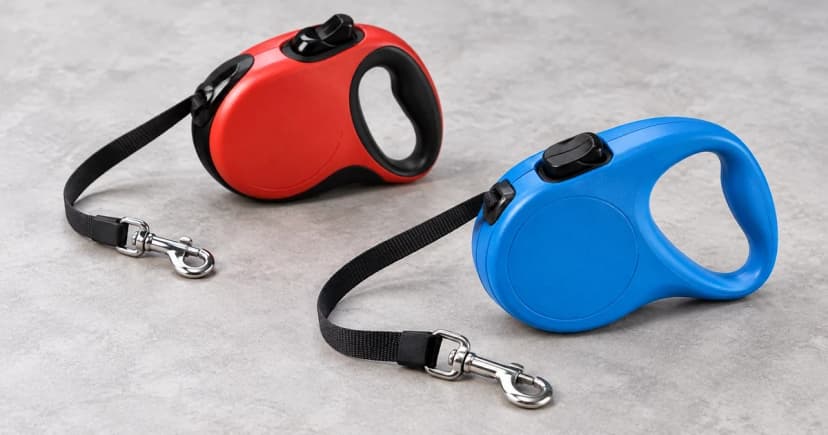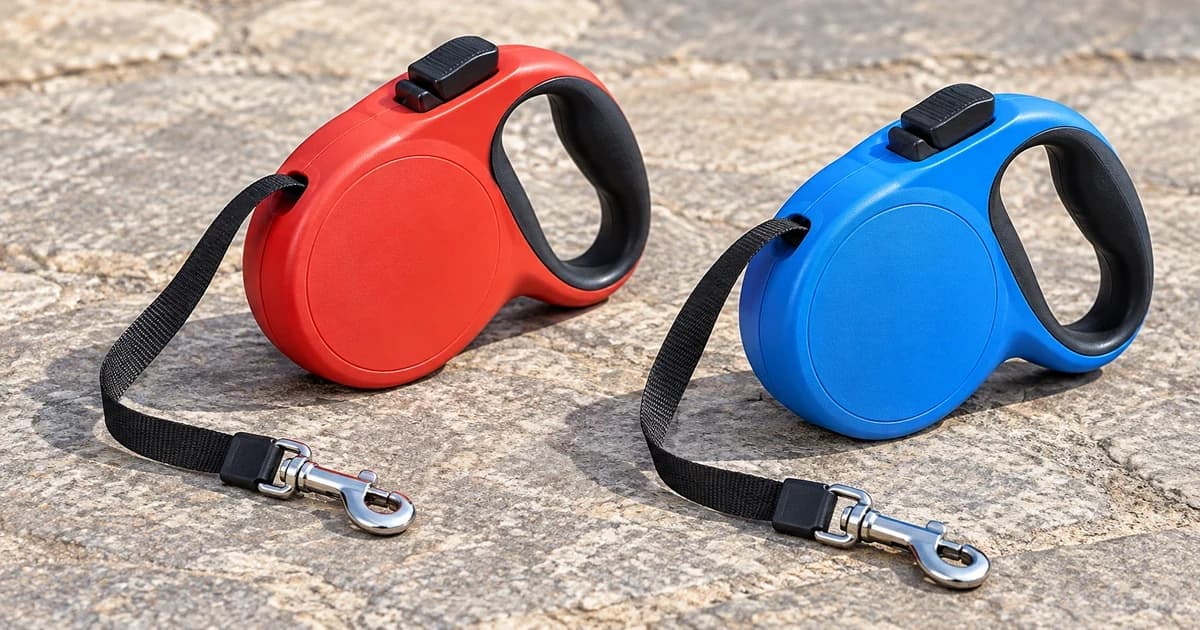
A retractable leash is a conditional equipment choice rather than an all-purpose walking upgrade. Answering “are retractable leashes safe” depends on whether you can reliably control your dog's momentum, operate the thumb brake without hesitation, and keep the extending tape or cord completely clear of bystanders, traffic and other dogs. Whenever your route requires consistent close-by positioning, standard fixed-length dog leashes remain the more direct choice.
Welfare and training organizations draw clear boundaries: MSPCA-Angell recommends traditional non-extendable leads in most walking situations, while the American Kennel Club outlines limited uses in quiet, open spaces with trained dogs.
The lock stops extension; it does not reel a pulling dog back
Inside a retractable handle sits a spring-loaded spool of tape or cord. As the AKC retractable leash guide explains, pressing the brake or lock stops additional line from paying out, while rewinding the line requires slack. Pressing the lock while a dog pulls at 15 feet freezes the line at 15 feet—it does not winch the dog back to your side.
Flexi North America's official instructions explicitly warn handlers never to hold or grab the working cord or tape to control the dog.
Make the decision for the whole walking arrangement
| Situation to consider | Question before choosing a retractable | Reason to use a fixed-length leash instead |
|---|---|---|
| Busy sidewalk, doorway or roadside traffic | Does the dog need to stay right beside your leg continuously? | Immediate close positioning matters more than variable length. |
| Other dogs, pedestrians or children nearby | Could an extended line cross a path or wrap around legs or paws? | Insufficient clear buffer to prevent line entanglement. |
| Quiet, open area with clear sightlines | Can you watch the dog continuously and manage handle controls before the dog bolts? | If the dog lunges at wildlife or ignores recalls, a long line builds high momentum. |
| Unfamiliar or abraded equipment | Are the model's weight limit, brake action and tape condition verified? | Any sticking button, frayed tape or unknown limit calls for retiring the unit. |
Note: Even in an open field, a retractable leash is not an automatic safety guarantee—safe use still depends on a responsive dog, attentive handling and intact hardware.
Check what the manufacturer's precautions actually require
Flexi North America's precautions and directions require an attentive adult handler, a dog within the model's labeled weight limit, keeping the line clear of bystanders, shortening the lead before passing people or animals, and never using the leash around small children or while riding bicycles, skateboards or inline skates. Flexi also cautions that even a small dog accelerating to the end of a long line can pull hard enough to injure a handler.
Inspection cannot expose every internal spring problem
Inspect the full tape length and snap hook before every walk. Flexi instructs owners to retire any leash showing abrasion or damage and warns never to open the plastic casing because the internal spring is wound under high tension. If a brake button sticks or fails to retract smoothly, take the unit out of service immediately rather than attempting a home repair. Note that our long-line care guide applies only to non-retractable webbing lines and never authorizes soaking or opening a spring-loaded housing.
Choose equipment without promising a training result
Compare retractable leashes and standard leashes according to your route and control needs, and see our harness-versus-collar guide to pair your chosen lead with an appropriate body or neck attachment.