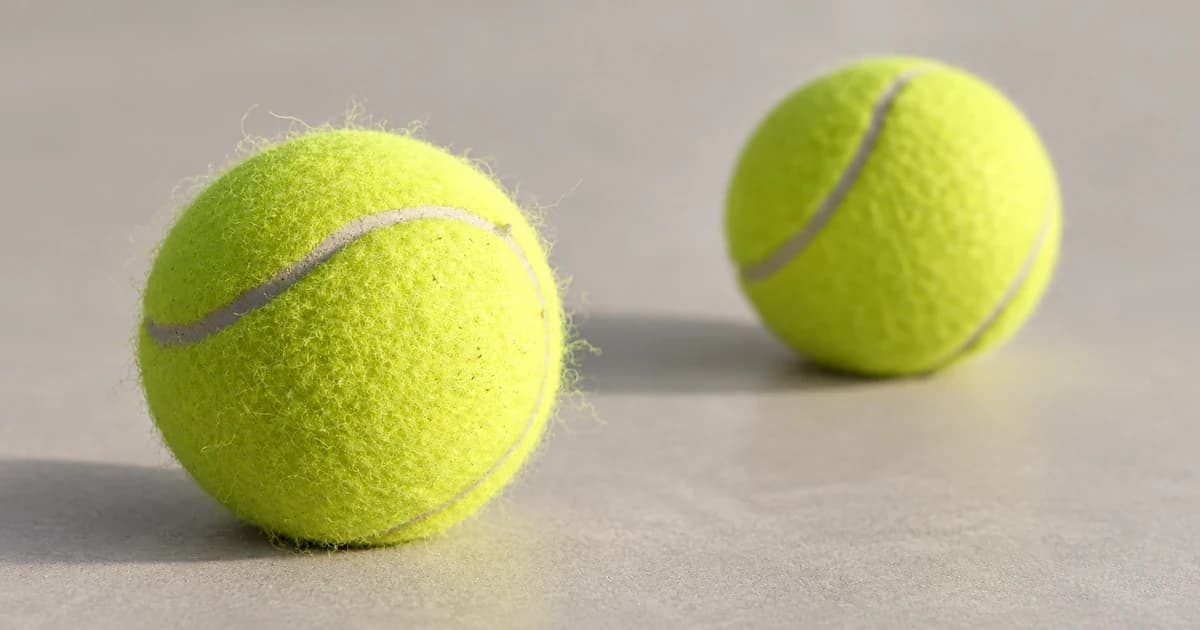
Asking are tennis balls safe for dogs requires looking past a familiar game of fetch to three separate physical hazards: acute airway obstruction from a whole or collapsed ball, intestinal blockage from swallowed rubber or felt, and progressive tooth wear from chewing an abrasive surface. If your dog crushes tennis balls, strips the fuzzy cover, or settles down to gnaw them after a retrieve, end access and switch to a toy built for that play style.
Published guidance differs across welfare and kennel organizations. Blue Cross advises avoiding tennis balls altogether because balls can lodge in the throat and chewed fragments can block the stomach, whereas the American Kennel Club outlines supervised fetch and immediate removal if a dog starts chewing. Neither organization treats a standard tennis ball as a leave-alone chew toy.
Separate the three distinct hazards
1. Acute airway obstruction (choking emergency): A whole tennis ball—or a ball that compresses or splits under jaw pressure—can slip past the teeth and wedge in the back of the throat, blocking the airway. The fact that a dog can carry a ball comfortably during a run does not prove the ball cannot lodge when the dog catches it on the bounce, pants heavily, or squeezes it. Animal Trust veterinary guidance reviewed by Dr. Gillian Burkhill (July 2026) treats active choking or difficulty breathing as an immediate veterinary emergency.
2. Swallowed felt or core fragments (gut blockage risk): Even when breathing is completely normal, dogs that peel the yellow fuzz or bite chunks out of the hollow core can swallow pieces that cannot pass through the digestive tract. Both Blue Cross and the AKC highlight ingestion hazards from stripped felt and split rubber.
3. Abrasive dental wear (blunting and pulp exposure): The woven felt cover acts like fine sandpaper against tooth enamel—an effect worsened as the fuzz traps grit, sand, and saliva. The AKC cites veterinary dental specialist warnings that repetitive chewing on tennis ball felt wears down the tips of the canine and premolar teeth over time. A soft-feeling outer nap is not a dental safety credential.
Because these three hazards work differently, checking a ball for missing chunks does not prevent enamel wear, and buying an oversized tennis ball does not stop a dog from scraping its teeth on dirty felt.
Match each risk to the right immediate action
Keep emergency airway signs, suspected swallowing, and everyday play management on separate decision tracks:
| Situation and observed signs | Immediate action to take | Veterinary and safety boundary |
|---|---|---|
| Active choking or difficulty breathing (coughing, gagging, pawing at the mouth, high-pitched breathing sounds, blue or pale gums, or collapse during ball play) | Contact an emergency veterinarian immediately and follow their directions to bring your dog in right away (Animal Trust veterinary emergency guidance). | Do not blindly push your fingers into the throat, risk pushing a wedged ball deeper, or delay emergency transport to try unverified home extraction methods. |
| Suspected swallowing of a ball, rubber fragment, or felt strip (breathing is normal, but part or all of the ball is missing, or the dog later shows vomiting, lethargy, abdominal pain, or loss of appetite) | Contact your vet straight away for advice (PDSA gut-blockage guidance), even if your dog still seems bright right after swallowing the piece. | Never try to induce vomiting at home or wait days for missing rubber or felt to pass on its own. |
| Repeated crushing, stripping, or post-retrieve gnawing (no choking and no pieces swallowed yet) | Retire the tennis ball immediately; trade for a reward rather than turning removal into a chase or tug struggle. | Supervision only helps if you intervene before the ball splits or the felt is stripped; standing nearby while a dog chews felt still allows tooth wear. |
Watch what happens right after the retrieve
Most tennis-ball problems happen in the thirty seconds after the chase ends. Observe whether your dog brings the ball back for an immediate trade, tries to cram two balls into its mouth at once, lies down to compress the rubber between its molars, or uses its front teeth to pluck at the seam. Treat any crushing, peeling, or multi-ball hoarding as a clear signal to end tennis-ball access.
How to choose a replacement toy by verified specifications
When owners ask what is the best dog toy to replace a tennis ball, the answer depends on the specific job: high-visibility fetch, a two-toy exchange game, or dedicated stationary chewing. To find the best dog toy for your individual dog's mouth size and jaw strength, check three concrete product facts before buying:
- Verified diameter and airway clearance: Choose a ball or retrieve toy sized above your dog's lower-jaw width so it cannot slip behind the premolars, and avoid hollow spheres that collapse flat under bite force.
- Non-abrasive, single-piece surface: Replace woven felt covers that trap sand with smooth, rinseable surfaces that have no glued seams, fabric fuzz, or detachable squeaker plugs.
- Explicit play-mode rating: Separate fetch-only toys (built for chasing and returning under active supervision) from chew-rated toys designed for sustained gnawing.
Browse our dog toys and enrichment directory to compare individual product dimensions, materials, and intended play modes—remembering that a category listing or a “tough” marketing adjective never replaces checking fit and supervising how your dog actually interacts with the toy.