Choose a dog flying disc by verifying its intended play activity, exact variant diameter, gram weight, and rim construction, then inspecting the full 360-degree edge before and after supervised fetch. A “soft” label on a product listing does not tell you the disc's diameter, weight, material transitions, or whether it floats, and a disc built for fetching is never automatically a chew toy.
Always start with the dog-specific product instructions for the exact variant you are considering rather than assuming any flexible round flyer suits every dog. This guide helps you compare equipment specifications for supervised fetch; it does not prescribe a jumping program or certify any disc as tooth-safe, indestructible, or universally sized.
Confirm What the Disc Is Designed to Do
Check the permitted activity and removal rules before comparing colors or flight claims. The KONG Flyer, for example, is documented as fetching equipment, and its warning explicitly excludes use as a chew toy. Its instructions also specify supervised outdoor use in an open area free of obstacles and state to discontinue use if damaged.
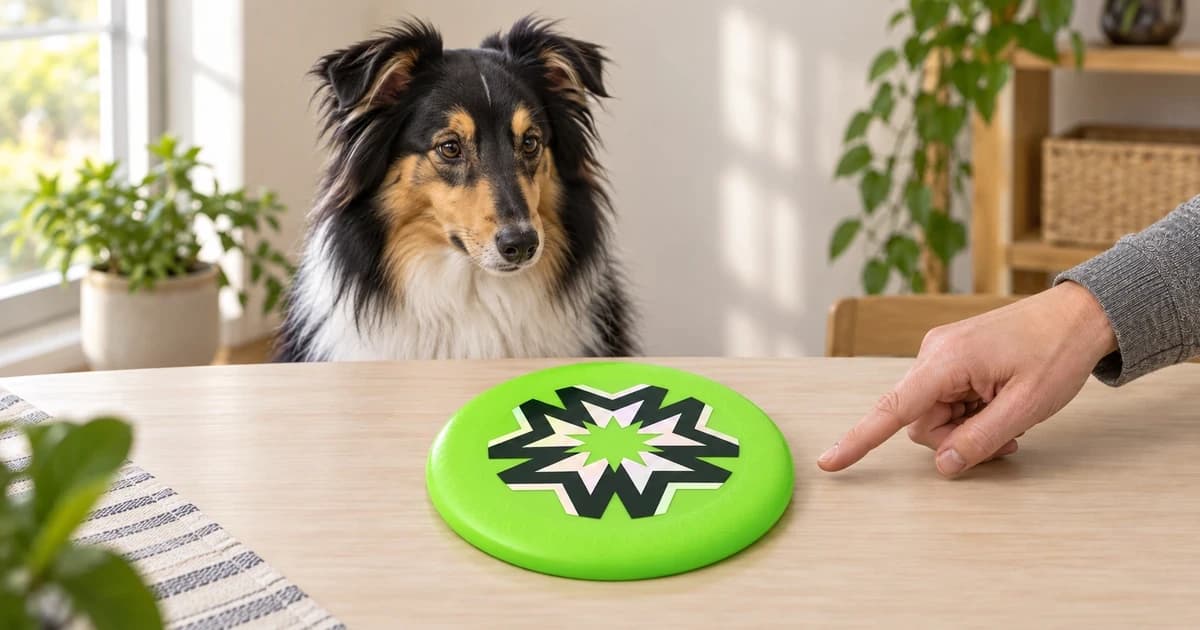
Keep those usage boundaries tied to that specific product. A generic “pet flyer” listing leaves key safety boundaries open if it omits whether chewing is excluded or when surface wear requires retirement. A lifestyle photograph of a dog carrying a disc never proves that the disc is sized or constructed for your dog.
Compare Size and Weight Separately from Softness
Always look up dimensions for the exact variant name. Labels like “Small” and “Large” are internal catalog names, not cross-brand standards, and a multi-number dimension string may describe packaging rather than disc diameter.
Next, check gram weight and flex independently of diameter. Hyperflite's specifications demonstrate why equal diameter does not mean equal handling: within the same K-10 series, three variants share an approximate 8.75-inch diameter while differing in gram weight and manufacturer-stated formulation flex:
| Exact Variant (Manufacturer Specification) | Stated Diameter (Manufacturer Specification) | Stated Weight (Manufacturer Specification) | Manufacturer Flex / Formulation Description | Comparison Scope & Boundary |
|---|---|---|---|---|
| Hyperflite K-10 Competition Standard | Approx. 8.75 inches | 115 grams | Standard K-10 competition formulation (exact numerical stiffness rating not verified here; check manufacturer chart) | Same-brand K-10 comparison only; lighter 115 g weight changes handling compared with 150 g K-10 variants |
| Hyperflite K-10 Jawz | Approx. 8.75 inches | 150 grams | Tough, puncture-resistant K-10 formulation (relative stiffness rating on brand scale only; explicitly not indestructible) | Same-brand K-10 comparison only; durability scale does not certify tooth safety or permit unsupervised chewing |
| Hyperflite K-10 HyperFlex | Approx. 8.75 inches | 150 grams | Softer, ultra-flexible K-10 formulation (relative stiffness rating on brand scale only; check exact listing details) | Same-brand K-10 comparison only; shares 150 g weight with Jawz despite softer flex formulation |
Use the five-question checklist below alongside the Hyperflite K-10 example whenever you evaluate another brand's flyer:
| Property | Question to Resolve on the Product Listing |
|---|---|
| Size | Is the number explicitly labeled as disc diameter (rather than an overall four-part packaging string), and which exact variant does it describe? |
| Weight | What gram weight is stated for that exact variant rather than another formulation sharing the same diameter? |
| Flex | How does the brand describe this material formulation, and is any stiffness scale strictly internal to that brand? |
| Rim and Face | Is the disc single-piece molded rubber/polymer or a multilayer fabric center with a joined rim, and can you inspect the entire perimeter? |
| Play Limits | Does the documentation specify supervised fetch only, exclude chewing, or state explicit water-flotation and damage-removal rules? |
The sources reviewed here do not establish a mouth-to-disc sizing formula. Never force a disc into a dog's mouth or assume a heavier or wider disc is better; if your dog hesitates to pick up or carry a disc during voluntary play, pause and reassess the equipment.
Identify the Construction Behind “Soft”
Different materials create very different kinds of flex. KONG identifies its Flyer as natural rubber, whereas the Chuckit! Paraflight pairs a multilayer nylon interior with a soft rubber edge. Never treat a fabric-centered flyer and a single-piece molded rubber disc as identical construction simply because both descriptions use the word “soft.”
Examine the surfaces your dog's mouth contacts—especially the outer rim, stitched seams, and transitions between fabric and rubber. Follow the product's care rules rather than folding or twisting an unfamiliar disc repeatedly to improvise a durability test.
When a brand like Hyperflite publishes relative stiffness and durability ratings, treat them strictly as internal comparisons across that maker's own lines, not cross-brand safety scores. Hyperflite explicitly notes that even its Jawz disc is not indestructible, so a high durability rating never grants permission to leave a flyer with a dog that is chewing or shredding it.
Keep Ambiguous Dimensions and Features Separate
Verify environment-specific features on the exact product page. Petmate describes the Chuckit! Paraflight as floating, which applies to that named flyer—do not assume another rubber or polymer disc floats just because it is photographed near water.
Apply the same discipline to dimension strings. The reviewed Chuckit! Paraflight Large listing supplies a four-component dimension string without labeling which number is the disc diameter. Do not pick the largest figure from a four-part string and treat it as a confirmed diameter.
Inspect the Full Rim Before Use and Retire When Damaged
With your dog out of reach, rotate the disc through a full 360 degrees to inspect the entire outer rim and both faces for split rubber, frayed nylon seams, punctures, or raised edges. Checking only the center logo area misses the rim zone your dog catches and carries.
Follow the product's retirement rule—such as KONG's explicit discontinue-if-damaged warning—rather than trimming a jagged edge, taping a split seam, or cutting away torn fabric. During supervised play, distinguish retrieving and carrying from lying down to gnaw the rim, and end the session immediately if your dog begins chewing the disc or shows reluctance to pick it up.
Keep a Short Equipment Record for Comparison
When comparing options, write down the confirmed brand and variant, stated diameter (or unverified dimension string), gram weight, rim/core construction, permitted activity, and damage-retirement rule, leaving any missing field marked unverified. Browse the broader dog-toy category when your dog wants a dedicated chew or tug item rather than a supervised fetch flyer, and see our editorial policy for how we keep source specifications distinct from hands-on testing claims.