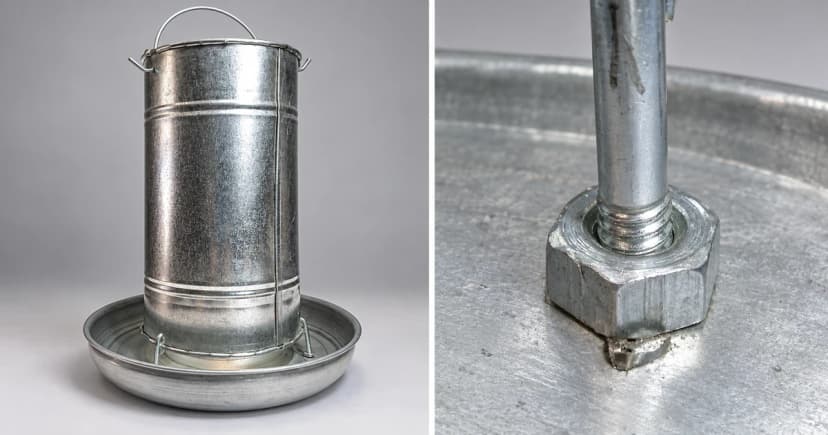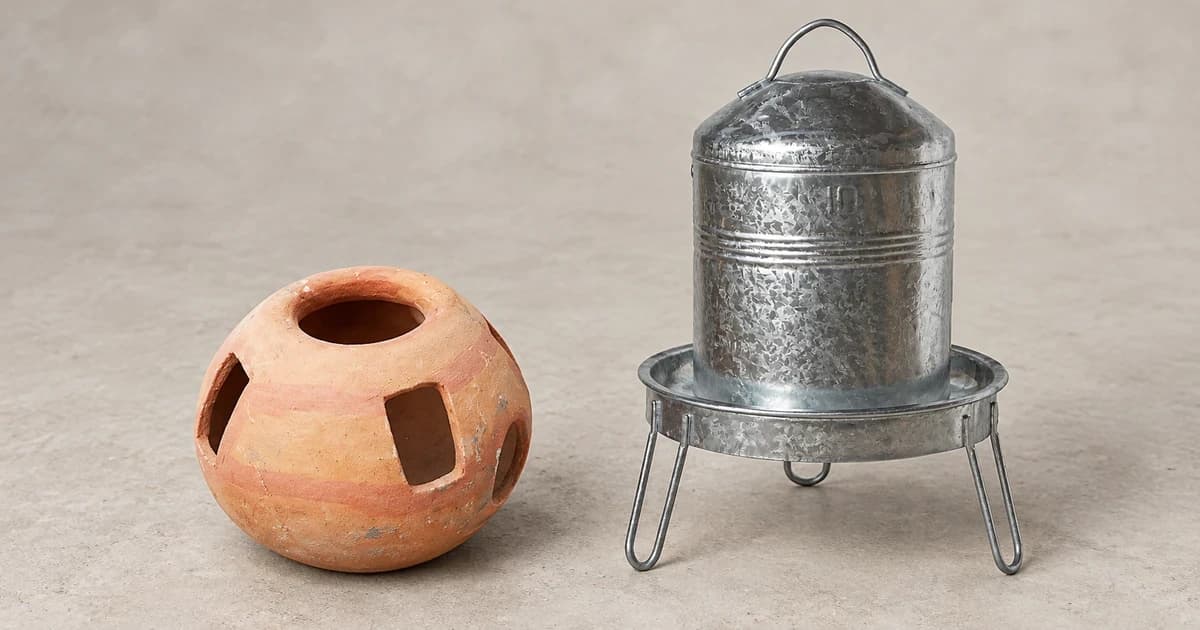
Choose a chicken waterer by comparing its reservoir, drinking outlets, documented users and placement requirements together. Then check how you will refill it and reach the parts that need care. The reservoir's capacity label does not tell you how accessible its pan, cups or nipples will be in your setup.
Start with the exact model and variant. Keep its instructions beside your comparison, especially when one product family offers several sizes or outlet styles.
Separate stored water from drinking access
Identify where the water is stored and how it reaches the drinking area. An open drinking pan, an auto-fill cup and a nipple are different interfaces. Record the actual opening or outlet arrangement and the maker's intended species and age group, rather than choosing on reservoir size alone.
| Comparison field | What to establish |
|---|---|
| Reservoir | The selected variant's stated capacity and dimensions |
| Drinking interface | Pan, cup or nipple configuration, access height and available opening dimensions |
| Placement | The exact permitted floor, leg, clip or hanging arrangement |
| Refilling | Where the filling point opens and whether the item stays in place |
| Care access | Which parts can be reached or removed, and the permitted cleaning method |
A capacity rating does not establish a drinking quantity, a number of birds served or days between checks. Likewise, a box containing spare outlets does not establish the number of drinking positions installed at once.
Read three named designs within their stated scope
Miller Manufacturing's Double Wall Metal Poultry Fount is described for chickens, turkeys and other poultry. The listing describes inner and outer tubes, separate handles and a vacuum-fed drinking pan. It explicitly requires ground or floor placement: this is not a hanging waterer.
Its 2-gallon variant is listed as 12.25 inches in diameter and 10.75 inches high; larger capacities have their own dimensions. Compare the selected variant's footprint and the access needed for its separate outer tube. The presence of handles does not approve hanging it from an arbitrary hook. The page does not supply age-specific suitability for every bird.
RentACoop's 32oz(1L) Automatic Drinker with Auto-Fill Cup and Horizontal Nipple is described for chicks, quail and small birds, with adult birds also mentioned. Treat that as this maker's intended-use description, not a universal age recommendation for other waterers.
The kit lists an auto-fill cup with a removable insert, a horizontal nipple with a dribble dish, a sliding top-refill lid and the Coop Clip installation system. Those are useful questions for access and maintenance. Keep the printed 32oz(1L) label without treating it as an exact unit conversion, and check the supplied installation instructions for the proposed surface.
Omlet's Chicken Waterer support page says its waterer has only been tested with adult chickens and does not recommend it for other animals. It also says chicks cannot reach it during their first few months.
Within this family, cups and nipples require different access heights; Omlet does not recommend mixing them. The 5-gallon version has no handle and cannot be hung, and its extendable metal legs are not compatible with the 1.5- or 3-gallon versions. For those smaller versions, hanging guidance specifies Omlet's purpose-designed strap and approved support arrangements, including a support pole rather than direct run mesh.
Omlet's kit counts include spare cups and nipples, so do not turn those counts into simultaneous drinking positions. Its care guidance permits hosing or wiping rather than a dishwasher, with cup and viewing-window care described separately. Keep that permission with this family.
Check the handling route before choosing the position
Mark the proposed footprint and the space around the drinking interface. Include walls, posts and other equipment that could obstruct access. Check the actual model's height options and intended users; a photograph of another flock does not resolve whether your arrangement is suitable.
Also allow space for the specified filling, lid movement and permitted removal process. Resolve an uncertain mount or access route before purchase rather than assuming a carry handle or a larger reservoir answers it.
Finish with a model-specific comparison record
For each candidate, record the intended users, reservoir label, outlet configuration, dimensions, placement requirements, refill route and care access. Avoid substituting another model's detergent, dismantling or dishwasher instructions.
Compare individual options in the poultry feeders and waterers category using that record. The useful choice is the model whose documented requirements you can accommodate, with remaining questions answered before you rely on the equipment.