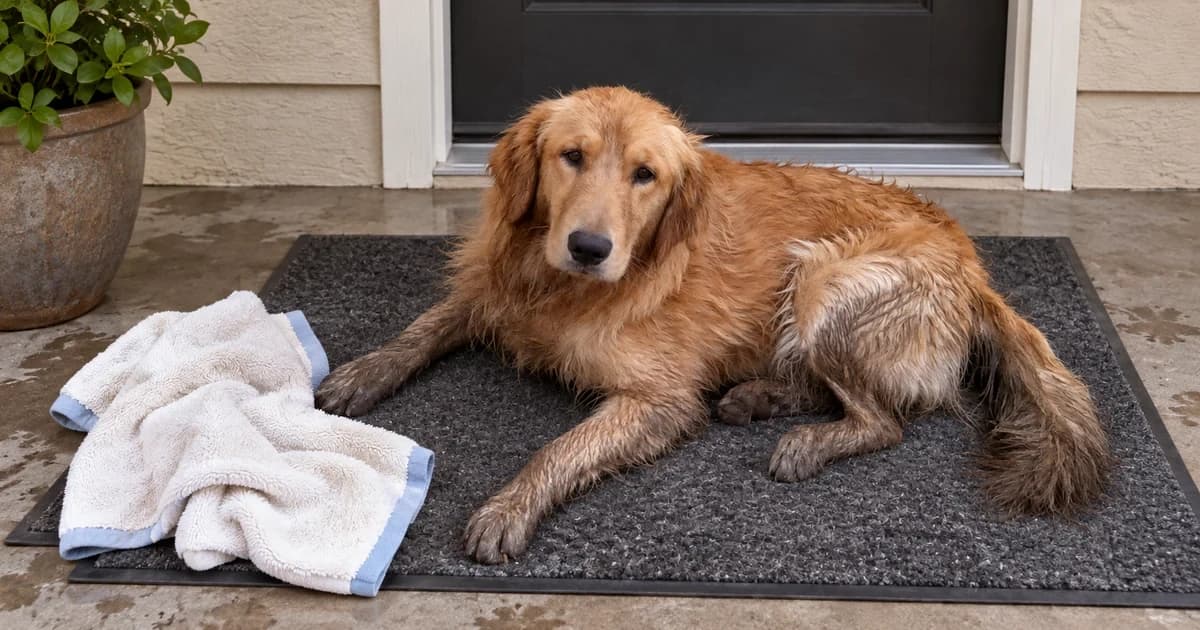
If you are deciding how to clean muddy dog paws before coming inside, match the method to the amount of dirt: remove surface mud with a damp cloth or use a gentle rinse for packed mud, visually inspect between the toes and around the pads, and blot each paw dry before your dog walks farther indoors. A paw-washing cup is one option for ordinary mud when the opening fits your dog's paw according to that model's sizing guide, your dog cooperates willingly, you follow the manual's water and cup-handling steps, and you finish by visually checking and drying the paw after removal and cleaning the tool itself.
The useful distinction is how much dirt is present. A dry towel can blot a clean, wet paw, but it cannot rinse packed mud out of fur. Set up one small cleanup area near the entrance so you can finish the job without carrying a dripping dog across the room.
How to choose the least elaborate method that removes muddy dog paws
| What you can see on the paws | A practical starting point for how to clean muddy dog paws | What still needs checking |
|---|---|---|
| Wet paws with little visible dirt | A clean towel for pressing and dabbing dry | Look around the toes and pad edges before assuming they are clean. |
| A light surface smear of mud | A damp cloth, followed by a clean dry towel | Use a clean part of the cloth; move to a rinse if gritty dirt stays in the fur. |
| Mud packed around paws or lower legs | A controlled cool or lukewarm rinse in a suitable washing area | Clean beyond the paw if mud extends up the wrist and lower-leg feathering. |
| Ordinary paw mud and a dog comfortable with a correctly sized washer | Model-specific water level and gentle cup-twisting instructions | Visually inspect and dry the paw after removal; empty and rinse the tool. |
The AKC's paw-cleaning guide describes wipes, targeted paw washing and portable cleaners as different options, and emphasizes checking between the toes and drying thoroughly. For this routine, a washable cloth and water keep the setup simple. There is no need to buy a washer if a cloth or rinse already removes the ordinary dirt comfortably.
This guide covers ordinary outdoor mud only. If you do not know what substance your dog stepped in, do not assume that a quick doorway mud routine addresses it. Identify the substance and seek veterinary advice before choosing a cleanup method.
Prepare the entrance before you start handling paws
Have a damp cloth, a separate dry towel and access to fresh water within reach. Choose somewhere your dog can stand steadily. If you move to a tub or suitable sink, the AKC's bathing guidance recommends a towel or non-slip mat under the dog and cool or lukewarm water rather than hot water.
Keep the setup within reach so you do not have to let go of the dog to find a towel. Leave a place for the used cloth or dirty washer water that is separate from the clean towel. A tray beside the washing area is an organizational option, not an extra cleaning requirement.
Start with the amount of handling your dog accepts. For a dog unfamiliar with towels or foot handling, practice short, calm introductions when you are not facing a doorway full of mud. The AKC's towel-drying guidance describes introducing the towel gradually and working toward more sensitive areas, including the feet. A struggling dog is a reason to pause, not to grip the paw harder.
Wipe or rinse one paw, then inspect and dry it
- Look before wiping. See whether the mess is just on the top surface or extends between the toes, around the pads or up the lower leg. Do not pull at a hard lump caught in the coat.
- Use water to loosen ordinary mud. Wipe a light smear with the damp cloth. If that leaves dirt behind, move to a controlled rinse rather than repeatedly rubbing the same gritty patch.
- Check the less visible spaces gently. Look between the toes and around the pad edges only as far as your dog comfortably allows. Seeing a cleaner top surface does not tell you what remains underneath.
- Dry with a clean section of towel. Press and dab the wet fur instead of rubbing vigorously. Check the underside as well as the top before putting the paw down.
- Repeat for the remaining paws and any muddy lower-leg fur. Move to a clean part of the cloth or rinse it as needed. Keep the already-clean paws out of the discarded mud and water.
Pressing a towel into the fur is supported by the AKC's drying guidance; vigorous rubbing can create tangles. A towel that has become soaked is less useful for finishing the next paw. Have another dry section or towel ready rather than stopping while your dog is still dripping.
Do not force apart the toes, scrape the pads or continue if handling appears painful. Visible soreness or injury calls for advice from a veterinarian; this routine does not diagnose or treat a paw problem.
If you use a paw-washing cup, follow its own instructions and inspect afterward
A complete paw-washer routine requires five linked conditions: a cup sized to your dog's paw according to that model's measurements, your dog's calm cooperation, following the manual's water and cup-twisting instructions, visually inspecting and towel-drying the paw after removal, and emptying and cleaning the tool before storage. Even then, a washer remains just one option for ordinary paw mud rather than a replacement for a sink or tub rinse when mud reaches higher up the legs.
Check the opening size and the maker's paw-size guidance before use. A label such as small, medium or large is not a universal measurement. The Dexas MudBuster with Lid product page, for example, provides paw-width guidance for its particular medium and large versions. Do not transfer those dimensions to a different washer or use breed examples as proof that a cup fits your dog.
The Dexas MudBuster instruction sheet shows adding water, guiding the paw into the silicone bristles, twisting the cup back and forth, removing the paw and dabbing it dry, then discarding the water and rinsing the tool. That is a specific manual, not an instruction to rotate the dog's leg or to force a paw into any cleaning cup.
Use the amount of water and handling method specified for your tool. Introduce the equipment calmly, stop if the paw cannot enter or leave comfortably, and do not continue a cleaning motion while the dog pulls away. Afterward, look at the paw yourself. A cup hides the paw during use, so it cannot replace the final visual check or the towel.
Plan a separate rinse if mud extends above the area that fits inside the cup. Choosing a larger washer solely to reach farther up the leg does not establish that its opening or handling is suitable. A plain rinse may be simpler for that particular mess.
Reset the cloths and washer for the next muddy walk
Empty the dirty water and rinse the washer rather than putting it away with mud inside. Follow its instructions for removable liners, drying and any deeper cleaning. Dexas's instruction sheet permits dishwasher cleaning for that MudBuster; the permission does not automatically apply to every paw washer, lid or accessory. Check your own tool's care manual before using heat or a machine cycle.
Set aside used cloths and towels for laundering according to their labels, and keep a clean, dry set near the entrance. Before the next walk, check that the washer is clean and ready to assemble as its maker directs. Preparation should make the next cleanup easier, rather than introduce yesterday's dirty water into it.
Those details matter more than a claim that every paw will be clean in seconds. For cleaning other equipment after play, our dog toy cleaning guide separates washable materials from parts that need different care.
Our editorial policy explains that distinction. The goal is visible dirt removal, a dry paw and a tool ready for reuse, with a method your dog can comfortably tolerate.