
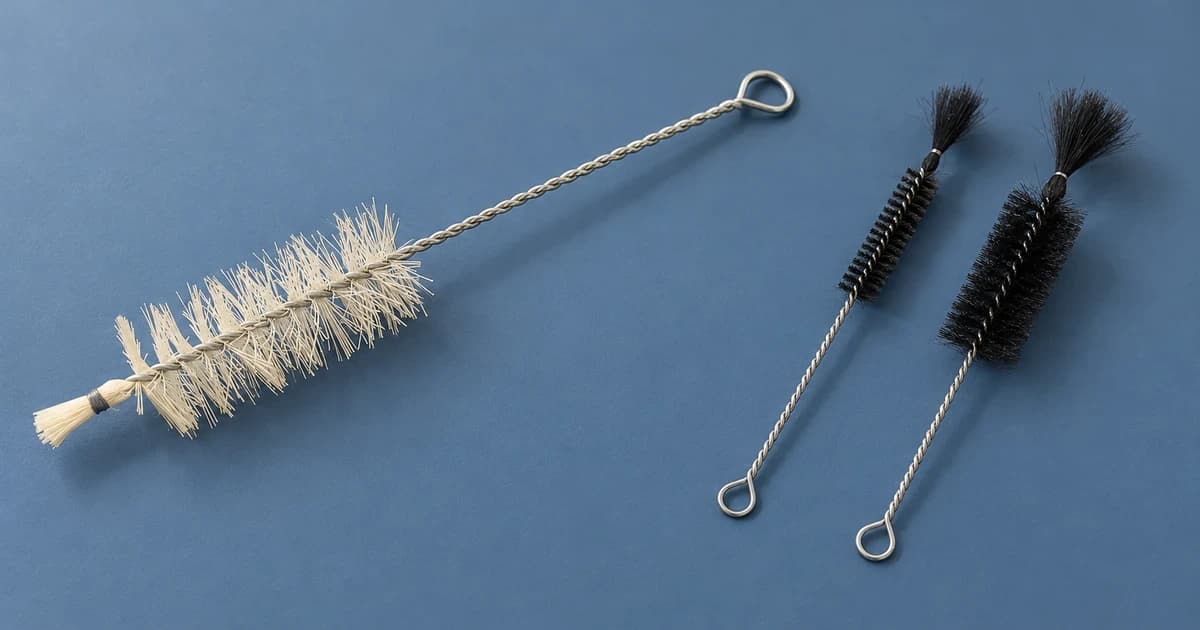
Choose aquarium filter cleaning brushes by the part you need to reach, the documented brush configuration and the access your filter's instructions permit. A long hose-cleaning wire and a compact impeller brush set address different spaces. Neither a familiar brand nor a brush that looks narrow establishes a match.
The three configurations below provide a practical shortlist. Compare interchangeable attachments, a small-component set and a double-ended hose tool, then finish a purchase record for your actual equipment. This is a documentation comparison, not a cleaning or flow-performance test.
Identify the target before comparing brush sets
Record the filter model and the specific target: a removable hose, an inlet or outlet passage, a tap, or an accessible impeller chamber. Keep the hose's documented internal diameter separate from an external hose dimension. Also distinguish the opening you can reach from a passage behind a component that the manual does not authorize you to remove.
Next, identify the tool information needed for that target: brush-head dimensions, shaft arrangement, usable reach and any required attachments. A stated overall tool length does not by itself establish the length available inside a bend or fitting. Leave an undocumented field unresolved rather than selecting a brush from its photograph.
Compare three documented configurations
| Named configuration | Documented arrangement | Purchase distinction |
|---|---|---|
| EHEIM Hose Cleaner Set 4005570 | A wire with three attachment brushes selected for hose diameter. | A hose-oriented attachment system; the prose does not give the individual brush diameters or working wire length. |
| EHEIM Impeller Brush Set 4009560 | Described for narrow inlet, outlet, tap and impeller-chamber areas in EHEIM equipment. | A small-component tool set, rather than documentation of a long through-hose cleaning wire. |
| JBL Cleany 6136100 | A steel helix with a small and large brush at opposite ends; the product page lists 160 cm length. | A double-ended hose tool whose published diameter wording needs clarification before using it as a fit range. |
Choose attachments or small-part access deliberately
The EHEIM Japan page distinguishes the 4005570 hose set from the 4009560 impeller set. Its hose-set directions describe attaching the brush appropriate to the hose diameter to the wire. Confirm the actual attachment sizes for your hose; three supplied brushes do not establish three particular dimensions.
The page describes the impeller set for EHEIM filters and pumps. Keep that brand-specific statement separate from permission to access a particular chamber, remove a fitting or use the tools on another maker's equipment. Its narrow-space description does not supply those missing instructions.
Use this distinction to reduce the shortlist: for a documented through-hose task, investigate the hose-oriented configurations; for an accessible small component, investigate a set documented for that component. If your maintenance requires both, record both requirements instead of expecting one purchase label to cover them automatically.
Separate a brush diameter from a hose compatibility claim
The JBL English product page prints an internal-hose-diameter range of 9 to 30 cm. Do not silently change that unit or treat the sentence as a verified fit range for your equipment.
The one-page Cleany brochure instead labels brush-end diameters of 9 and 30 mm and a length of approximately 1,600 mm. Those diameter labels concern the brush ends; they are not automatically an approved hose-internal-diameter range.
A useful enquiry includes the exact brush code, filter model, target hose or passage and the dimension supplied by its equipment documentation. That gives the manufacturer a specific compatibility question. A unit discrepancy is a reason to resolve the information before ordering, rather than choosing the more convenient number.
Finish the shortlist with a complete equipment record
- Target: filter model, exact hose or component, and the applicable access instructions.
- Tool: maker, product code, attachment inventory or double-ended arrangement.
- Dimensions: confirmed head sizes and usable reach, with unresolved quantity or unit labels identified.
- Permissions: the equipment maker's allowed access and cleaning method for that part.
- After purchase: the tool's own care, storage and replacement guidance where supplied; do not invent missing directions.
Use our aquarium filter maintenance guide for the separate component and timing record. Browse aquarium brushes and cleaning kits once you know which tool configuration you need. Regional manufacturer pages document the examples here; they do not establish current US availability or Pawlivy stock. The useful result is a justified shortlist with the remaining compatibility questions visible.