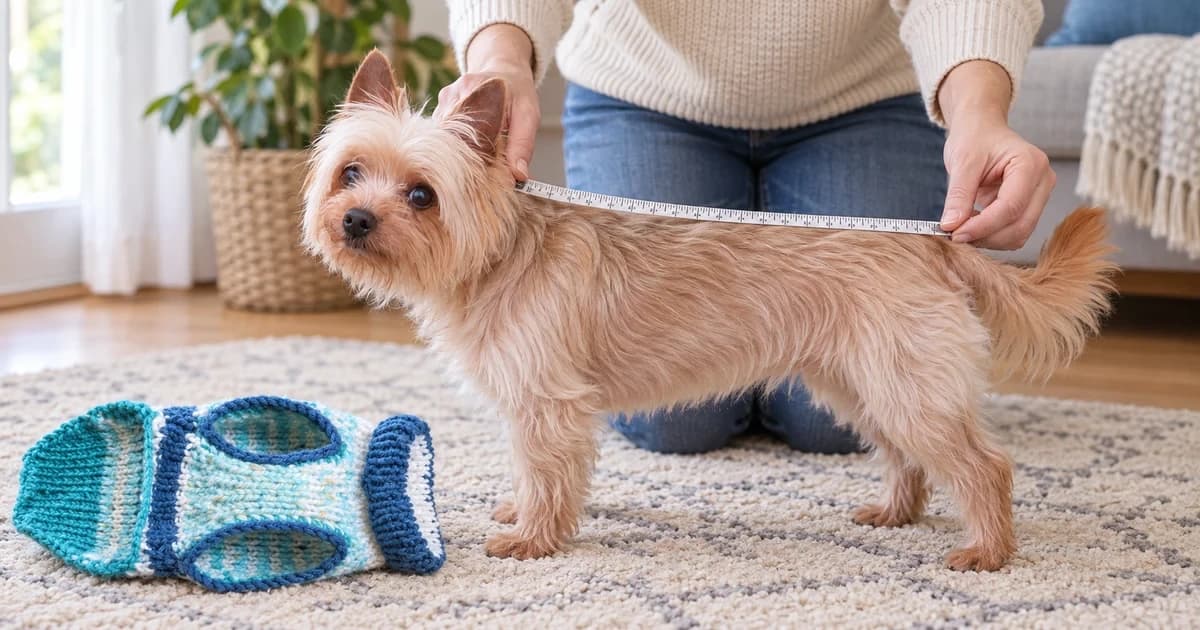
To measure your dog for clothes, start with chest circumference, lower-neck circumference and back length while your dog stands naturally. Compare those measurements with the chart for the exact garment, then check its openings, belly cut and fit during movement. A size label alone cannot tell you whether a sweater or coat will fit.
When sizing for dog sweaters, use the garment’s own chart to compare chest, lower neck and back length. Keep the measurements for a dog sweater together with the exact model and size you considered. Dog sweater sizes are not a shared code across different cuts or fabrics, and a dog sweater size chart by weight cannot replace the measurements requested by that garment’s maker.
The useful result is a small measurement record you can reuse, rather than a permanent claim that your dog wears “medium.” Different brands, fabrics and clothing shapes can require different sizes.
How to measure a dog for clothes: take three measurements
Use a flexible sewing tape. If you do not have one, mark a piece of non-stretch string and measure it against a ruler. Ask another person to help your dog stand comfortably on all four feet, with the body straight. Pause if your dog keeps turning or sitting; a twisted pose changes the back-length reading.
Hurtta’s measuring guide identifies the lower neck, widest chest and neck-to-tail back length for coats. Check the chosen maker’s diagram first, because the precise starting point and any measuring allowance matter.
| Measurement | Where to measure | What to record |
|---|---|---|
| Chest circumference | All the way around the widest rib-cage area, usually just behind the front legs | Complete circumference, units and any allowance the maker instructs you to use |
| Lower-neck circumference | Around the base of the neck near the shoulders, following the garment’s diagram | Complete circumference; do not substitute a measurement taken high behind the ears |
| Back length | Along the back from the neck/shoulder starting point to the base of the tail | Length without including the tail; note the starting point used |
Keep the tape level around the chest and neck, without pulling it tight enough to flatten the coat. Follow the maker’s instructions about extra space. For example, Hurtta describes about a finger’s width when measuring over fur; that is its guidance, not a universal number of inches to add to every brand’s chart.
Write the date beside the measurements and repeat any reading that seems inconsistent. For sleeved overalls, the maker may also request leg or waist measurements. Take those only at the points shown in that garment’s instructions; ordinary back length does not describe sleeve length.
Find out what the size chart is measuring
Before selecting a row, check whether the numbers describe the dog’s body or the finished garment. A chest range labeled for dogs is different from a shirt’s flat width or an unstretched sweater circumference.
For a body-size chart, compare your dog’s measurements directly, using the measuring method supplied. Do not add an automatic two inches if the recommended range already allows for fit.
Confirm inches versus centimeters and the selected variant. Do not average the figures, trust the larger one, or assume a return will resolve an avoidable sizing problem.
When browsing dog sweaters or raincoats, look for a model-specific chart and instructions. A category label does not establish a garment’s size, stretch, weather performance or availability.
Use the cut to solve a mismatch between measurements
A bigger size can increase several dimensions at once. It may create room for a broad chest while making the back too long or the neck too loose. If no chart row accommodates the required measurements, another cut may be a better starting point than the next size up.
Chilly Dogs’ instructions prioritize chest and neck for its coats, then use back length to help distinguish body styles. Its coat chart separates standard, long-and-lean, and broad-and-burly shapes. Those names belong to that maker; they illustrate why a long, narrow dog and a short, broad dog may need different proportions, even when their weights are similar.
- Long back, narrow chest: investigate a longer-body cut instead of accepting a loose chest merely to gain length.
- Broad chest, short back: look for chest room with a shorter rear panel, then confirm the neck opening.
- Thick fur or an intended underlayer: follow the model’s allowance instructions and check the complete combination during fitting.
A pullover also has to pass over the head without forcing it. A neck circumference that suits the dog when worn does not automatically establish that the opening stretches or opens enough for dressing. Check the closure and opening instructions before ordering.
Try the garment on and check these five areas
Start with a brief, supervised fitting indoors. Follow the dressing sequence and adjust only the closures provided. Do not force a reluctant dog’s legs through sleeves or pull a tight neckline over the head.
- Neck and shoulders: the opening should sit as intended without pressing into the throat, riding up toward the ears or pulling the front panel backward.
- Chest and closures: fasteners should close without straining. Watch for panels that twist, excessive loose folds or fabric pulled tightly across the ribs.
- Leg openings and sleeves: check that seams do not rub behind the front legs and cuffs do not cover the paws. Let your dog take a few willing steps, turn and sit to check whether movement changes the fit.
- Back and tail: the rear panel should end where the design intends, without trapping the tail or sliding over the rear. Longer coverage is not automatically a better fit.
- Belly and toileting clearance: inspect the underside separately from the back. Fabric should leave the genital area and anus unobstructed; a male dog may need a shorter belly panel or a suitable cutout even when the back length is correct.
Canada Pooch’s clothing guide warns that excessive rear overhang can interfere with toileting. The AKC measuring guide also identifies underside clearance as a consideration for male dogs. Choose a compatible cut rather than shortening the measured back length to hide a belly-panel problem.
If your dog freezes, repeatedly tries to remove the clothing or moves differently, remove it and reconsider the fit and whether your dog accepts that style. Do not leave the garment on merely because its chart row matched. Also remove it if you notice rubbing or pressure during the fitting.
Keep the record, then recheck it
Save the dog’s dated measurements, chart version, selected size and fitting notes. For puppies, choose a fit appropriate to their current body and remeasure as they grow; oversized clothing bought for future growth can fit poorly now. Check again after a substantial grooming or body-size change.
When comparing coats and jackets, use that record to ask precise questions about the model. A successful clothing fit does not establish a temperature limit or replace correctly fitted walking equipment. Our editorial policy explains how source guidance and untested product claims are handled.