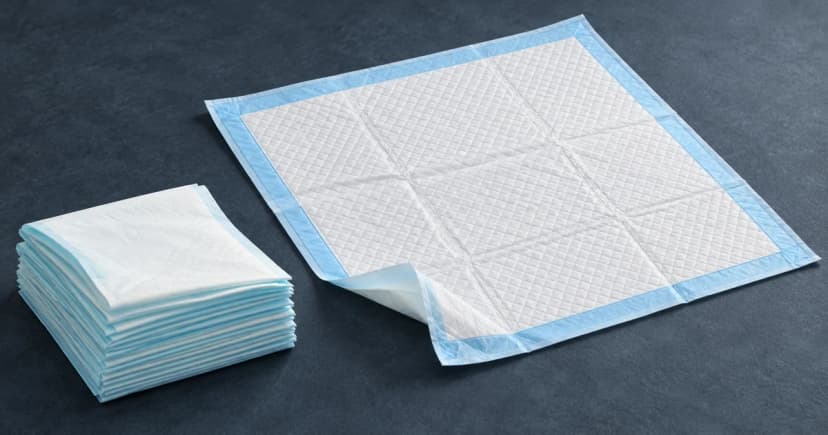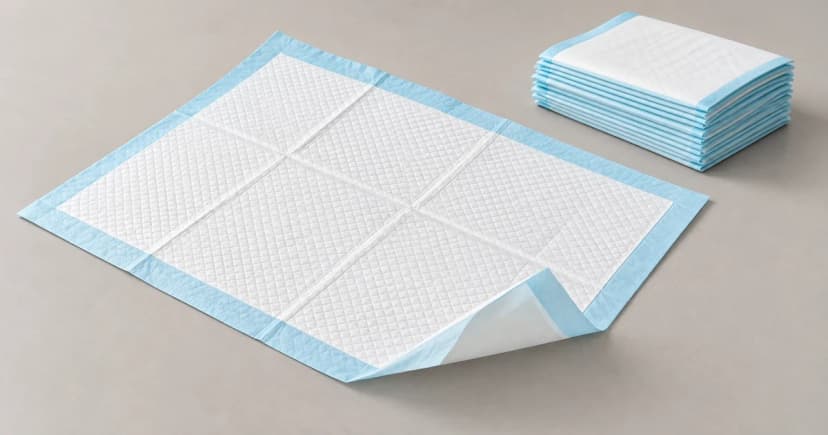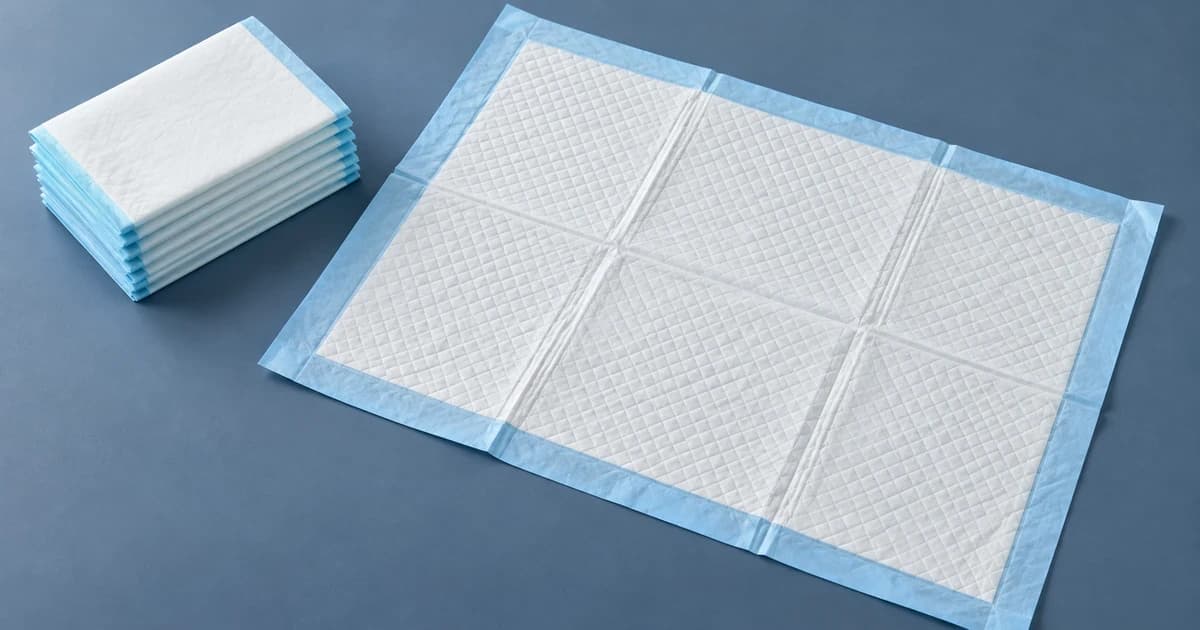
How do dog pee pads work? The basic job is to receive liquid at the surface, hold it in an absorbent section and limit its passage through the bottom. The exact construction depends on the pad, and this guide does not supply a universal liquid-capacity rating. Some makers describe a polymer that turns liquid into gel, but a white quilted surface does not tell you the core material, layer count or how much that particular pad can hold.
Read the product's construction description separately from its training claims. A pad's physical design and a dog's learning to use the intended place are different questions. For the learning routine, see our puppy pee-pad training guide.
Follow the description from the top to the bottom
Start with the exact pad name and variant. Then find what the manufacturer says about the surface, the absorbent section and the underside. A layer count alone leaves those functions unexplained; a branded technology name also needs its accompanying description.
For example, Four Paws' Wee-Wee Superior Performance description identifies a six-layer Floor Armor design. It describes a quilted top, an absorbent polymer that turns liquid into gel and a bottom intended to act as a barrier. These are the maker's descriptions of that named pad. They do not supply a complete list of every internal material or establish the construction of other pads.
This gives you a useful reading order: what receives the liquid, what retains it, and what separates the absorbent area from the surface underneath. Use this three-part functional cross-section map to separate a pad's top-to-bottom roles from brand-specific layer counts and unpublished material lists (mapping three functional zones does not mean every pad has three physical layers):
| Top-to-bottom functional zone | Role in liquid handling | Named manufacturer descriptions (attached to exact products) | What remains separate or unverified |
|---|---|---|---|
| 1. Top receiving surface | Accepts liquid where the dog steps and directs moisture downward into the core | Four Paws Wee-Wee Superior Performance: quilted top; Hartz Miracle Guard: quick-dry, spot-concealing top sheet; Simple Solution Washable Pads: reusable fabric top surface | Surface appearance does not prove instant dryness or reveal the underlying core layers |
| 2. Middle absorbent section | Holds liquid inside the pad between the top sheet and the backing | Four Paws Wee-Wee: absorbent polymer that turns liquid into gel (within a six-layer Floor Armor design); Hartz Miracle Guard: Flash-Dry gel (within a six-layer design); Simple Solution Washable Pads: washable absorbent fabric core (not a disposable polymer-gel sheet) | Trade names (Floor Armor, Flash-Dry) and a shared “six-layer” count do not disclose chemical formulas, full layer-by-layer materials, or measured millilitre capacity |
| 3. Bottom barrier / backing | Limits liquid from passing through to the floor underneath | Four Paws Wee-Wee and Hartz Miracle Guard: bottom barrier/backing layer in a disposable pad; Simple Solution Washable Pads: reusable backing cleaned per garment care instructions | A barrier claim is not an independent leak-test score or permission to leave a saturated pad down indefinitely |
If a description names only two of those roles, leave the missing detail open rather than inventing another layer.
Keep each maker's layer and gel terms together
Hartz Home Protection Miracle Guard Extra Absorbent Dog Pads use their own terminology. Hartz describes a quick-dry, spot-concealing top sheet; its pad-specific explanation also refers to Flash-Dry gel and a six-layer design. Keep those statements attached to that product. Sharing a layer count with another pad does not demonstrate identical materials or equal performance, and the trade name alone does not identify the gel's chemical composition.
When asking how do pee pads for dogs work, avoid combining different brands' feature lists into one supposed standard recipe. A product may describe several functions without publishing its complete internal specification.
Check whether the pad is disposable or reusable
Simple Solution's Washable Training Dog Pads are explicitly described as reusable and washable. That establishes a different product type; it does not establish that their core uses the same gel or layer arrangement as the disposable examples above. Use the exact product's care information rather than applying a disposable pad's replacement instructions to it.
Keep this distinction when comparing disposable pee pads. The category helps you find that format, while the individual package and maker's information should identify the specific construction and intended care.
Separate a material explanation from a performance result
Terms such as absorbent, quick-dry or barrier explain a claimed role. They do not give you a measured liquid capacity, prove that every part of the surface stays dry or establish how a pad behaves after continued use. A dry-looking top and an unchanged outline are not measurements of the remaining absorbent capacity.
Before choosing a pad, note its exact name, disposable or reusable status, stated absorbent material and backing description. If capacity, a layer material or a claimed benefit matters to your decision, look for information about that exact variant and the conditions behind any stated result. Keep open points marked as unknown. Understanding those limits is more useful than treating a layer count or a gel name as a universal promise.