
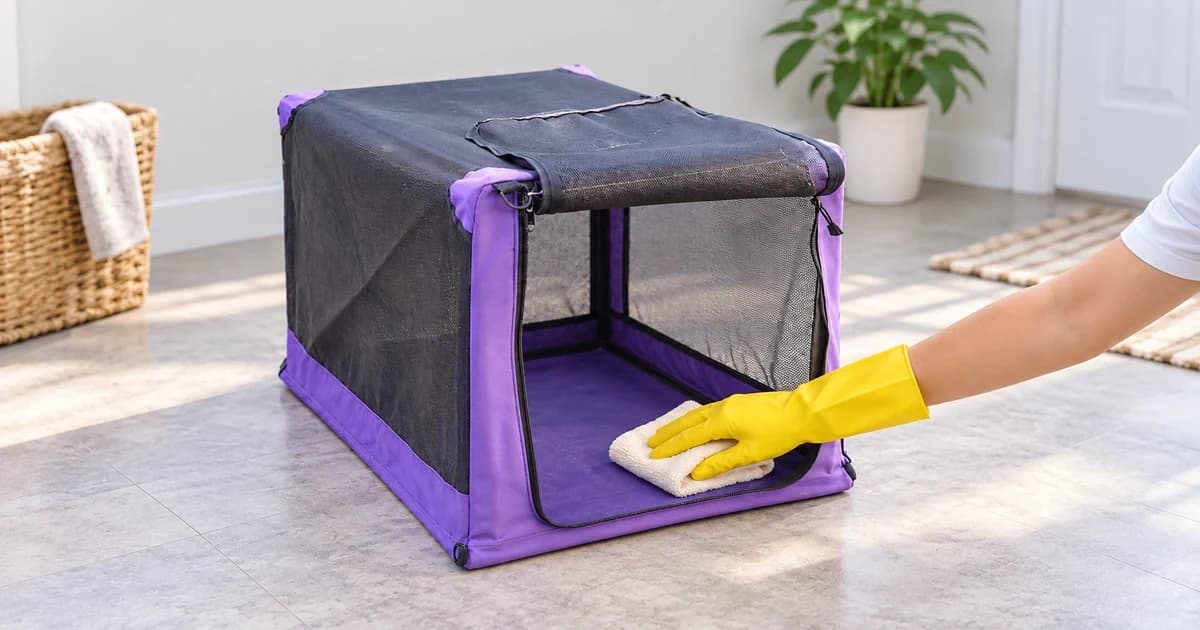
To clean a soft dog crate, first identify which parts its maker permits you to remove and wet-clean. A washable fabric cover, a removable floor insert and a folding frame can have different instructions. Empty the crate, record the connections before taking it apart, clean only the permitted components and follow the model’s drying and reassembly directions.
A soft shell does not automatically make the whole crate washable. The examples below show why the care label and model number matter, including a cover that requires handwashing and an inflatable kennel with a different cleaning method.
Identify the shell, floor and supporting structure
Find the model number on the label, purchase record or manual. Look for a care section as well as the assembly diagrams. If the product page only says “easy to clean,” you still need to establish the method: wiping, handwashing and machine washing are different permissions.
With the crate empty, make a short component record. Photograph the way straps, sleeves and frame connections are arranged before releasing anything. This is a reference for reassembly, not a reason to dismantle a connection the maker has not identified as removable.
| Component | What to establish before cleaning |
|---|---|
| Outer fabric and sewn-in mesh | Can the cover come off? Does its label permit wiping or washing, and at what temperature? |
| Floor cushion, liner or insert | Is it separate from the shell? Is the entire insert washable, or only a removable cover? |
| Folding tubes, joints and straps | Which connections release, and how must they reconnect? Is there a specific frame-cleaning instruction? |
| Zippers and door fastenings | Are the teeth, slider, seams and retaining straps intact? Does the manual specify their care? |
| Inflatable panels and valve | Does the maker specify spot cleaning and a particular drying or storage sequence? |
A removable floor pad does not establish that the surrounding shell can be soaked, and mesh ventilation panels do not identify a detergent or temperature.
Compare the instructions for the exact model
These examples are manufacturer-specific. Their permissions do not transfer to a similar-looking crate.
| Source and structure | What its instructions establish | What to avoid assuming |
|---|---|---|
| Chewy-issued Indoor & Outdoor Soft Dog Crate manual, models 105032–105036 and 105038–105042 | Remove the cover carefully after disassembly. Handwash it in cold water with the specified mild, nontoxic detergent and a gentle, nonabrasive cleaning material; hang it to dry. The manual excludes the washer and dryer. | This cover instruction is not a wash recipe for every cushion or metal frame. |
| MidWest Canine Camper 1700CC-series tent crate | The assembly diagram shows lifting the end panels, joining steel tubes and twisting the grooved connection over the adjoining rod on each side. | The assembly manual reviewed here does not establish cover washing, machine use or frame immersion. |
| Diggs Enventur inflatable kennel | The care section starts with fresh-water spot cleaning. For dirt that will not rinse away, it permits mild dish soap. It requires complete drying before deflation and storage. | This inflatable construction does not share the removable-cover procedure of a tube-frame crate. |
See the complete Chewy soft-crate manual, MidWest assembly manual and Diggs Enventur manual for their full instructions and limitations.
Empty the crate before choosing a cleaning method
Have the dog outside the crate while you work. Take out loose belongings and separately removable bedding. Clean removed toys according to their own material instructions; the dog-toy cleaning guide treats those separately from the crate. Keep the floor insert’s label with it so it does not get mistaken for the fabric shell. If the model allows removal, set aside each component where you can identify it later.
Pick up accessible loose hair and debris without pulling on mesh or seams. Check the corners and the edge of the floor, where residue may be less visible than on the open panel.
Separate a dirt problem from a damage problem. Torn mesh, a loose seam, a bent connection or a zipper that no longer closes calls for the maker’s repair or replacement guidance. Cleaning does not establish that a damaged enclosure is fit to use again.
Clean each permitted part separately
Once the instructions are clear, lay out the approved cleaning materials and follow that component’s method. For a removable cover, use the specified disassembly sequence rather than stretching it off an assembled frame. Preserve the position of internal straps and keep your fingers clear of folding connections.
For the Chewy models above, follow the handwash and hanging-dry directions for the cover. For the Enventur, follow its spot-cleaning instructions and its drying-before-deflation sequence. If your own shell has only a wipe-clean instruction, do not turn that into permission for a bath, washing machine or hose-down.
Check the floor insert separately. A foam-filled cushion, a fabric sleeve over a board and a simple loose blanket are different assemblies. If the label identifies only a washable sleeve, do not include the core in that wash.
Do not add bleach, solvent, steam, a pressure washer or a zipper lubricant based on these examples. None supplies general permission for those methods. This guide addresses visible dirt and material care; it does not provide a disinfection process or claim pathogen removal.
Dry, rebuild and check the empty crate
Follow the specified drying method before rebuilding or storing the cleaned component. Do not use a tumble dryer just to shorten the wait when the cover’s instructions exclude it. Diggs expressly requires the Enventur to be fully dry before deflation and storage; that sequence belongs to its inflatable design.
Use the assembly diagram and your earlier photographs to restore the empty crate. Confirm each required strap and connection rather than stopping once the shell looks upright. On the Chewy manual’s frame, the internal straps are part of its setup. On the MidWest model, its grooved tube connections require the stated joining action. These are distinct mechanisms.
Check the mesh, floor edges and seams, then operate the zippers without forcing them. If a connection remains loose or a door cannot close as the maker describes, pause use and request the correct repair or replacement advice. A photograph of a reassembled crate cannot certify its containment, transport or suitability for a particular dog.
What to check when comparing soft crates
When browsing soft dog crates, look for access to a model-specific manual, component care labels and replacement information. A folding frame or removable cushion is useful information, but it is not a washing instruction. Compare how the shell releases, how the floor is constructed and how the supports reconnect before choosing a care method. Our editorial policy explains how source-based guidance is reviewed.
A soft crate and a pet carrier can have different uses. The Chewy manual above explicitly excludes transporting a pet inside that crate. Do not infer transport approval, escape resistance or a cleaning guarantee from a carry handle, mesh door or generic product photograph.