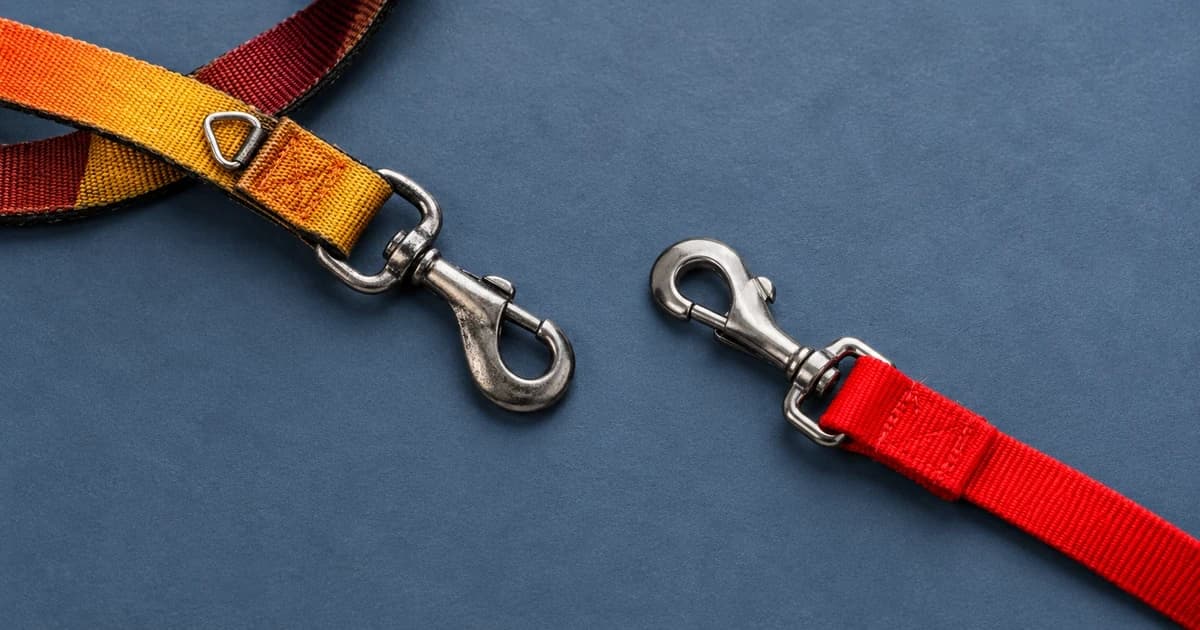
To connect and adjust a leash coupler for two dogs, first identify the actual connector, its main-leash attachment and the separate ends intended for each dog. Check which sections your model permits you to adjust. Then assess whether the person walking can manage these two dogs together; a splitter does not establish that the pairing or equipment is suitable.
A useful setup record separates the connection arrangement, each arm's setting and what you actually observe. Keep unanswered clip, attachment or adjustment questions for the maker before trying the arrangement.
Identify the complete arrangement before connecting it
Record the coupler model and size, the host leash and each dog's existing collar or harness. Confirm the intended attachment on each item using its own instructions. A double-ended leash connected twice to one harness is a different arrangement from a connector serving two dogs.
For readers checking how to use a double dog lead, EzyDog's official FAQ describes a main leash connected to the splitter attachment and individual ends going to each dog's collar or harness. It then calls for adjustment as needed.
Another answer on that page uses the wording “primary leash handle” for the initial connection. That wording needs clarification against the actual model's connection diagram. Do not treat it as an instruction to clip a splitter onto an arbitrary handle loop.
Do not assume a coupler is compatible with a retractable leash.
Distinguish an adjustable arm from a fixed one
Check the model's size and adjustment information before moving a slide. Record each side separately instead of assuming two branches have identical settings. A published adjustment range is not an elastic stretch allowance or a pulling-load rating.
The RC Pets Primary Adjustable Coupler page describes adjustable slides and gives different ranges by size: Small is listed at 10.2–15.5 inches, with 3/4-inch width; Large at 14.5–22.5 inches, with 1-inch width. Match the actual size rather than applying one range to every coupler. Those figures do not establish an individual pair's fit or handling result.
The EzyDog Soft Touch Couplers page instead lists an adjustable setting of 14–24 inches and a fixed side of 24 inches. Keep that distinction even though the general FAQ discusses adjusting the leads.
For your own model, follow its adjustment method and check the resulting arrangement against the maker's instructions. If the two dogs' positions require settings the product does not permit, leave that mismatch unresolved rather than forcing both sides to look equal.
Check the dogs and the handler separately
Dogs Trust's professional dog-walker guidance says dogs walking together should have met beforehand. It also emphasizes individual needs, discussing equipment with the owner and avoiding more dogs than the walker can manage. This UK professional guidance is a preparation boundary, not approval of a particular coupler or pair.
Consider what each dog does on ordinary walks and whether the handler can attend to both at once. A connector does not teach loose walking or resolve difficulty around another dog. The loose-leash walking guide covers that separate training task.
If either dog's equipment, response to the other dog or the handler's ability remains uncertain, resolve that first. A separate walking arrangement or individual help may be the appropriate next step.
Observe a manageable first check without forcing a result
Once the actual connection and adjustment instructions are established, follow them in a supervised setting the handler can manage. Observe each dog as well as the connecting equipment: can both move without one repeatedly drawing the other across its path? Can the handler attend to them without the arrangement becoming a struggle?
Pause if a connection does not behave as its instructions describe, a dog becomes uncomfortable or the handler cannot manage the pair. Do not pull harder, improvise an extra attachment or continue simply to demonstrate success. An apparently tidy connection does not verify strength, reliable locking or a tangle-free result.
- Exact coupler, host leash and each dog's attachment equipment.
- Which arm adjusts, which remains fixed and the permitted settings used.
- Each dog's observed response and what the handler could manage.
- The reason for continuing, pausing or choosing a different arrangement.
Keep care instructions with the same model record. The long-line care guide explains why strap and hardware permissions need separate attention; it does not authorize washing an unidentified coupler.
When browsing leash couplers, look for the information needed to resolve this whole arrangement. A product name or category cannot promise compatibility, easier handling or successful paired walking.