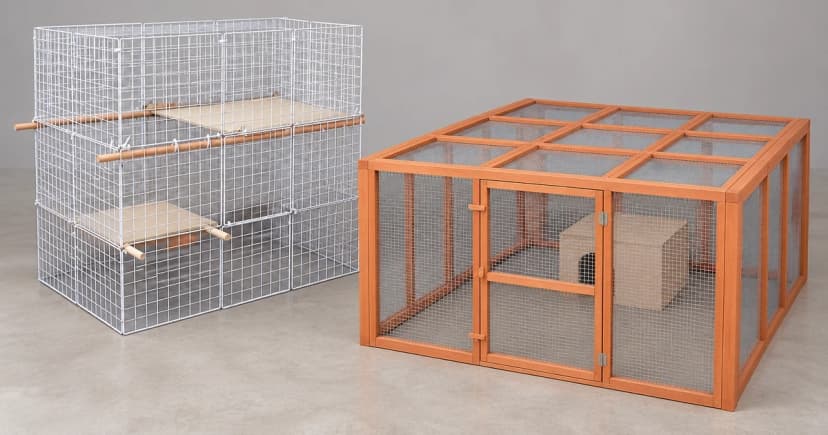
To set up a rat cage, plan the shared space before adding individual accessories. Work through the group, enclosure, resting places and resources before your rats arrive.
Start with the group and enclosure
Woodgreen recommends groups of at least three rats. Its rat care guide gives a minimum of 80 cm high, 50 cm deep and 80 cm wide for up to four, with 1 cm bar spacing.
Those figures describe that guide's recommendation for that group size; they do not establish that every cage with those outer dimensions has a suitable interior. Check the usable arrangement, the rats who will occupy it and the enclosure's own assembly instructions together.
Choose the position and check the structure
The RSPCA housing guide calls for a solid floor, secure gaps and no harmful projections. Choose a ventilated position away from draughts, direct sun, strong artificial smells and disruptive noise.
Build the actual cage as instructed before filling it. Close each access panel and resolve an unclear latch or platform fitting with the supplier before move-in. General welfare guidance cannot identify missing hardware or approve a repair.
Arrange climbing and resting choices
Include different heights, climbing opportunities and horizontal space without filling every available area. Provide several dark shelters with multiple exits; rats need opportunities to rest separately or together.
The RSPCA's new-owner guide describes shelves and climbing ropes, and at least one shelter large enough for the whole group. Extra exits let a rat leave without being blocked by a cage-mate.
Lay out the resources before fastening accessories in place. Trace a route from the resting area to water and food: a hammock occupying the only opening is a layout problem to resolve, rather than another item to add.
Give each bedding material a purpose
Woodgreen separates base substrate, nesting bedding and litter-tray material. Its examples include shredded card for the base, soft white tissue in hides and non-fragranced paper pellets in litter trays.
Avoid dusty sawdust and cotton-wool-style nesting material that separates into fine strands.
A package marked bedding does not identify which role it will fill. Check the material itself against the rat-specific guidance; a substrate chosen for another rodent is not automatically an appropriate substitute. Keep the three uses clear while assembling your shopping list.
Fit water and prepare the handover
Woodgreen recommends two fresh-water sources, using bottles or securely mounted bowls, at different ends or levels in case one fails.
Follow the actual fitting instructions and keep both sources reachable. For bottle equipment, use our flow and leak checks before relying on the installation.
Prepare the bedding, nesting material and furniture before collection. Arrange suitable familiar, dry used bedding with the adoption centre, and have the rats' existing food ready. The RSPCA advises contacting the vet or adoption centre when settling-in concerns arise.
Finish with a practical handover: identify what is ready, what still needs a fitting answer and who will provide that answer. Keep unresolved equipment out of use. This prepares accommodation for an established compatible group; introducing unfamiliar rats is a separate task.