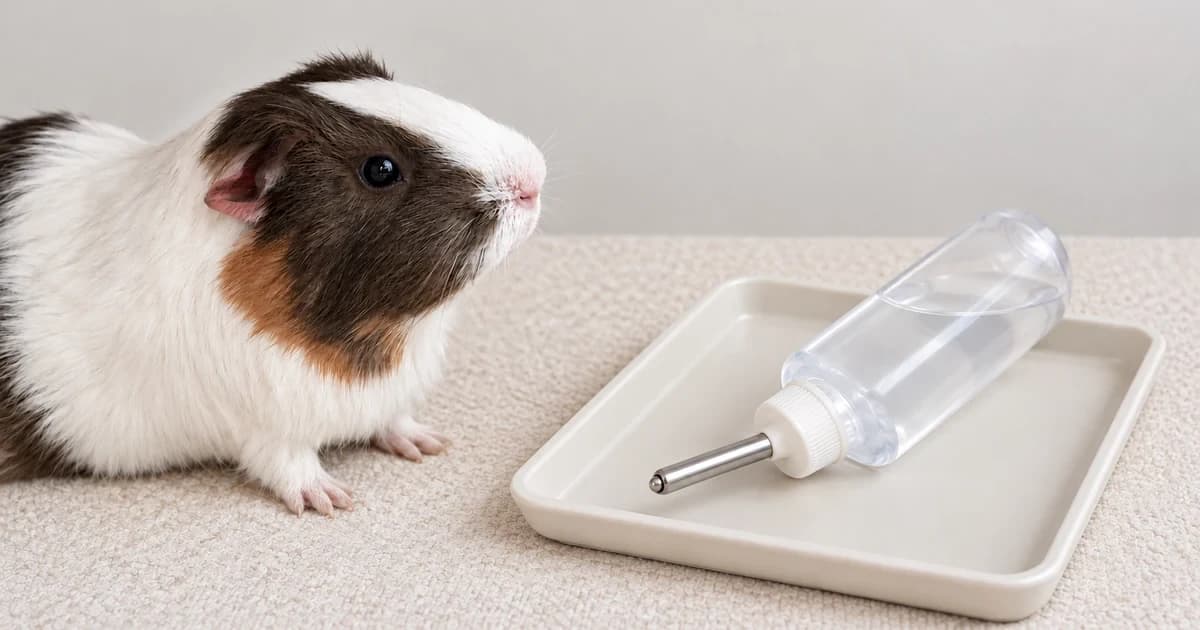
A small-pet water bottle can contain water without dispensing it, and a bottle sold as “no-drip” can still release residual drops after use. Check the exact bottle's filling, cap and nozzle instructions before trying to correct either problem. A vacuum bottle and a bottle with a separate plunger-and-seal valve do not necessarily need the same treatment.
Start with equipment identification, then check flow and leakage separately. Keep an appropriate, known-working water arrangement available while you inspect a suspect bottle; do not wait for the animal to become thirsty to make it use unfamiliar equipment. This guide concerns bottle operation, not water quantities, medical care or a guarantee that every pet can operate every nozzle.
Identify the bottle before changing the cap setting
Find the model name and its instructions. Note where water enters, whether the drinking tube is part of a removable cap or base, and what the maker says controls the flow. A visible steel ball is not enough to identify the internal system. Nor does a flip-top lid tell you how the seal below it is assembled.
Keep the original bottle, cap, tube and mount together until you have confirmed replacement compatibility. Do not add a washer because another bottle uses one, or remove a ball because an unrelated listing suggests doing so. The Classic Lixit 8 Ounce Bottle, for example, uses a two-piece tube-and-stopper design without separate additional refill washers. That differs from Lixit's plunger-and-seal assembly.
Pawlivy's small-pet water bottles category includes cage-mounted and stand-supported layouts. Match the actual holder and bottle instructions. A mount supplied for one bottle does not establish that a similarly sized bottle will fit it.
Use the filling rule for that particular mechanism
| Named example | What the maker says | Boundary for your bottle |
|---|---|---|
| Lixit Wide Mouth 8 Ounce | Its vacuum seal requires filling to the top and a tight cap; some initial dripping after inversion is normal. | This is a named vacuum-bottle instruction, not a rule to tighten every valve bottle harder. |
| Lixit Top-Fill No-Drip manual | A plunger and seal dispense water when the steel ball is depressed. The cap should be secure without excessive tightening. | The manual warns that overtightening can make its rubber seal gap. Its parts and assembly order are specific. |
| Savic Source drinking bottle | A flip-top cap permits refilling without taking the bottle off the cage; the maker describes a stainless-steel valve. |
The Wide Mouth product instructions specifically explain the vacuum method. Follow that filling and cap instruction for the identified bottle, rather than borrowing a maximum-tightness recommendation for a different mechanism.
For the assembly described in the Lixit Top-Fill No-Drip manual, more cap force is not the answer to every leak. The maker says to tighten enough to stop leakage around the cap without overtightening. It separately explains why excessive tightening can open the rubber seal's slit. published document is provided as a PDF; its diagrams are not instructions for every top-fill bottle.
Check the drinking outlet after filling
Use the flow test in the bottle's own instructions before relying on reservoir level. The Lixit Top-Fill No-Drip manual tells the owner to depress the steel ball several times and check that water dispenses freely. Perform that check on the identified assembly, then observe what happens when the ball is released.
Record the result as an observation: water came out during the permitted check, no water came out, or the outcome was unclear. An air bubble in a reservoir, an advertised capacity or water remaining above the cap should not substitute for observing the outlet. Do not push a wire into the tube or modify an unidentified valve to produce a result.
If water does not dispense, return to the exact assembly and filling instructions. Check whether you have the right components and whether a stated preparation step was missed.
Separate residual drops from continued leaking
Lixit's No-Drip manual explains that water can remain in the tube after the ball is depressed, producing some residual dripping. Its Wide Mouth page also allows initial dripping while the vacuum arrangement settles after inversion. Neither statement establishes that a continuously emptying bottle is operating correctly.
Observe where the water is appearing: at the drinking tip, around the cap or somewhere else on the bottle. Note whether it followed your flow check or continues without another activation. There is no universal drop count or settling time in the sources used here, so do not invent one as a pass threshold.
Persistent leakage from the named Lixit plunger system has a specific troubleshooting path. Its manual describes sediment or small particles lodging in the rubber seal, directs rinsing and reassembly, and provides a seal inspection diagram. Use that procedure only when you have positively identified the same assembly. The drawing's gasket, seal, plunger and ball order is not a generic list of parts for every sipper.
Inspect and clean within the maker's permissions
Record visible damage, missing original components or an uncertain seal position before asking for help. Do not treat a new gasket from another bottle, extra packing material or a mixed cap-and-tube assembly as an approved repair. If the equipment is damaged or cannot produce the required flow, keep it out of service while you resolve the problem.
Cleaning permissions also differ. The Savic Source page specifies hand washing with its bottle brush and excludes the dishwasher. That is a named product instruction; it does not establish detergent, heat or immersion permissions for unrelated caps and holders.
Recheck the actual installed arrangement
After the maker-supported check, reinstall the bottle using its matching holder and diagram. Keep a stand-supported bottle's setup distinct from a cage bracket. Observe the installed nozzle position and the animal's ordinary access without forcing its head toward the tube or treating an owner-operated flow check as proof that the animal can use it.
A short record keeps the next check focused. It documents equipment observations rather than certifying a leak-free product.
| Record | Your note |
|---|---|
| Exact bottle and instruction source | Model: ____ Instructions: ____ |
| Mechanism and filling rule confirmed | Vacuum / identified valve / unresolved: ____ |
| Maker-supported flow check | Check used: ____ Outlet observation: ____ |
| Leak location and sequence | Tip / cap / other: ____ After activation / continuing: ____ |
| Mount and next action | Matching mount: ____ Recheck / maker help / keep out of service: ____ |
A label, a full reservoir and a staged image cannot establish ongoing operation. Keep the bottle's model-specific instructions alongside your observations. Our editorial policy explains the source-based approach used in this guide.