To learn how to measure a horse for a fly mask accurately, select the exact brand and mask style first, follow that model's specific tape routes and units, compare your numbers against its published size chart, and then inspect the physical mask on your horse after delivery. A size label alone cannot verify clearance over the eyes and eyelashes, room inside ear covers, or where the bottom edge sits on the nose.
Record the raw tape measurements, the chart row selected, and the delivered fit observations as separate entries. Keeping those steps distinct makes any chart overlap easy to verify before your horse wears the mask in the field.
Identify the mask style before measuring
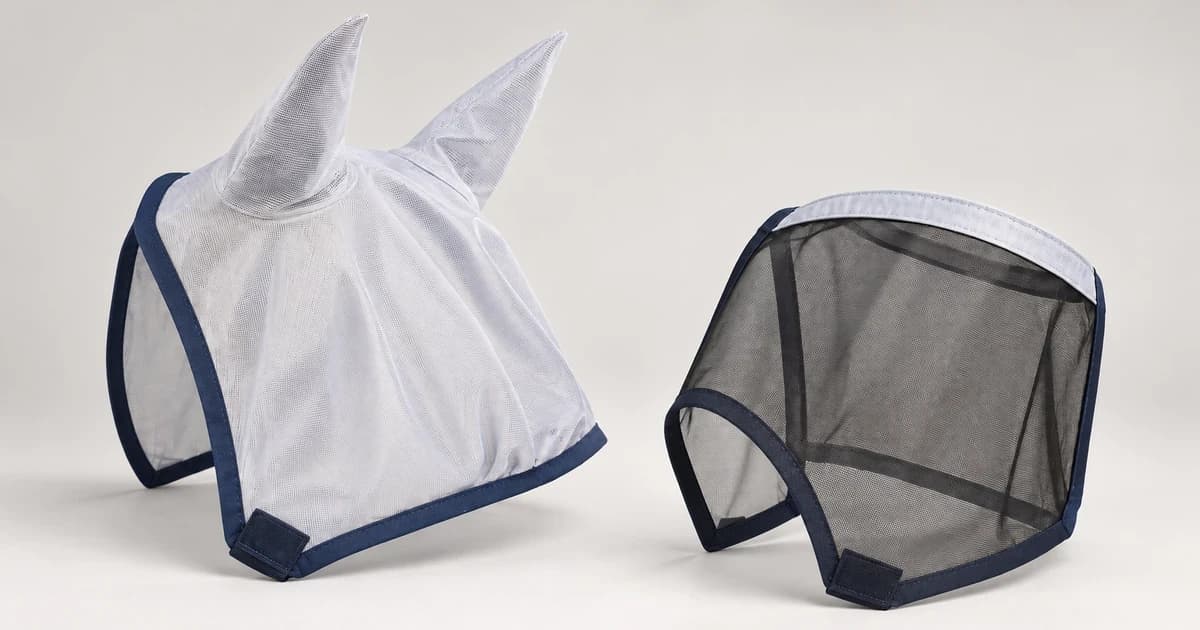
Write down the exact product name and coverage layout: standard eye mesh, covered or open ears, and whether a nose extension is attached. Distinguish a fitted mesh fly mask from a browband fly fringe, then open the current sizing guide for that exact model to see which measurements apply.
Use a soft measuring tape and note the starting landmark, tape path, endpoint, and unit before measuring. When a landmark on a diagram looks ambiguous, confirm it with an experienced equine professional or the brand's published sizing team rather than guessing a convenient spot.
Keep the brand's measurement routes together
Kensington's fly-mask measuring guide defines five lettered measurements in inches:
| Label | Route described by this guide |
|---|---|
| A: poll to nose | From the top center of the poll between the ears, straight down the center of the face to where the mask edge should end. |
| B: head circumference | Around the head, starting near the poll and passing underneath the jaw. |
| C: nose circumference | Around the nose at the level where the lower edge of the mask will sit. |
| D: ear length | From the base of the ear to its tip, used when selecting a style with ear covers. |
| E: nose length | From just below the eye area down to the intended nose-cover endpoint. |
Compare your numbers against the chart on the specific Kensington product listing. Kensington's guide explains the five tape paths and specifies fit checks once on the horse: mesh standing clear of the eyes so the horse blinks normally, comfortable room inside ear covers, and edges ending at the intended landmarks.
Never carry Kensington's A–E letter labels over to another brand's chart. Save the guide title and date alongside your numbers so anyone reading your barn notes knows which route each number represents.
Resolve overlapping sizes and conflicting directions
Cashel's Crusader sizing guide uses a completely different single route: starting at the back of the neck, running down to the mid-jaw point, and continuing across to the matching point on the opposite side. Follow Cashel's diagram for Crusader masks rather than substituting a nose or throatlatch circumference.
In that Cashel guide, the table lists Medium at 38–40 inches, Large at 40–42 inches, and X-Large at 42 inches. A hypothetical 42-inch measurement therefore touches both Large and X-Large rather than pointing to a single unique row. Furthermore, the article's written text advises sizing up when between sizes, whereas the embedded sizing graphic on the same page advises sizing down.
Cashel also notes checking for two fingers of space along the outer edges and verifying that the structured eye darts hold the mesh off the eyes. Hook-and-loop straps allow minor adjustment but cannot make an incompatible crown or eye-dart shape fit every horse.
When a measurement lands on an overlapping number like 42 inches or encounters conflicting up-versus-down prose and graphics, leave the chart row marked as pending clarification rather than guessing. Share the exact model name, tape route, measured inches, and the overlapping chart lines with Cashel's sizing team, and log the dated reply in your fit record before ordering or fitting.
Check the delivered mask beyond its size label
Equilibrium's Field Relief guide uses the horse's bridle size as an initial reference for its range. Once on the head, it calls for a snug two-finger check along the outer face edges to prevent gaps at the poll or nose, paired with a separate check that the dome mesh stands well clear of the eyes and eyelashes. Field Relief Midi styles adjust over the poll and beneath the cheeks.
Keep those two checks separate: the two-finger rule applies to the perimeter edge against the face, not to eye-mesh dome clearance. Never pull cheek or throat straps tighter to compensate for mesh collapsing toward the eyelashes.
Fasten the delivered mask according to its manual and inspect the eye domes, ear pockets, perimeter edges, and closures while the horse lowers its head and chews. If any panel pulls, gaps, shifts, or touches the eyelashes, remove the mask and leave the fit status unresolved until you swap to a suitable cut or size.
Save a useful fit record
Use the structured record below to keep your tape measurements, chart status, and on-horse observations together in one place:
| Record field | What to write down | Example / boundary note |
|---|---|---|
| Exact mask model & coverage style | Brand name, model line, ear coverage (with ears vs. earless), and nose coverage (standard vs. long nose). | Do not mix sizing notes between a standard eye mask and a full-nose style. |
| Guide version, route & units | Date or URL of the brand guide used, exact landmarks (such as Kensington A–E or Cashel neck-to-mid-jaw route), and unit (inches/cm). | A number without its route label cannot be reused on another brand's chart. |
| Raw measured values & chart row | Each measured figure and the matching chart row—or mark Pending if the number hits an overlap. | Hypothetical 42-inch Cashel result: touches both Large (40–42 in) and X-Large (42 in) while prose and graphic conflict on sizing up vs. down; record as Unresolved until verified. |
| Clarification date & reply | Date you submitted the model, route, and overlapping figure for verification, plus the exact size recommendation received. | Replaces guesswork when a published chart overlaps or contradicts itself. |
| Delivered fit check (eyes, ears & edges) | 1) Eye mesh and darts clear of cornea and eyelashes during blinking; 2) Ear tips unpinched; 3) Two-finger perimeter edge check at face/jaw; 4) Fastener security. | If mesh touches eyelashes or edges gap, stop use rather than over-tightening straps. |
When browsing Pawlivy's horse care and tack section, check each individual listing's current sizing chart and coverage notes. That category page groups equine supplies and does not confirm stock or fit for a specific fly mask.