

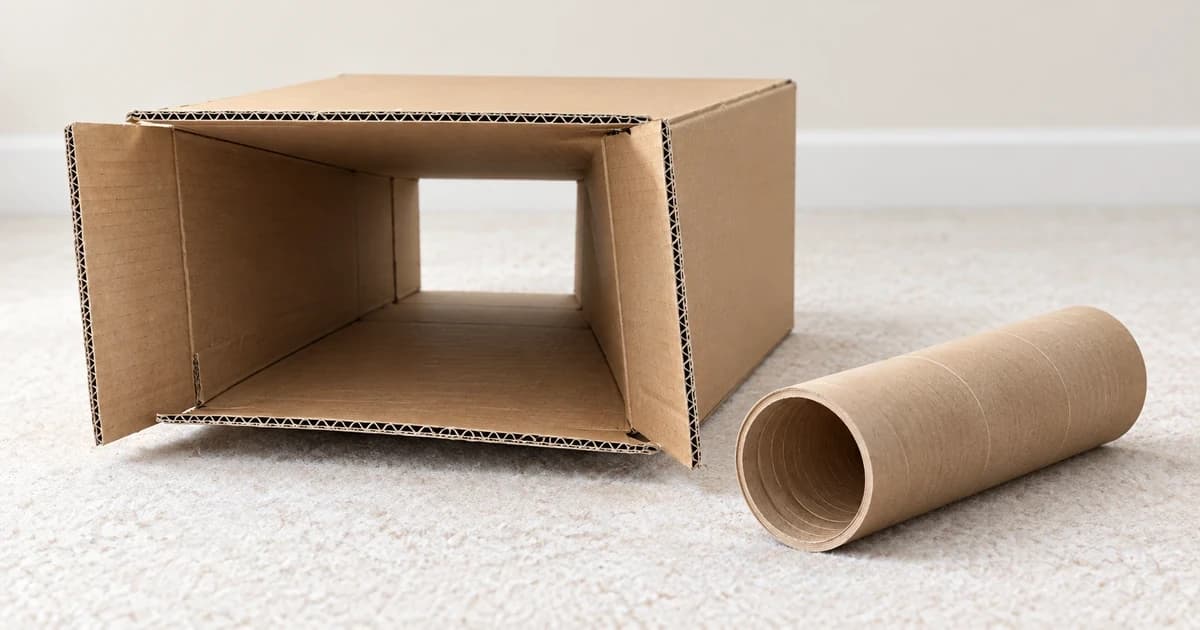
When owners ask what toys do rabbits like, the most reliable answer is to offer choices built around four natural rabbit behaviors: foraging for hay and daily greens, chewing safe untreated materials, darting through dual-exit tunnels, and digging in ground-level trays (RSPCA; PDSA; Blue Cross). Because individual rabbits have distinct personalities—one rabbit may love shredding cardboard while its companion prefers digging or tossing willow sticks—introduce one or two rabbit enrichment toys at ground level with plenty of room to approach or walk away.
Compare rabbit toy ideas: activity, first setup, safety checks, and adjustments
Use this five-column planner to pick an enrichment activity, set it up for the first time, and adjust based on what your rabbit actually does:
| Behavior opportunity | Item to offer | First-time placement setup | Material & exit checks | Next adjustment based on response |
|---|---|---|---|---|
| Foraging & searching | Plain cardboard tubes stuffed with hay, or a shallow floor tray scattered with their normal daily ration/herbs (PDSA). | Place at ground level near their usual hay station with hay ends poking out visibly so the scent and texture are obvious. | Use only plain unbleached/lightly printed cardboard with zero tape or staples; keep food within their normal daily allowance. | If finished quickly, fold tube ends loosely or hide hay across two or three tubes; if ignored, leave the tube open-ended beside their hay rack. |
| Chewing & tossing | Documented rabbit-safe untreated wood branches (such as apple or willow), plain cardboard, or woven grass mats (PDSA; RSPCA). | Lay two different textures (e.g., an untreated willow stick and a plain cardboard roll) on the floor a few feet apart so the rabbit can choose. | Verify wood is untreated, unpainted, and free of pesticides or varnish; remove any item with glue, metal wires, or splintered sharp points. | Rotate chewed items out before small fragments detach, and note which texture (soft cardboard vs. bark) your rabbit prefers. |
| Hiding & tunneling | A low sturdy cardboard box with at least two cutout doorways, or a wide rabbit-sized tunnel (RSPCA; Blue Cross). | Set flat on a non-slip floor along a wall or between two familiar zones, leaving clear open floor around both doorways. | Confirm both entrance and exit holes are wide enough for your adult rabbit to pass through without squeezing or catching its hips. | If your rabbit naps inside, leave it undisturbed as a safe retreat; if two rabbits share the space, add a second dual-exit box so neither blocks the other. |
| Digging & rooting | A wide, low-sided litter tray or cardboard box filled with shredded plain paper, hay, or documented rabbit-safe soil (RSPCA). | Start with dry shredded plain paper and hay in a stable low tray during supervised floor time. | Never assume garden soil or cat litter is safe; inspect daily and discard damp or soiled paper immediately. | Tuck a few sprigs of their normal dried forage into the paper layer to combine digging with scent work. |
Worked setup example: two-exit cardboard hideout plus hay-tube foraging trail
You can build a complete, low-cost enrichment circuit in ten minutes using items supported by PDSA and the RSPCA:
- Prepare a two-door cardboard box: Take a clean, plain corrugated box, peel off all packing tape, labels, and glue strips, and pry out any metal staples. Cut two wide ground-level doorways on opposite or adjacent walls so your rabbit has a clear sightline and a through-route without backing up.
- Stuff two plain cardboard tubes with hay: Pack clean, dust-extracted feeding hay loosely into two wide cardboard rolls, tucking a few leaves of your rabbit's regular daily greens or herbs in the center.
- Place at ground level with retreat room: Set the box on a non-slip mat with at least two feet of open space around each doorway. Lay one hay tube just outside the exit door and the second tube a short hop away—never hang toys from strings or force your rabbit to climb unstable boxes to reach food.
- Observe without crowding: Let your rabbit sniff, chin-mark, nibble the doorway, or hop straight through at its own pace. If the rabbit retreats into the box to rest, treat the box as a sanctuary and never reach inside to pull the rabbit out.
Essential safety and species checks when shopping for toys
When browsing commercial small-pet tunnels or small-pet chew toys, never rely on a broad “small animal” category tag:
- Separate rabbit gear from rodent gear: As Blue Cross's species breakdown shows, exercise wheels and narrow 5–8 cm plastic tubes are for small rodents—they are dangerous for a rabbit's spine and body width. Always check exact opening diameters against your adult rabbit's measurements.
- Verify untreated wood and dye-free construction: Both the RSPCA and PDSA warn against treated, painted, varnished, or chemically processed wood. If a chew toy does not specify its wood species and untreated status, leave it off your list.
- Inspect daily for sharp edges and dampness: The RSPCA advises checking toys regularly and removing anything with sharp splinters, loose threads, or urine-soaked cardboard.
Remember: toys never replace living space or companionship
Even the best rotation of foraging tubes and cardboard castles cannot compensate for a cramped hutch. Rabbits need permanent room to hop, binky, stretch out fully, and interact with a compatible companion—see our guide on rabbit enclosure space to check minimum housing and exercise-run dimensions, and read our editorial policy for how we attribute welfare guidance.