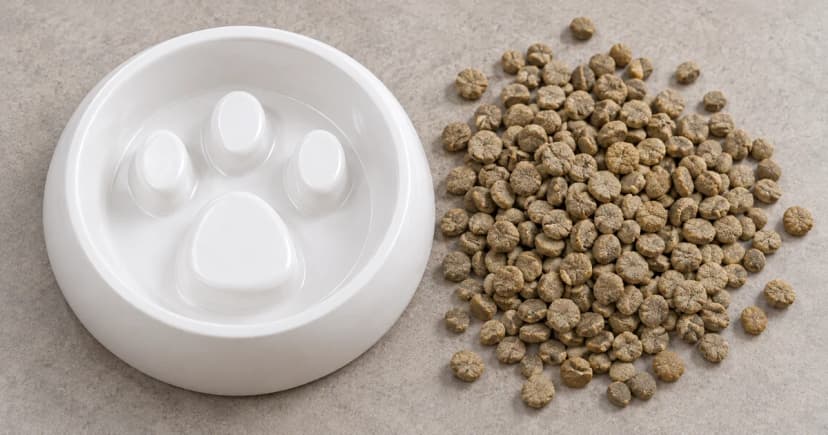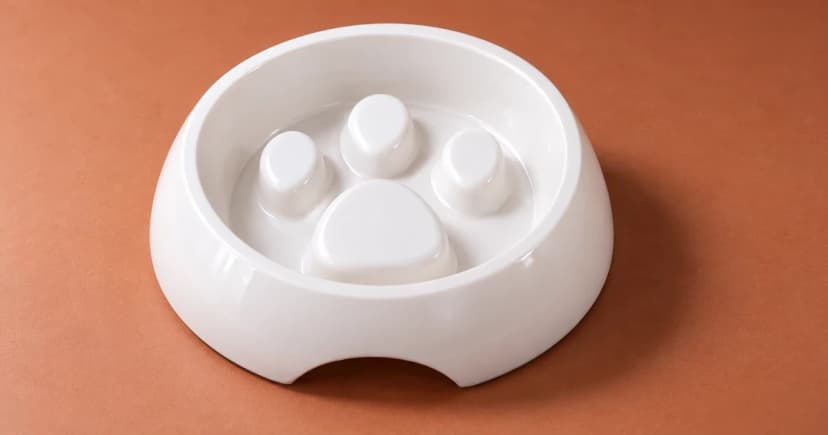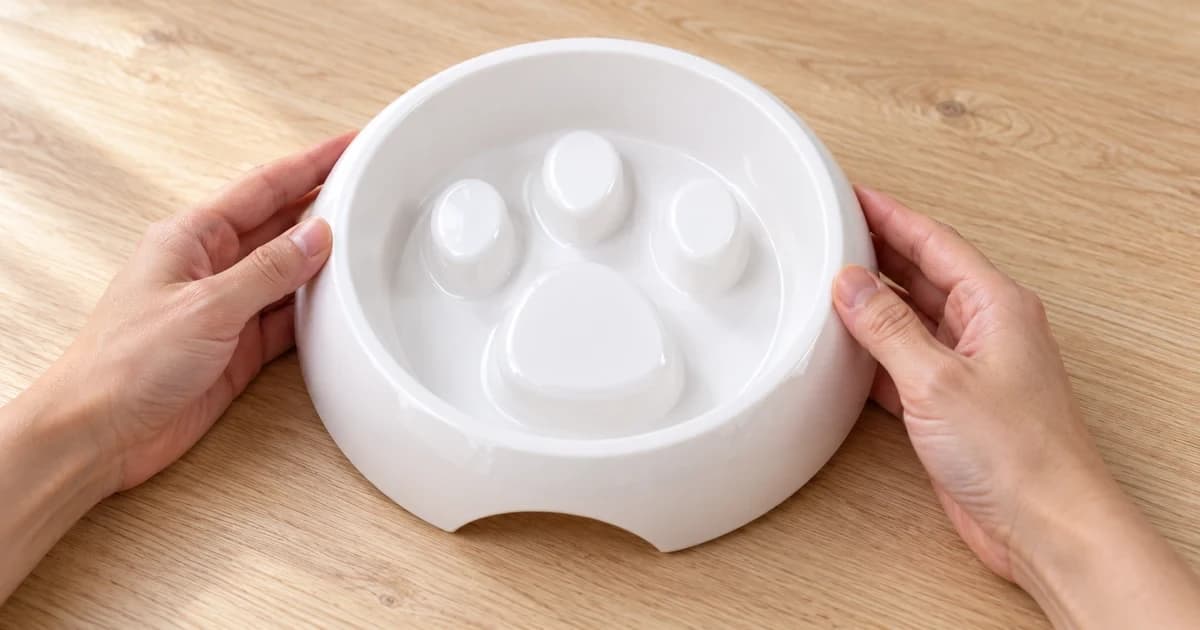
A slow feeder dog bowl uses raised shapes, grooves or compartments to change how a dog reaches food. An insert can add barriers to an existing bowl, while a textured bowl offers a different surface to work around. Choose the structure by checking your usual meal’s fit, your dog’s comfortable access and the maker’s care instructions. The bowl’s advertised capacity does not tell you how much to feed.
This is an equipment guide, based on published product instructions. The practical question is whether a particular construction can be set up and cleaned appropriately for your dog.
Start with the construction, rather than a benefit slogan
Look inside the vessel and identify which parts create the barriers. An integrated molded bowl, a removable attachment and a flexible textured bowl have different fitting and cleaning questions. A label such as “slowest” describes the maker’s product range; it is not a universal difficulty scale or a suitable target for every dog.
| Construction | Named source example | Check before using it |
|---|---|---|
| Barriers molded into a bowl | Outward Hound’s medium Fun Feeder Notch is described as shallow, with a simple pattern and a 2-cup dry-or-wet-food capacity | Whether the actual portion fits among the shapes and whether your dog can reach the food without an awkward approach |
| Attachment in an existing bowl | Loving Pets’ Gobblestopper blocks sections of a flat-bottom bowl | The attachment’s fit chart, the host bowl’s shape and how the two parts are secured |
| Flexible curved, textured bowl | LickiMat Wobble has internal dimples and is described as a reversible natural-rubber bowl | The surface your dog will use, comfortable access and the instructions for handling and washing that particular item |
These examples come from the Fun Feeder Notch product and care page, the Gobblestopper instructions and size choices and the LickiMat Wobble product page. They explain construction differences, rather than establish that an unidentified bowl shares those features or that these models are in Pawlivy’s catalog.
Check capacity and access as separate questions
Begin with the amount you already intend to serve, using your existing feeding guidance. Compare that amount with the exact model’s stated capacity. If a product page lists several sizes, make sure the capacity belongs to the variant you are considering. Do not substitute the outside diameter or a breed-size label for a volume specification.
Then inspect the usable area between the barriers. A portion piled above them is a different arrangement from food distributed in the channels. Before your dog uses the bowl, check whether the usual amount fits without covering the features you chose it for. This is a practical setup observation, not a laboratory capacity measurement.
Comfortable access is a second decision. Look at the depth and spacing of the raised shapes and watch how your dog approaches them during a supervised first use. A maker’s larger capacity or more elaborate pattern does not demonstrate that it is easier for your dog to reach. If the dog repeatedly cannot reach the food or handles the bowl as something to chew, stop and reconsider the construction.
Keep the food format in view too. A product that expressly permits dry and wet food is a documented example, rather than permission for every bowl, insert or attached accessory. This guide does not recommend ingredients, recipes or a change to your dog’s diet.
For an insert, check the host bowl as well
An attachment creates a two-part setup. Record both the attachment model and the bowl you want to use with it. Look for the required bottom shape, size range and securing method; do not assume that a bowl with the correct outside width also has the required usable interior.
For example, Loving Pets specifies a flat-bottom bowl and offers small for bowls under 6 inches, medium for 6–8 inches and large for over 8 inches. Those are that attachment’s published size choices.
Assemble the parts using their instructions and inspect the result before adding the meal. Check that the attachment sits where intended and that the host bowl rests properly on the chosen surface. Observe the connection during use as well; a size chart by itself does not prove that an attachment will remain secure in every bowl.
Make the first use an observation, not a speed contest
Read the instructions before loading the equipment. Place it where you can watch your dog approach and use it without having to reach over the bowl continually. LickiMat’s Wobble page specifically calls for supervision during introduction until the owner is confident the dog will not chew it; Outward Hound states that its feeder is not a chew toy.
Watch access, movement of the equipment and the dog’s handling of it. Useful notes include “food remained behind a barrier the dog could not reach” or “the insert moved from its intended position.” Those observations are more actionable than assuming a longer meal automatically means the arrangement is better.
You do not need to reproduce a maker’s advertised slowing multiplier. If the setup is unsuitable, change the equipment or return to a method your dog can use comfortably. Persistent difficulty eating belongs with a veterinarian who knows the dog, rather than a stronger claim about a bowl.
Use the exact care instructions and inspect the barriers
Heat permissions can differ even among feeding products. The named Outward Hound Notch page allows a dishwasher’s top rack on a low-heat setting and says not to microwave it. LickiMat’s named Wobble page lists different permissions and says to invert it for dishwasher washing. Neither instruction establishes what an unidentified plastic, silicone or rubber item tolerates.
For a retrofit attachment, treat the insert and the host bowl as separate items. Loving Pets’ top-rack dishwasher permission for the Gobblestopper does not establish a cycle for the vessel around it.
Check the internal shapes, rim and any connection points before reuse. Outward Hound directs owners to remove and replace its damaged feeder. Do not cover a broken edge with food or leave a loose part in service. Our dog toy cleaning guide uses the same principle of identifying the assembly before choosing a care method; a feeder should still follow its own instructions.
Keep a short equipment record
Save the model and variant, stated capacity, intended meal amount, host bowl if applicable, care method and anything observed during the first use. Separate the maker’s specifications from your observations. “Listed as 2 cups” and “the portion fit today” answer different questions.
When browsing slow feeder bowls or the wider feeding equipment collection, look for clear construction, sizing and care information. A listing name does not verify a health effect, material certification or current availability. Our editorial policy explains this source-based approach. Choose an arrangement you can understand, observe and maintain, with its limits kept alongside its features.