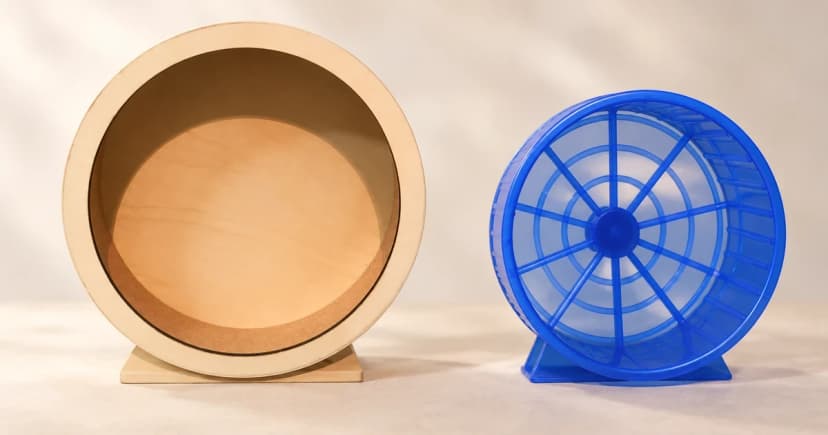
Working out what size wheel does a hamster need requires pairing species-specific diameter ranges with a live check of your hamster's back posture while running. A generic “small pet” or “dwarf” box label, the total height of the wheel stand, or a promotional photo of a hamster sitting motionless inside a drum does not prove fit. Start with the species diameter reference, verify whether a product listing states outer rim diameter or inner running diameter, and observe whether your hamster runs with a level, unarched spine.
Blue Cross’s hamster-care guidance publishes distinct wheel-diameter ranges across five hamster species and defines a well-fitted wheel as one large enough for the hamster to run with a straight back without tipping its head upward, yet light enough to turn smoothly.
Start with the species diameter table, not one “dwarf” label
Use these Blue Cross species ranges as your baseline filter before looking at individual product listings (note that Blue Cross's page carries a March 30, 2023 review date and a March 30, 2026 scheduled review date):
| Hamster species (Blue Cross) | Recommended wheel diameter (cm) | Approximate inch equivalent | Key species sizing note |
|---|---|---|---|
| Syrian hamster | 27–32 cm | Approx. 10.6–12.6 in | Requires the largest upright drum; standard “medium” pet-store wheels are too small. |
| Chinese dwarf hamster | 25–27 cm | Approx. 9.8–10.6 in | Longer body and tail require a larger diameter than other dwarf species. |
| Campbell’s dwarf hamster | 22–25 cm | Approx. 8.7–9.8 in | Verify individual adult body length and straight-back posture in motion. |
| Winter white dwarf hamster | 22–25 cm | Approx. 8.7–9.8 in | Same starting range as Campbell's; do not downsize to a 15–17 cm mini wheel. |
| Roborovski dwarf hamster | 20–22 cm | Approx. 7.9–8.7 in | Smallest species range, yet still needs at least 20 cm (8 in) and easy rotation. |
Never apply the smallest Roborovski range (20–22 cm) to every hamster sold under a generic “dwarf hamster” sign—a Chinese dwarf hamster needs 25–27 cm in this same guide.
Separate five different wheel measurements on product pages
Before comparing options in Pawlivy’s small-pet exercise-wheel category, separate five dimensions that listings frequently blend together:
- Nominal or outer wheel diameter: the overall drum diameter named in the product title. Unless the specification sheet explicitly calls it the inside running track, treat a single diameter number as an outer rim figure.
- Inner running diameter: the actual circular span inside the drum where the hamster's feet land. Thick wooden or cork rims reduce inner diameter relative to outer rim width.
- Total stand height and base clearance: the vertical height from the bottom of the stand to the top of the drum, or the adjustable gap underneath. You need stand height to check whether your cage lid will close, never as a substitute for drum diameter.
- Running track width: the front-to-back depth of the walkway inside the drum, which must give your hamster's shoulders and hips clear room without rubbing the side walls.
- Front-panel entry openings: the cutout holes on enclosed wheels, which affect entry clearance rather than running curvature.
Note that sloped flying-saucer discs use an angled footprint rather than an upright drum; their diameter numbers are not interchangeable with Blue Cross's upright wheel table.
How manufacturer specification pages differ in practice
These two published product pages illustrate why you must read every dimension line individually rather than relying on S/M/L size letters:
| Manufacturer listing | Published dimensions on the page | Specification gap or mismatch to note |
|---|---|---|
| Niteangel Super-Silent Hamster Exercise Wheel | Menu selector lists S (8 in), M (10 in), L (11 in), and XL (12.6 in), while body text lists the Small at 8.2 in and notes a 1–4 in adjustable stand height. | The 8 in vs. 8.2 in Small labels differ on the same page, the 1–4 in figure is stand clearance rather than drum size, and inner track diameter is not listed separately for every size. |
| Exotic Nutrition Silent Runner 12 in (Wide) | Separately states a 12 in wheel diameter, 4 in wide running track, 4 in diameter front openings, and 13 in total height on the stand. | Manufacturer copy names hedgehogs, rats, and similar pets; a catalog variant listing 13.5 in stand height reflects stand-height variation while the 12 in drum diameter stays the same. |
Check track construction and voluntary running posture
Both Blue Cross and the RSPCA hamster-behaviour guide call for an upright wheel with a solid, continuous running surface and no open wire spokes, mesh rungs, or scissor-hazard crossbars. Once the wheel is mounted securely in the cage, wait for your hamster to wake up and use it voluntarily, then run through this four-point posture checklist from a side view:
- Spine alignment: While trotting and running at normal speed, is the hamster's back straight and level rather than curving upward in a U-shape?
- Head carriage: Can the hamster run looking forward naturally without tilting its chin upward to clear the curve of the drum?
- Rotation effort: Does the drum spin smoothly when the hamster starts and stops without flinging the animal or requiring straining?
- Track & axle clearance: Do all four feet land squarely on the solid walkway without catching on a central spindle or rubbing the front lip?
Fillable wheel-comparison checklist and ongoing care
When comparing two or three candidate wheels, copy these seven fields into your buying notes:
- Hamster species & Blue Cross target range: (e.g., Syrian / 27–32 cm)
- Exact wheel model & size variant:
- Stated outer diameter vs. verified inner running diameter:
- Running track width & construction (solid, axle-free, non-slip):
- Total height on stand vs. available cage height above substrate:
- Observed voluntary running posture (straight back / level head / smooth stop):
- Care rules for the wheel material: Because hamsters frequently pee on their running track while exercising, check how the drum disassembles and follow our guide on how to clean a hamster wheel so bearings and wooden or plastic surfaces are not damaged during washing.
See our Pawlivy editorial policy for how we distinguish welfare recommendations from published product specification sheets.