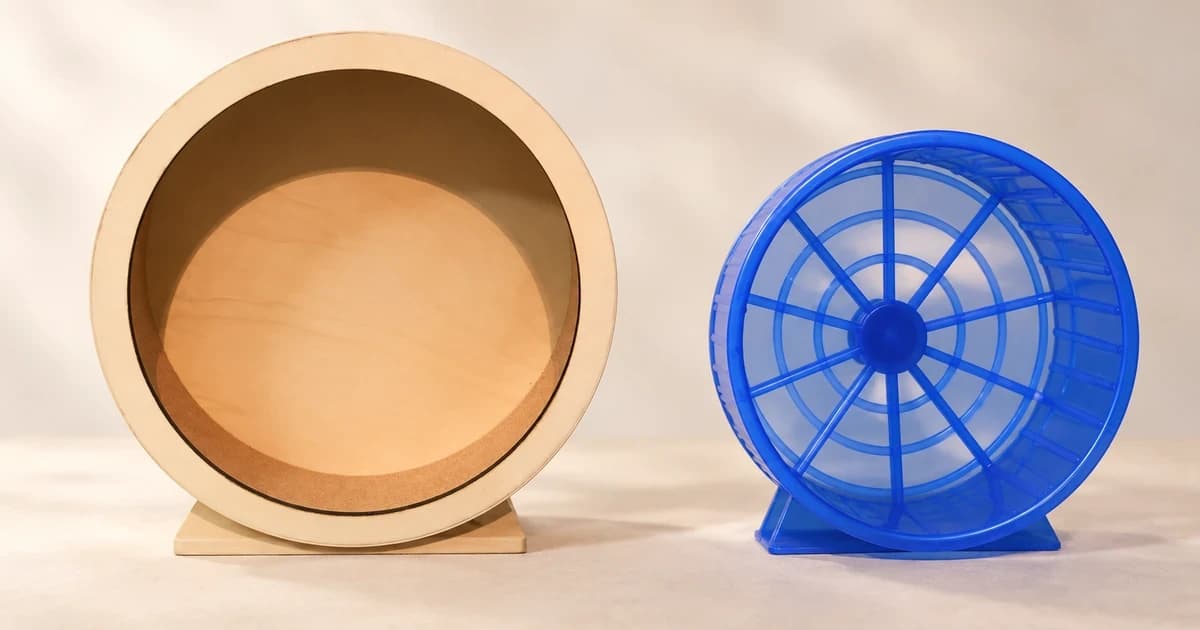
Clean a hamster wheel by identifying the exact model and its removable parts in the product manual, separating the running drum's washing rules from cage-base cleaners and bearing care, and completing full drying before reassembly. Permission to use a cage cleaner on a plastic habitat base does not automatically apply to the exercise wheel attached to it, and a lubrication or bearing instruction for one wheel family is never a universal recipe for all hamster wheels.
Identify the Exact Wheel and Stop If Parts Do Not Match
Check the brand name, model code, and exploded parts diagram before removing any fastener or applying liquid. Note the running drum, any cork or wood lining, the center hub or dual bearings, and the support stand or cage-wall mount. Stop immediately at the identification step if your wheel's material, center cap, or mounting bracket does not match the manual in front of you—never pry off an unidentified hub cap or soak a wooden or cork-lined drum using plastic-wheel rules.
Component Care & Reassembly Matrix: Kaytee Manual PP1001014 (Item 100079213) and Named Wheel Scopes
To prevent mixing cleaning permissions with reassembly steps—or applying cage-base disinfectants to a wheel—use this three-column breakdown keyed directly to Kaytee's CritterTrail Extreme Challenge Habitat manual (item 100079213, PP1001014) and the other cited wheel designs:
| Component & Manual ID | Documented Manual Action (Separated by Phase) | Non-Extrapolation Boundary (Do Not Extend Beyond Scope) |
|---|---|---|
| Kaytee Xtreme Wheel (Part K) — Phase 1: Removal & Cleaning | Pinch the shaft tabs where they emerge at the front and pull wheel K completely off; wash wheel K only with soap and water | Manual explicitly prohibits cage cleaners and disinfectants on wheel K; do not use Base A's cleaner on the wheel |
| Kaytee Habitat Base (Part A) — Separate Base Cleaning Rule | Manual separately permits a named cage cleaner for habitat base A | Applies strictly to base A; never treat base A's cleaner permission as an exception for wheel K or hub L |
| Kaytee Wheel Hub (Part L) & Track — Phase 2: Reassembly & Hub Tip | Snap-lock hub shaft L into wheel K; orient support-arm grooves facing down; lock base into roof with hub positioned; align nylon wheels, rollers, and track; manual notes a small drop of vegetable oil on this hub shaft | This snap-lock sequence and vegetable-oil tip apply only to Kaytee hub shaft L in manual PP1001014—never oil sealed ball bearings or other brands' axles |
| Exotic Nutrition Silent Runner — Dual Bearings (Cleaning & Drying) | Describes two bearings; warns that wear and corrosion can cause seizing; calls for regular cleaning followed by thorough drying | Applies to Silent Runner dual-bearing care; does not supply a universal soaking liquid or authorize submerging a complete wheel |
| Unidentified Wood, Cork, or Lined Wheels | Stop before wetting; verify on the exact product care sheet whether the wood finish, cork lining, or adhesive may contact water | Do not invent a soaking time, disinfectant mix, dishwasher cycle, baking step, or sanding method for unverified natural materials |
Keep Wheel Cleaning Separate from Cage-Base Cleaners and Reassembly
In Kaytee's CritterTrail Extreme Challenge manual (item 100079213, PP1001014), the Xtreme Wheel is labeled K and its center hub is labeled L. For removal and cleaning, the manual directs you to pinch the shaft tabs where they emerge at the front, pull wheel K completely off, and clean that wheel only with soap and water—explicitly prohibiting cage cleaners and disinfectants on the wheel. Even though the same manual permits a named cage cleaner on habitat base A, that permission belongs strictly to base A.
Reassembly is a separate phase: follow the manual's diagrams so hub shaft L snap-locks into wheel K, the support-arm grooves face down, the base locks into the roof with the hub positioned, and the nylon wheels, rollers, and track align. The manual's small-drop vegetable-oil note applies only to this specific hub shaft L, never as a general rule for other hamster wheels.
Check Bearing Drying Rules Before Returning a Wheel
Exotic Nutrition's Silent Runner bearing guidance explains that its wheel uses two bearings, warns that wear and corrosion can cause seizing, and instructs owners to perform regular cleaning followed by thorough drying. Keep that bearing-drying requirement attached to the Silent Runner series without turning it into a blanket rule to immerse any wheel or oil sealed metal bearings.
Routine surface washing is also distinct from bearing replacement. Never pry apart a working bearing housing during a regular wash or apply cooking oil borrowed from another brand's plastic-shaft instructions.
Keep Unidentified Wood, Cork, and Lining Materials Open Until Verified
If your hamster wheel uses untreated wood, sealed plywood, cork track inserts, or glued traction strips, verify the exact water and cleaner limits on that product's care sheet before wetting it. The plastic and metal bearing sources reviewed here do not establish how an unidentified wood finish or cork adhesive reacts to water—never guess a soaking time, disinfectant dilution, dishwasher cycle, or sanding routine.
Return Dry, Properly Aligned Equipment While Your Hamster Is Awake
The RSPCA's hamster environment guidance emphasizes maintaining clean, dry conditions, scheduling cleaning while hamsters are awake, and cleaning or replacing soiled items. Use that timing and dryness standard alongside your wheel's specific care manual.
Before placing the wheel back in the enclosure, confirm that every washed surface and hub recess is dry and that the mounting lock or stand is aligned as shown in the manual. For full enclosure maintenance, see our hamster-cage cleaning guide, and check our wheel sizing guide to compare diameter and running posture.