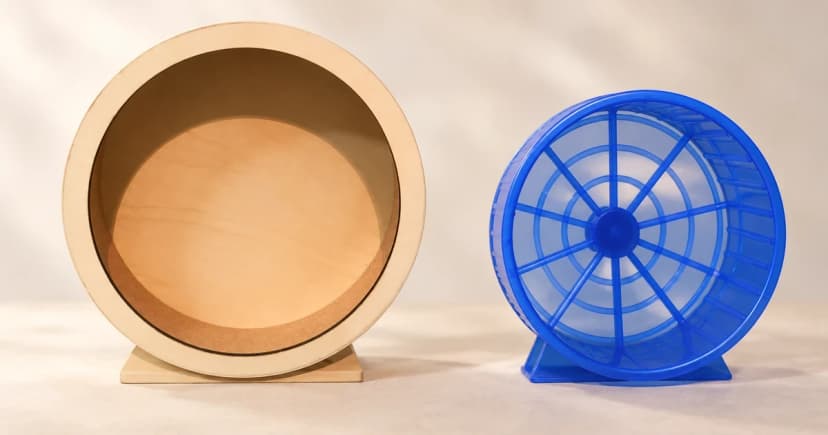
Choose a hamster wheel by combining species guidance with the space your hamster uses while running. A label such as “small pet,” the height of the stand or a photo of a hamster sitting inside a wheel does not answer the size question. Start with the wheel diameter, identify exactly what that number describes, then observe voluntary running rather than placing the animal into a position for a photograph.
Blue Cross’s hamster-care guidance gives separate diameter ranges for five species. It also describes a suitable wheel as large enough for running with a straight back and without raising the head, yet small enough for the hamster to rotate easily. The numerical range and that observation are separate checks.
Start with the species, not one “dwarf hamster” size
The following ranges are attributed to Blue Cross. They are a starting reference for the size task, rather than a universal fitting certificate or a promise about a particular product.
| Species named by Blue Cross | Wheel diameter in its guidance |
|---|---|
| Syrian | 27–32 cm |
| Campbell’s dwarf | 22–25 cm |
| Winter white | 22–25 cm |
| Roborovski | 20–22 cm |
| Chinese dwarf | 25–27 cm |
Do not apply the smallest range to every animal sold as a dwarf hamster. For example, the Chinese dwarf range in this source differs from the Roborovski range. If the animal’s species is uncertain, leave that field unresolved while you obtain reliable identification; guessing the smallest category makes the comparison meaningless.
The page displays a review date of March 30, 2023 and a next-review date of March 30, 2026. That scheduled date has passed; the page does not establish that a new review occurred in 2026. We preserve the guidance’s stated dates rather than presenting it as newly reviewed advice.
Find out which dimension the listing gives
A wheel description can contain several numbers with different purposes. Keep them in separate fields before comparing products in Pawlivy’s small-pet exercise-wheel category.
- Wheel diameter: the diameter named by the manufacturer. Unless the maker specifies the measurement boundary, do not silently call a nominal size the inner running diameter.
- Inner running diameter: a separately identified measurement of the circular space used for running. Use that wording only when it is explicitly supplied or you have clearly recorded your own measurement of an empty wheel.
- Stand height or adjustable clearance: the height of the whole unit or the space below its drum. Neither replaces the diameter.
- Track width: the width of the running surface, which is a different dimension from its diameter.
- Entry openings: holes in an enclosed front panel. Their dimensions do not describe the circular running space.
When measuring an empty wheel yourself, note whether you measured the inside running surface or the outside rim. Record the unit and measurement method; do not turn a rough photograph or an unspecified number into a precise internal diameter.
A flying-saucer listing needs a separate description of its sloped running surface. Its overall footprint and height are not directly interchangeable with an upright wheel’s circular running diameter. Some catalog entries also contain inconsistent metric and inch dimensions, so checking the shape and units comes before selecting a size label.
Keep manufacturer examples separate from a size recommendation
Two current manufacturer pages show why a single prominent number can be misleading. These are examples of reading specifications, not recommendations for every hamster or confirmation of a catalog item’s exact version.
| Named manufacturer example | What the page actually distinguishes | What remains unresolved |
|---|---|---|
| Niteangel Super-Silent wheel | The selector lists S 8-inch, M 10-inch, L 11-inch and XL 12.6-inch. The description lists the small size as 8.2 inches and describes 1–4-inch bottom-height adjustment. | The small-size labels disagree. The adjustment is clearance, not wheel diameter, and the page does not resolve every variant’s inner measurement. |
| Exotic Nutrition Silent Runner 12-inch Wide | The page separates 12-inch wheel diameter, 4-inch track width, 4-inch openings and 13-inch height on the stand. | The maker names hedgehogs, rats and similarly sized animals. That wording is not specific approval for your hamster. |
One entry in Pawlivy’s category describes itself as a Silent Runner 12-inch Wide and gives a 13.5-inch stand height. The maker page above gives 13 inches. Neither stand-height value changes the separately stated 12-inch wheel diameter.
Other compact entries contain 5.5/6.7-inch or 14/17-cm options, while another explicitly calls its 9.5-inch value an inner diameter. These labels should remain attached to their particular entries. A broad species list, a quietness claim or a familiar brand name does not establish individual suitability or resolve a conflicting specification.
Look at the running surface and structure
Blue Cross calls for an upright wheel with a solid running surface and advises replacing wheels with spokes or mesh. The RSPCA’s hamster-behavior guidance calls for a good-quality, large-diameter, solid, axle-free wheel, ideally with a non-slip running surface. That page gives no numerical diameter.
Read those descriptions alongside the actual structure. A solid track, a rear panel, front entry openings and a central hub are different parts; “solid” in a product name does not describe all of them. The RSPCA’s example of a wheel intended for rats does not approve every rat-wheel design or every hamster. Likewise, a manufacturer’s safety or health marketing is not a substitute for identifying the equipment.
Observe voluntary running, not a staged pose
After following the exact wheel’s assembly and placement instructions, allow the awake hamster to investigate in its own time. Observe running from the side when it happens voluntarily. Compare that view with Blue Cross’s straight-back and head-position guidance, and record whether the hamster can rotate the wheel easily. Do not hold the animal in place or turn the wheel with the animal inside to create a demonstration.
A hamster standing upright with its head raised is doing something different from running. A frontal photograph, sitting pose or successful entry cannot settle the back-position question. If you cannot get a useful observation, record “not observed” rather than treating the absence of evidence as a pass.
Keep a short comparison record
For each candidate, record the hamster’s species; the exact wheel or variant; nominal diameter; any separately stated inner diameter; track width; stand or clearance dimensions; and the source URL or manual. Add a field for conflicting values and a separate field for the actual voluntary running observation.
Leave missing facts blank or marked unknown. A size table narrows the comparison, but it does not certify an unidentified listing. The Pawlivy editorial policy explains our use of sources; this guide supplies an equipment-selection record, not a medical assessment or a product-performance test.