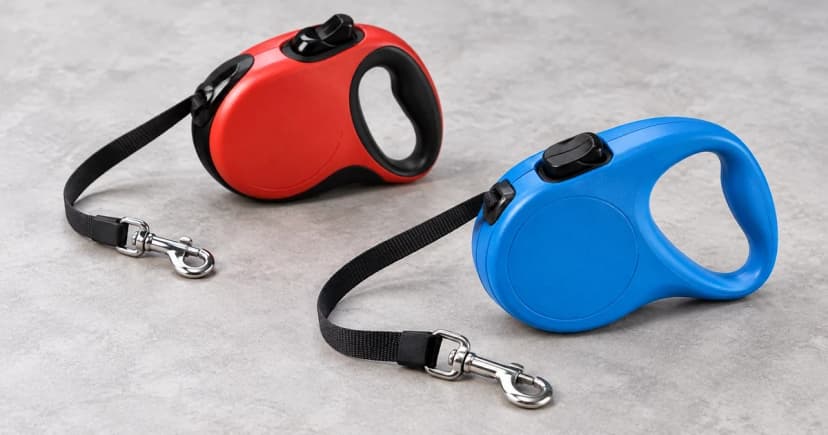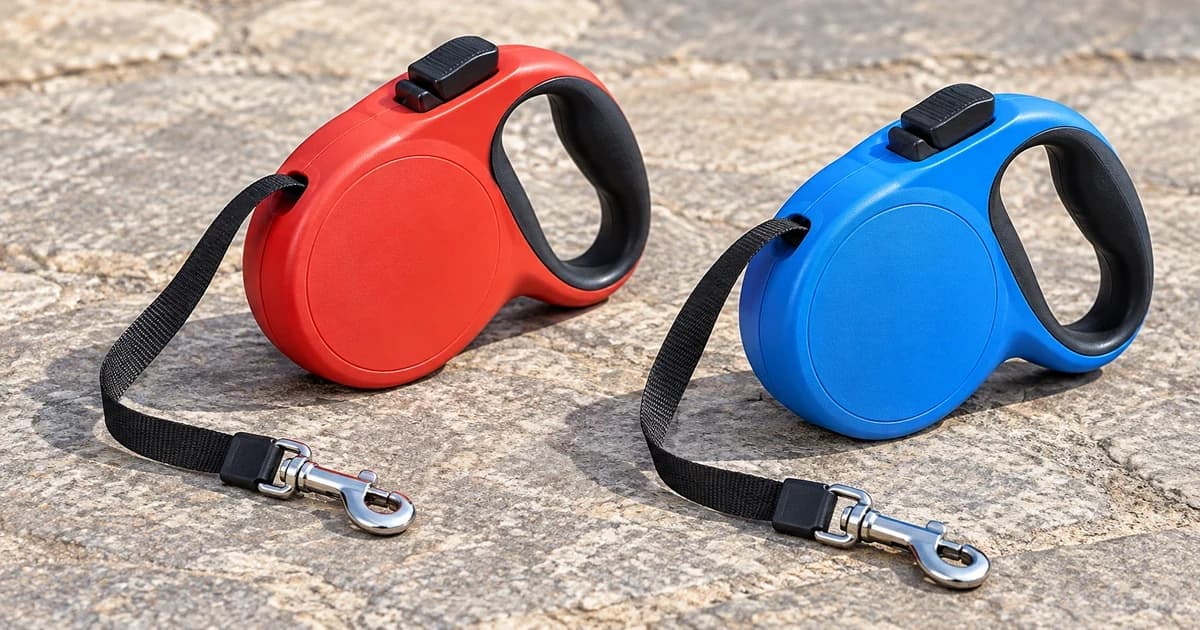
A retractable leash is a conditional equipment choice, not a general safety upgrade. Before using one, consider whether you can control this dog, operate the handle reliably and keep the extending line away from other people and dogs. A standard fixed-length leash is the more straightforward choice when you need your dog close by.
Advice differs in how much room it gives retractables. MSPCA-Angell recommends traditional non-extendable leads in most situations. AKC describes limited uses in quiet, open spaces. A maker's permission to use its particular leash comes with handling precautions, rather than proof that every walk is suitable.
The lock stops extension; it does not reel a pulling dog back
A retractable handle contains a spool of cord or tape. AKC explains that a brake or lock stops more line paying out, while retraction needs slack. If the dog is pulling against an extended line, pressing the lock does not automatically bring the dog beside you.
That distinction matters before you reach traffic, a narrow path or another dog. Decide how close your dog needs to remain before entering the situation. An extending line already stretched across someone else's path is a different problem from keeping it short in the first place.
Use the actual model's directions to understand its brake, lock and permitted method of shortening. Do not grab the moving cord or tape as a substitute for operating the handle. Flexi's instructions specifically warn against holding the working line to control the dog. A product described as one-handed or tangle-free does not remove that precaution.
Make the decision for the whole walking arrangement
| Situation to consider | Question before choosing a retractable | Reason to use a different arrangement |
|---|---|---|
| Busy sidewalk, entrance or nearby traffic | Will the dog need to stay beside you throughout? | You need close handling rather than changing extension. |
| Other dogs, pedestrians or children nearby | Could the line cross their path or wrap around someone? | There is insufficient clear space for the extending line. |
| Quiet, open place | Can you watch and control the dog while managing the handle? | The dog accelerates away or you cannot manage its response. |
| Unfamiliar or damaged equipment | Do you know the model's limits and operating instructions? | A label, mechanism question or visible defect remains unresolved. |
The table is a planning aid, not a measured risk score or a declaration that an open field makes every retractable safe. Space, a manageable dog and an attentive walker still do not establish the condition or performance of a particular mechanism.
Check what the maker's precautions actually require
Flexi North America's precautions and directions require a responsible user who can control and closely watch the dog, and a dog within the leash's labeled weight limit. They exclude an uncontrollable dog and tell users to keep the line away from bystanders, shorten around people or animals and avoid use near small children.
For that brand's equipment, the instructions also address attachment, a supplied safety collar, condition checks and model-specific handling. Read those details for the corresponding product. Do not copy an attachment diagram or accessory arrangement onto an unidentified brand because the housings look similar.
A maximum dog-weight label is one constraint. It does not answer whether this walker can manage this dog's sudden movement, whether a worn line is usable or whether the setting provides enough space. Flexi explicitly cautions that a small dog can still pull hard enough to injure its handler.
Keep hands on the handle and the line away from people
Before a walk, make sure the handle is comfortable to hold and that you understand the controls. AKC discusses a dropped handle startling a dog; do not plan to drop the housing to let the dog range farther. Hold the equipment as its directions require.
Flexi's warnings cover contact between the working line and skin, fingers or other body parts. Keep that line clear rather than wrapping it around your hand or trying to stop movement by grasping it. Its instructions also exclude using the leash while on wheels. These are handling cautions, not a quantified prediction of injury for any individual walk.
If the planned route repeatedly requires close control, choose equipment suited to that route at the start. A busy greeting with crossing lines is not a good demonstration of how to use a retractable, even if a photograph shows dogs wearing one.
Inspection cannot expose every internal problem
Follow the maker's pre-use inspection instructions for the leash and its attachment equipment. Flexi tells users to stop using a line with strong abrasion or damage and warns against opening or attempting to repair the housing because of its pre-wound spring.
MSPCA-Angell also points to the difficulty of inspecting the mechanism inside the handle. Seeing a clean exterior or a line that moves once does not establish hidden wear, reliable braking or strength.
Our long-line care guide concerns an ordinary detachable line. Its washing methods do not authorize soaking or opening a retractable housing.
Choose equipment without promising a training result
Browse retractable leashes for exact model instructions and handling limits, and compare standard leashes when the walk calls for consistent close positioning. A listing's length, strength or tangle-free wording needs its own substantiation; this guide has not tested those claims.
The separate harness-versus-collar guide considers the attachment on the dog's body. This decision concerns the extending line, housing, walker and setting. Changing either item does not, by itself, teach loose walking or make an unsuitable route manageable.