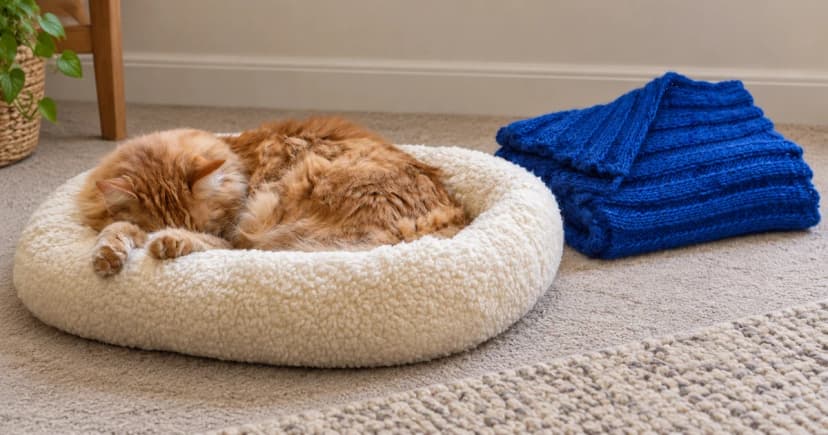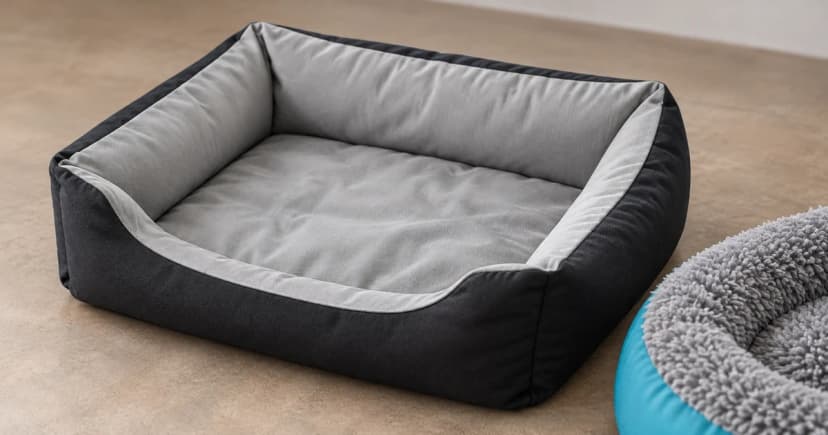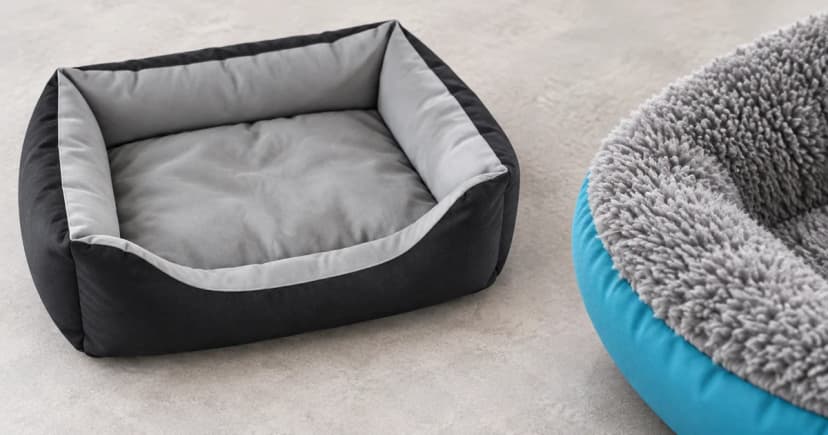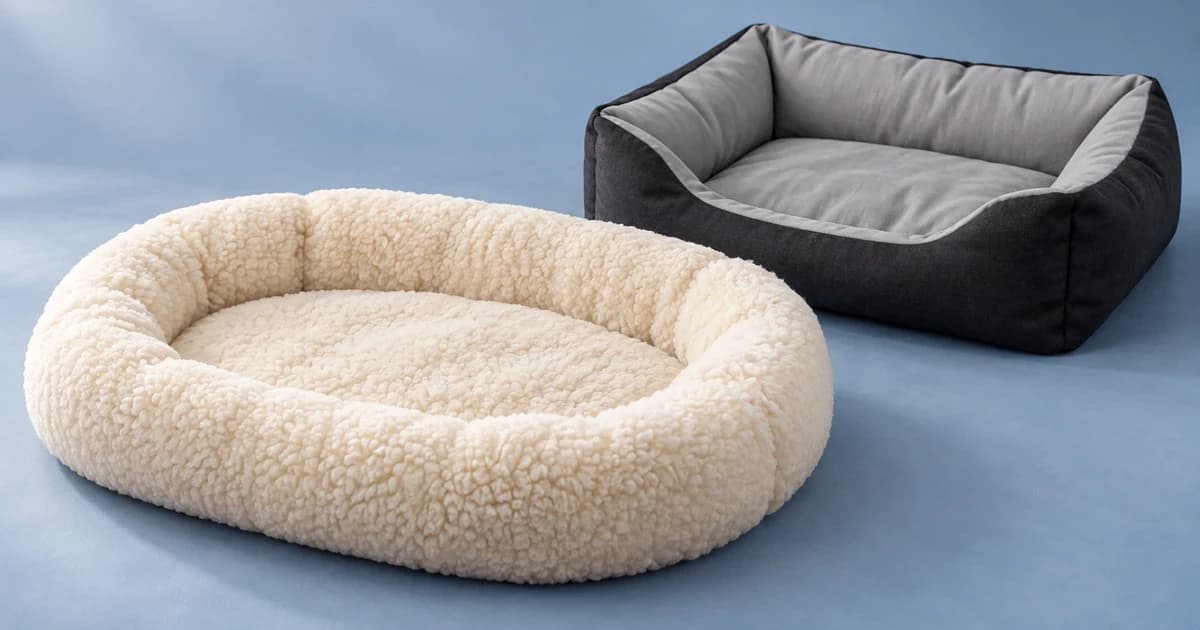
The best cat beds for large cats are the candidates whose documented space, access and care arrangements fit your requirements. Start with the individual cat's usual resting shape and the exact bed model, rather than treating a “large” label or a weight recommendation as a complete sizing answer.
When comparing cat beds for large cats, write down the usable resting area, the opening and any liner or bolster that occupies space. A wide outside diameter and a weight recommendation answer different questions.
This guide compares three manufacturers' descriptions of ordinary cat beds. It identifies useful differences and missing information; Pawlivy has not tested their comfort, established a universal fit or selected an overall winner.
Compare usable space before the size label
Notice whether your cat normally curls into a compact shape or rests with the body extended. Record the space that position occupies, then look for the bed's usable resting area. An advertised diameter may describe the outer edge, while bolsters, a curved shell or a liner occupy some of the inside.
Keep overall length, width and height separate from internal floor dimensions and the opening used to enter. Do not calculate an unknown interior by subtracting a guessed wall thickness. If the space that matters is absent, request that measurement for the exact size and configuration before buying.
| Named candidate | Written size information | Question to resolve |
|---|---|---|
| Tuft & Paw Kip, Wide | Technical details list 22 inches D by 4 inches H; the FAQ gives 21.65-inch width. | Which measurement describes the current item, and what usable surface remains? |
| Hepper Nest | 17.5 inches wide by 17.5 inches deep by 5.75 inches high, expressly described as overall size. | What are the lined interior's usable dimensions? |
| Armarkat C101HNH/ZH | Bed dimensions are 23.6 by 23.6 by 9.1 inches; pad thickness is separately listed as 2.76 inches. | What are the interior and notched-entry dimensions? |
These figures are not three measurements of the same thing. The largest published number cannot establish the largest usable sleeping area, and pad thickness is not entry height.
Kip: resolve the size boundary and cleaning commitment
The Kip product page describes molded foam, faux shearling and an ultrasuede base. Alongside the Wide figures above, its Small technical dimensions are 16 inches D by 4 inches H, while the FAQ says 15.70 inches wide.
The maker recommends Small below 12 pounds and Wide above 12 pounds. Those phrases leave exactly 12 pounds unassigned; the pictured model cat's stated weight does not resolve it. Kip must not go in a washing machine: its written care calls for lint rolling and spot cleaning. Do not infer a removable, washable cover from its upholstered appearance.
Nest: separate the shell from its liner
The Hepper Nest page describes a molded EVA foam shell with laminated fabric and a removable Sherpa fleece liner. Its guidance is for cats and small dogs up to about 17 pounds. The same page's customer anecdotes about 20-pound cats do not extend that guidance into a 20-pound capacity or a fit guarantee.
Its component care differs: the molded parts must not be machine washed and are air-dried; the liner permits a cold gentle machine cycle and low-temperature drying. Consider whether that split routine is practical, then obtain the missing usable-interior dimensions.
The Armarkat C101HNH/ZH page describes foam bolstered walls, mulberry velvet, black Oxford fabric and a notched opening. It does not provide that opening's height or the usable interior dimensions. Package dimensions and shipping weight cannot fill those gaps.
The page title calls it washable, but the written product description supplies no washing method, cover-removal instruction or drying permission.
Choose between documented arrangements
Reduce the list to candidates with enough confirmed usable space for the resting position you recorded. Then compare the entrance and surrounding walls as separate features. A notch or low-looking edge needs its actual dimensions when access matters; a product photograph alone cannot settle that question.
Next, list what you would need to maintain: the entire cushion, a shell and liner, or another explicitly identified component. A machine-washable liner and a spot-clean-only cushion create different commitments. Keep this purchase comparison separate from the detailed cat-bed washing guide, which starts with the actual care label.
Save the model and size, overall measurements, confirmed usable area, entry information and component care together. Mark missing or inconsistent fields for clarification rather than choosing a larger label automatically. None of the named weight statements proves that every cat at that weight will fit or use the bed.
The named examples here do not establish matching Pawlivy stock, current prices or a tested result.