When comparing a cat carrier for two cats, start with a complete, independent enclosure for each animal rather than assuming a shared shell works like two separate carriers. A double-carrier listing may describe two units that detach into standalone enclosures or a single shell split by an internal divider. Those two structures create very different answers for usable interior room, door access, and how you carry each cat between home, car, and veterinary clinic.
Keep a separate carrier for each cat as your baseline
Cats Protection advises giving each cat a carrier to themself, even when the cats get along well at home. Its carrier selection criteria also call for enough room for each cat to lie comfortably and change position. That welfare baseline does not endorse a specific divided kennel or treat an internal fabric partition as equivalent to an independent carrier.
Begin your comparison with two individual carriers as the reference standard. Evaluate a dual-compartment design only after checking what encloses each cat when the unit is configured for travel. A product description that mentions unzipping a center panel into one shared space is a configuration description, not a reason to transport two cats together in a single compartment.
Separate a removable divider from detachable units
An internal divider partitions the space inside one outer shell, whereas detachable units separate into two enclosed carriers that can be lifted and moved independently. Check what floor, walls, roof, and closed doors remain around each cat after separation; the word “double” in a product title does not settle those structural details.
| Carrier arrangement | Published structural description | Unresolved dimensions and handling limits |
|---|---|---|
| One for Pets Portable Double Kennel | Describes connected, divided compartments that can detach from a Double into two Single Kennels, or open at the center zipper into one space. | Overall size is printed as 20 × 20 × 39 inches with unlabeled axes; usable interior dimensions per detached unit, per-unit weight limits, and occupied lifting rules are not stated on the page. |
| Sturdi CarGo Portable Pop-Up Kennel, Double | Describes two compartments inside one pop-up shell, or one larger enclosure with the center divider unzipped, positioned for vehicle, home, hotel, and show use. | Listed at 19 in deep × 36 in wide × 21 in high overall (Single listed at 19 × 18 × 21 in); does not establish detachment into two standalone carriers or permission to lift the kennel while occupied. |
| Two individual carriers | Each cat travels in its own complete, self-contained enclosure with independent walls, floor, and door latches. | Verify each individual carrier's interior dimensions, door orientation, stated weight rating, and vehicle restraint path. |
Do not treat a removable center partition, dual front doors, or a zippered storage bag as proof that a product functions as two independently portable carriers.
Read total dimensions without inventing space per side
One for Pets lists its Double Kennel at 20 × 20 × 39 inches without labeling which number is height, depth, or width, and it does not publish interior measurements for each detached half. Dividing 39 inches by two produces an arithmetic estimate, not a verified interior footprint after seams, frames, and fabric tension are accounted for.
Sturdi lists the CarGo Single at 19 inches deep × 18 inches wide × 21 inches high and the CarGo Double at 19 inches deep × 36 inches wide × 21 inches high. Those external figures describe two different product models; they do not prove that each half of the divided Double provides the exact usable interior space of a standalone Single.
This distinction matters even more when shopping for a cat carrier for large cats, where an unverified outer width or a bowing fabric divider can leave one or both cats short of turning and lying room. Measure and record each cat individually using our cat-carrier sizing guide, and log each unit's stated pet-weight limit as a separate requirement rather than inferring strength from overall shell size.
Compare entrances, component care, and the transition plan
One for Pets highlights multiple entrances, zippered mesh doors, and a removable, washable pad cover, alongside built-in straps for seatbelt attachment. Verify which doors remain accessible when the two halves are joined versus detached before relying on top or side loading.
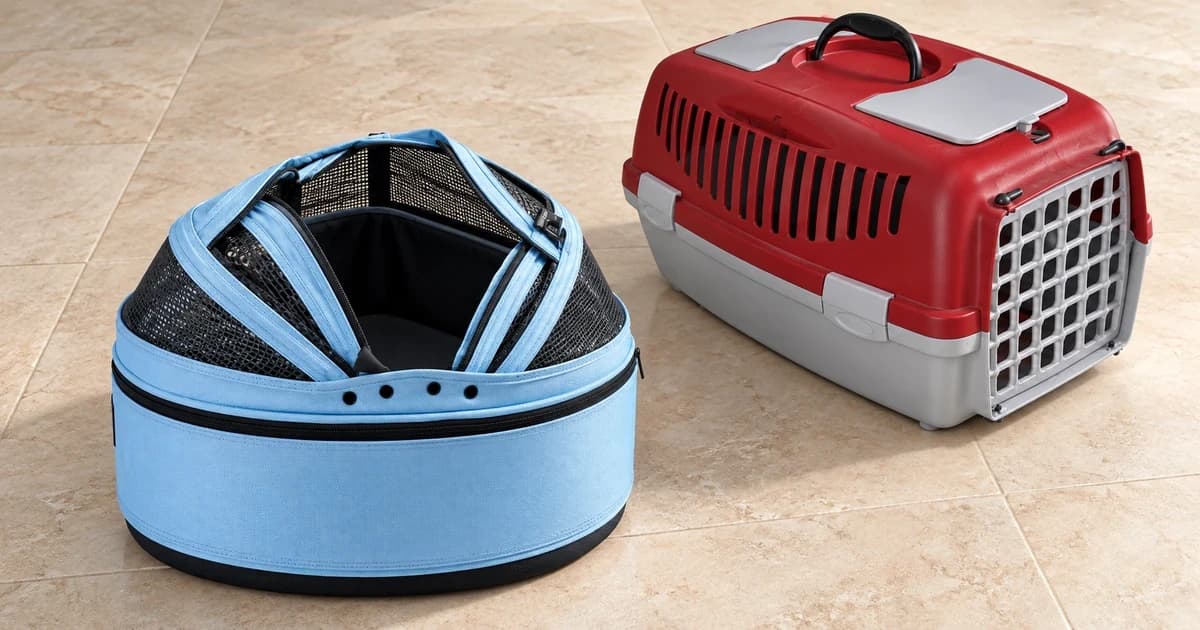
Sturdi's CarGo description lists dual zippered front doors, ceiling and back mesh panels, and care directions that require removing fiberglass rods and interior parts before machine-washing the outer shell in cold water. Include that disassembly effort in your comparison, and note that a pop-up vehicle kennel is not a substitute for an airline-approved cabin carrier or a rigid handheld box.
Map out every transition from living room to car seat to clinic waiting room before ordering. Check our car-journey preparation guide for vehicle restraint planning and our hard-versus-soft carrier comparison when weighing rigid shells against collapsible fabric enclosures.
Build your shortlist with unknown fields kept explicit
A practical two-cat transport setup accounts for both animals as individuals. Record the exact model and configuration, each cat's body measurements, verified interior dimensions per compartment, stated weight limits, door access, occupied-carrying rules, and cleaning steps. Browse the cat carrier category with that checklist beside you, and leave any unstated per-side dimension marked unknown rather than guessing from total exterior width.