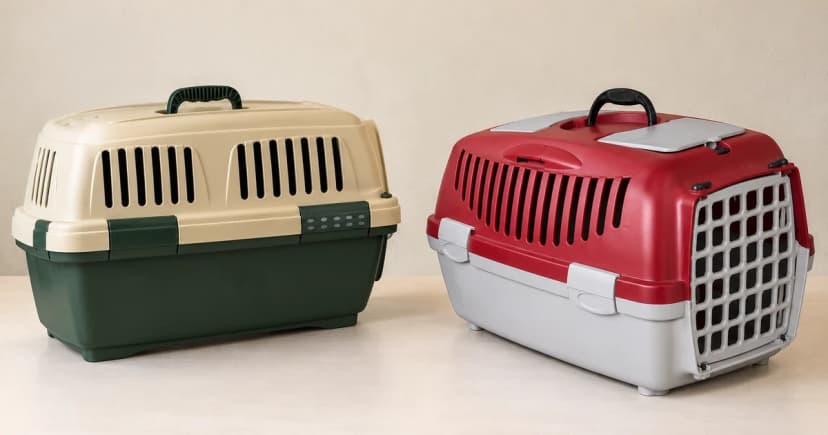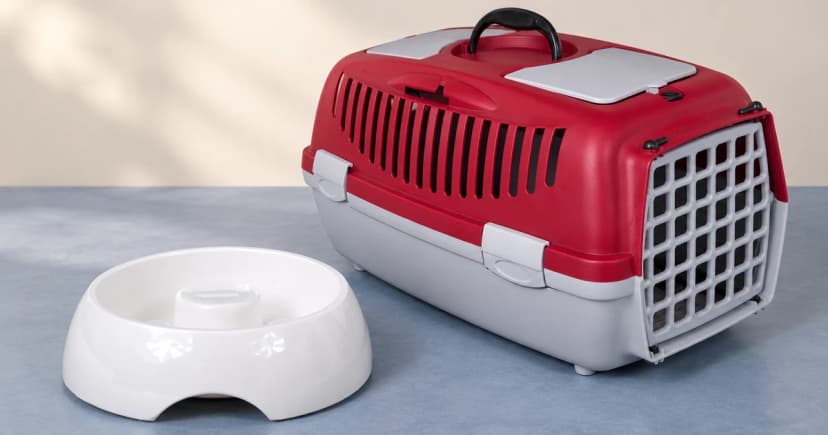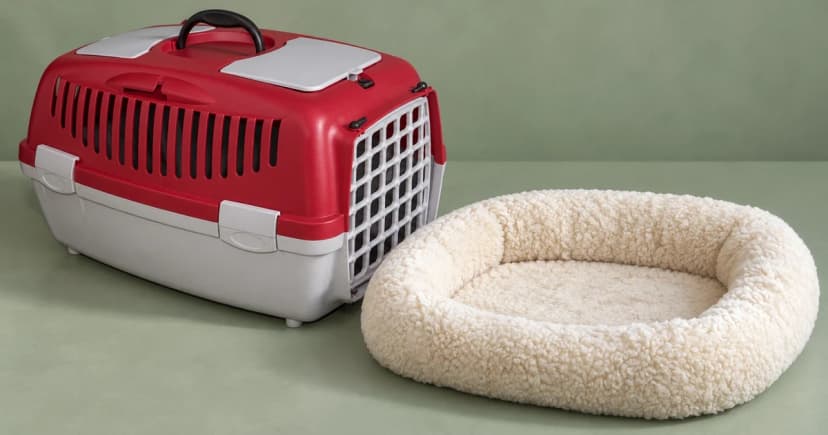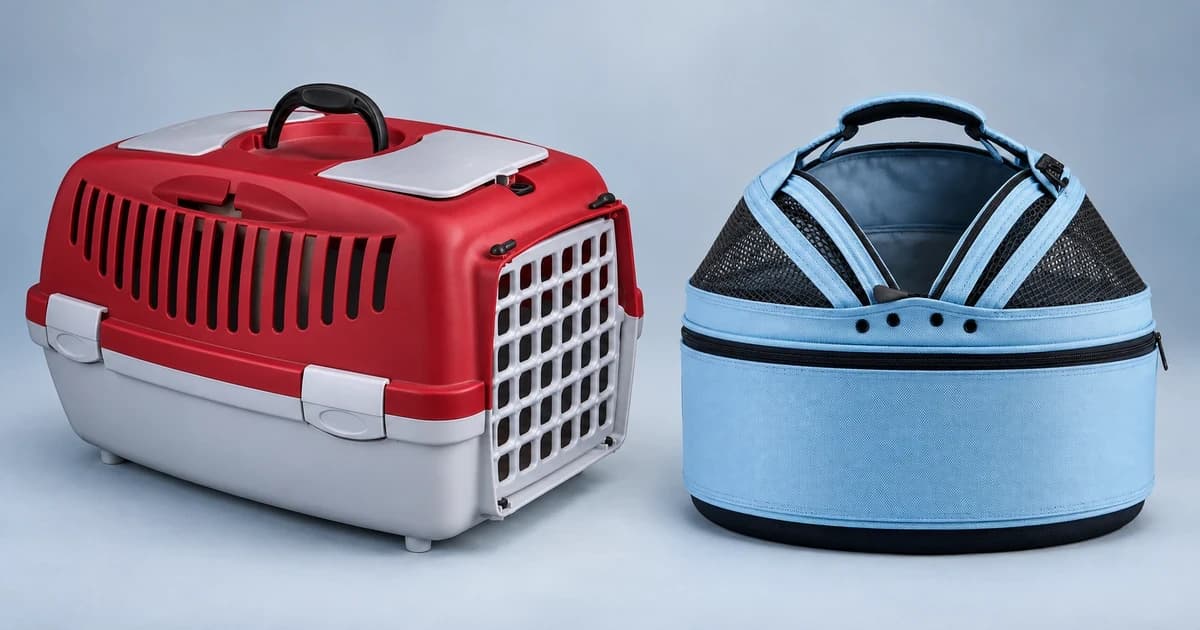
A practical hard vs soft cat carrier comparison starts with the specific model's structure and the rules of your planned trip. Whether you are evaluating a cat carrier hard or soft in outer construction, the shell or fabric panels, floor stability, door openings, component cleaning rules and transport restrictions determine how the carrier actually performs. Neither a rigid plastic shell nor a padded soft-sided bag automatically suits every cat or journey.
Compare the whole design across five checkpoints
Place the exact model specifications side by side in their normal assembled configuration, including any removable floor board or liner pad, so you compare complete designs rather than broad category labels.
| Decision point | Hard-carrier question | Soft-carrier question |
|---|---|---|
| Body and floor | Which shell halves and fasteners form the enclosure and base? | Which fabric panels, mesh windows, base board and internal frame maintain the shape? |
| Entry and access | Does the model offer a front door, a top hatch, or an upper shell that lifts off completely? | Which mesh panels unzip, and how wide is the clear opening when rolled back? |
| Carrying and storage | What handles, empty weight and disassembled storage footprint are stated? | What handles, shoulder strap, empty weight and permitted folding steps are stated? |
| Care burden | Which cleaning rules apply to the plastic shell, metal grate and separate cushion? | Which cleaning rules apply separately to the outer bag, fleece liner and stiff stability board? |
| Trip conditions | What transport modes, cabin dimensions or weight limits are explicitly stated or excluded? | What transport modes, under-seat dimensions or weight limits are explicitly stated or excluded? |
Avoid filling in missing details with category assumptions—for example, not every hard carrier has a top hatch, and not every soft sided cat carrier folds flat or fits under an airline seat.
Keep access separate from the outer material
Cats Protection's carrier guide recommends a sturdy plastic or coated-wire design and prioritizes secure latches, balanced carrying, easy cleaning and calm handling. It distinguishes a small top flap from a carrier whose entire upper half detaches, and calls for enough interior room for the cat to lie comfortably and turn around alongside ventilation on at least two sides.
Check how much of the interior opens up when loading a reluctant cat at home or lifting a cat out during an exam. Use our cat-carrier space guide to evaluate interior standing and turning clearance for your cat's body length and height.
Check what storage and cleaning will involve
The Sherpa FAQ shows how multiple components work together inside a soft carrier: it pairs a flexible bag and rear spring-wire frame with a stiff stability board and a removable faux-lambskin liner. While the liner is machine washable on gentle cycle, the stability board and outer shell are spot-clean only. The FAQ also notes a seatbelt/luggage pass-through strap while explicitly stating that the carrier is not crash-tested for collision restraint.
When weighing a soft cat carrier vs hard shell for storage and hygiene, check which parts detach and how each piece must be washed. Use our fabric-carrier care guide or hard-shell carrier care guide to match the cleaning workflow to the messes your cat typically makes in transit.
Let documented trip restrictions narrow the choice
Catit's PIXI Mio (product 41390) illustrates how model-specific rules govern a hard-shell ABS carrier: it features detachable front and top sections with a spot-clean cushion, is positioned for home use and short car trips for cats up to 6 kg and 30 cm tall, and explicitly excludes airplane travel.
If your trip includes air travel, verify the cat and itinerary's flight eligibility first and then match the exact cabin dimensions using our in-cabin pet carrier flight limits guide.
Eliminate unsuitable candidates in four quick steps
Instead of ranking hard or soft carriers in the abstract, narrow your shortlist in this order:
- Filter by trip exclusions first: Eliminate any model that explicitly excludes your transport mode (such as air travel) or exceeds your airline's under-seat dimensions.
- Verify interior posture clearance: Drop any candidate whose internal length and height cannot accommodate your cat lying down and turning around comfortably.
- Check veterinary and home loading access: Keep only models with top access or a removable upper half that lets you place and examine your cat without pulling them through a narrow front door.
- Confirm component cleaning rules: Choose the construction whose floor pad, stability board and shell match how you plan to clean and store the carrier between trips in our cat carrier collection.