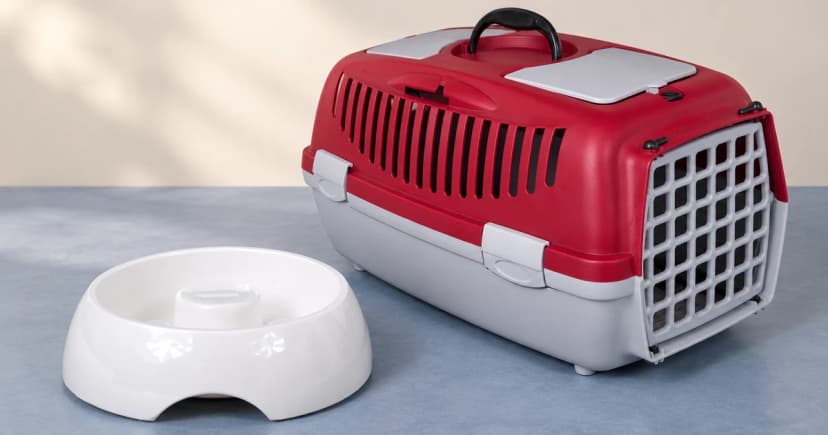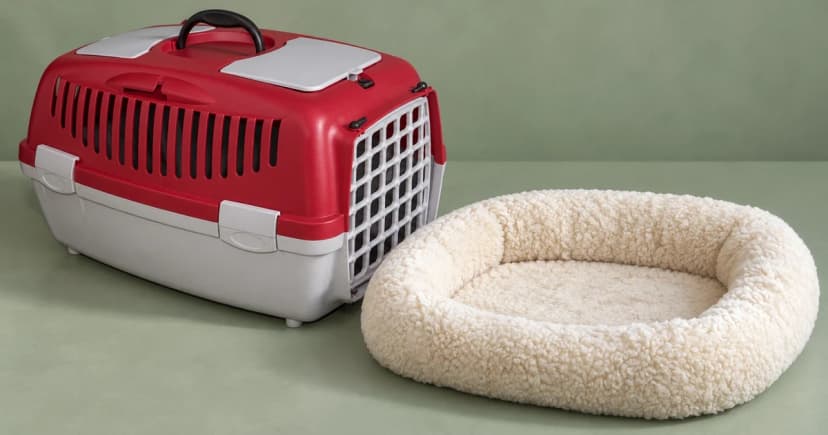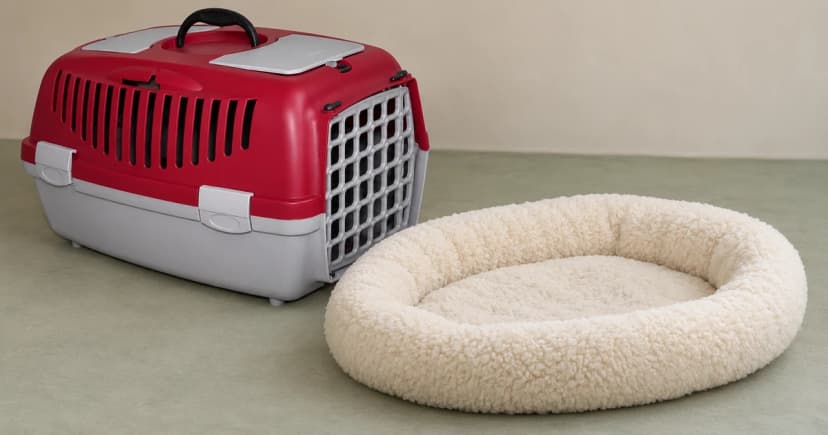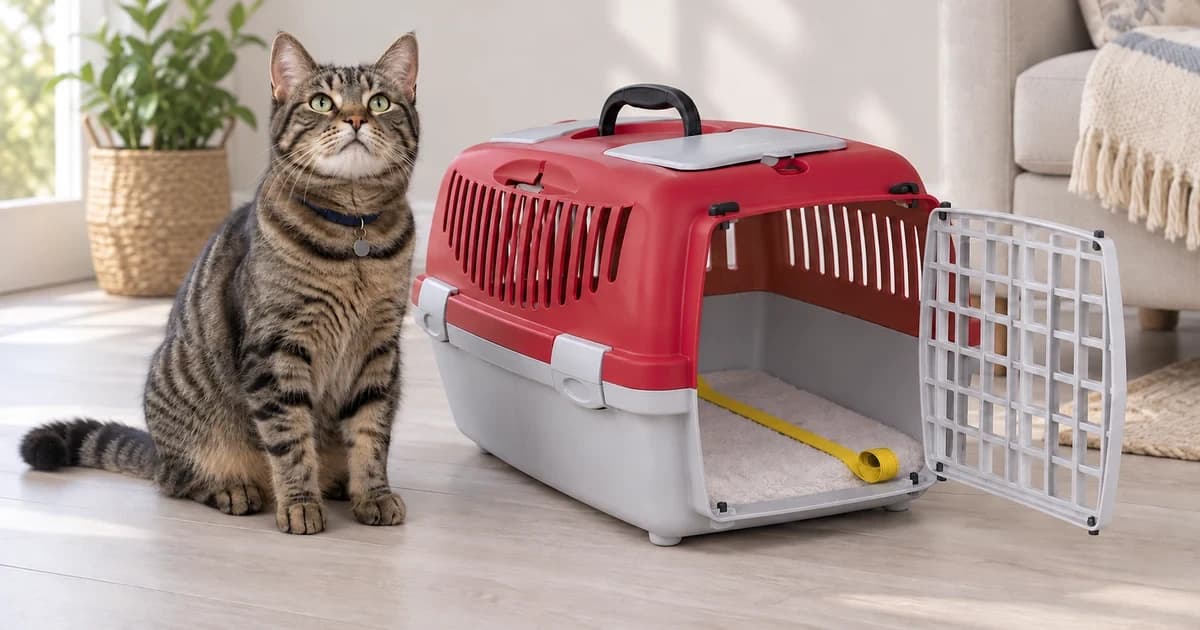
A cat carrier should give your cat room to stand, turn around and lie comfortably, with bedding in place. Choose it by your cat’s body and the carrier’s usable interior, rather than by a “small” or “medium” label alone. The doorway also matters: adequate space inside is little help if the opening makes entry awkward.
Compare cat carrier sizes using the interior with its intended bedding, not just the outer length or a small/medium label. Keep the cat’s body measurements, the usable interior and the doorway opening as separate records. Cat carrier size is only one check: an adequately roomy interior does not establish airline acceptance or crash protection.
There is no single inch allowance that settles every carrier choice. A curved roof, tapered floor or thick pad changes the space available. This guide helps you make a measurement record and then check ordinary movement voluntarily at home. It does not establish airline acceptance, crash protection or an escape-proof rating.
Start with three separate records
Keep the cat’s measurements, the carrier’s interior measurements and the manufacturer’s limits in separate columns. Weight is useful for checking the stated load limit, but two cats of the same weight can have different body lengths and heights.
Sherpa’s current FAQ tells owners to measure a standing pet’s length from the nose tip to the tail base and height from the floor to the top of the back for its pet carriers. Its backpack and tote instructions use different, seated measurements.
For a general shopping record, note nose-to-tail-base length and natural standing height, including which upper point you measured. If the maker asks for head height, use head height. If it asks for back height, record that separately. Do not hold your cat’s head up, pull the tail or press the body into a measuring position. Take a break if your cat moves away.
| Record | What to write down | Question it answers |
|---|---|---|
| Cat | Weight, nose-to-tail-base length, standing height and the height endpoint | Does this pet match the maker’s size chart and load limit? |
| Carrier interior | Usable floor length and width; height above the installed bedding | What room is actually available? |
| Access | Clear front opening, top opening if present, and removable-top arrangement | How will the cat enter and how can you access the interior? |
| Model information | Exact size/version, published interior dimensions and pet-weight limit | Are all the figures for the same product variant? |
Measure the inside with its normal bedding
Set an empty carrier on a level surface and assemble it as directed. Install its normal support board and bedding before checking headroom. A measurement taken with the pad removed describes a different setup from the one your cat will use.
- Measure the clear floor from front to back inside the shell or bag, avoiding the handle and outer door frame.
- Check the floor’s usable width. Note tapering sides or a rounded rear instead of treating the widest outside point as available floor space.
- Measure height from the top of the installed bedding to the inner roof. Note lower roof sections that interrupt the usable space.
- Record the unobstructed entry opening separately. A door frame, zipper opening or folded fabric edge can be narrower than the interior.
These are practical observation fields, not a transport certification formula. Do not squeeze it smaller and assume your cat still has the same room.
Petmate’s E-Z Load Two Door listing illustrates why the distinction matters. It lists the 19-inch version’s interior as 16.75 inches long, 11 inches wide and 9.25 inches high, while that version’s overall dimensions are 19.4 by 12.8 by 10 inches. The “19-inch” name is not 19 inches of floor space. Those are the manufacturer’s figures for that example, not confirmation that a similarly shaped carrier in our catalog is the same model.
Check movement without turning it into a forced test
Cats Protection advises enough room to lie comfortably and change position, while avoiding so much spare space that the cat falls about inside. It recommends leaving an open carrier in a quiet place for exploration and progressing only when the cat is comfortable.
When your cat voluntarily enters, observe whether it can settle, turn and stand without being pressed against the roof or sides. Look at the body, rather than counting only whether the head fits through the door. Keep the carrier on the floor for this observation. A cat remaining crouched or refusing to enter does not, by itself, prove the carrier is too small: reluctance and body fit are separate questions.
Do not close the door, tilt the carrier or repeatedly push the cat through the opening to produce a “pass.” In its carrier-training factsheet, Cat Protection Society of NSW stresses patience and avoiding forced entry during training.
Choose an opening you can actually use
A front door, top door and removable upper shell solve different access problems. Cats Protection notes that top openings can help with access, while a front-loading carrier with a removable top can be useful during familiarization. The NSW factsheet also favors front and top access and an easily removable upper section.
Before buying, find out whether “top opening” means a small hatch or the whole upper shell can come off. Check how the fasteners are secured afterward. With the carrier empty, verify that the door closes normally and inspect clips, screws and hinges for visible damage or missing parts. This inspection cannot establish an escape-proof rating, but it can identify an assembly problem before use.
For an existing carrier, the old kitten size is worth reassessing once your cat has grown. The NSW guidance specifically warns that handles and clips on lightweight carriers may be unsuitable for a heavier cat. Use the model’s current weight limit rather than guessing strength from the thickness of the plastic.
Use the record to narrow your choices
Compare actual dimensions and entry arrangements in our cat carrier category. Request missing interior measurements before choosing. If a listing supplies only outside dimensions, mark inside space as unknown; do not subtract an invented wall thickness.
For each candidate, keep one line containing the exact model and size, pet-weight limit, interior floor and headroom, bedding used and access arrangement. A carrier belongs on the shortlist only when you can reconcile those fields with your cat’s measurements and comfortable movement. For flights, make a separate check with the airline for the actual journey: a body-fit record does not confirm boarding eligibility.
Our editorial policy explains how we use source instructions and distinguish researched guidance from hands-on testing.