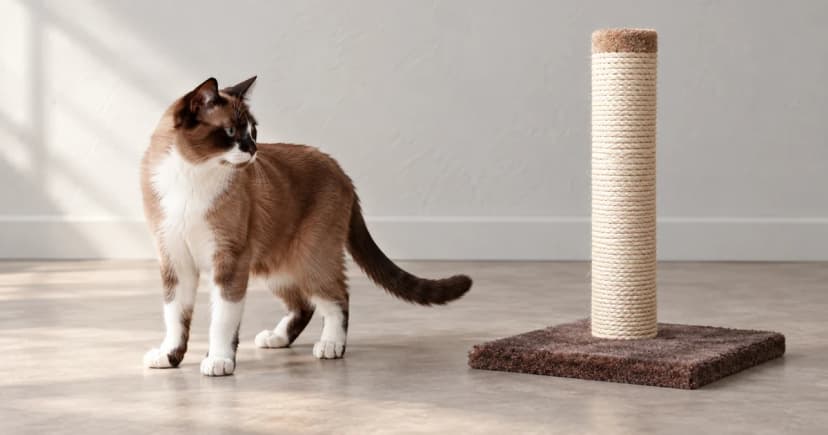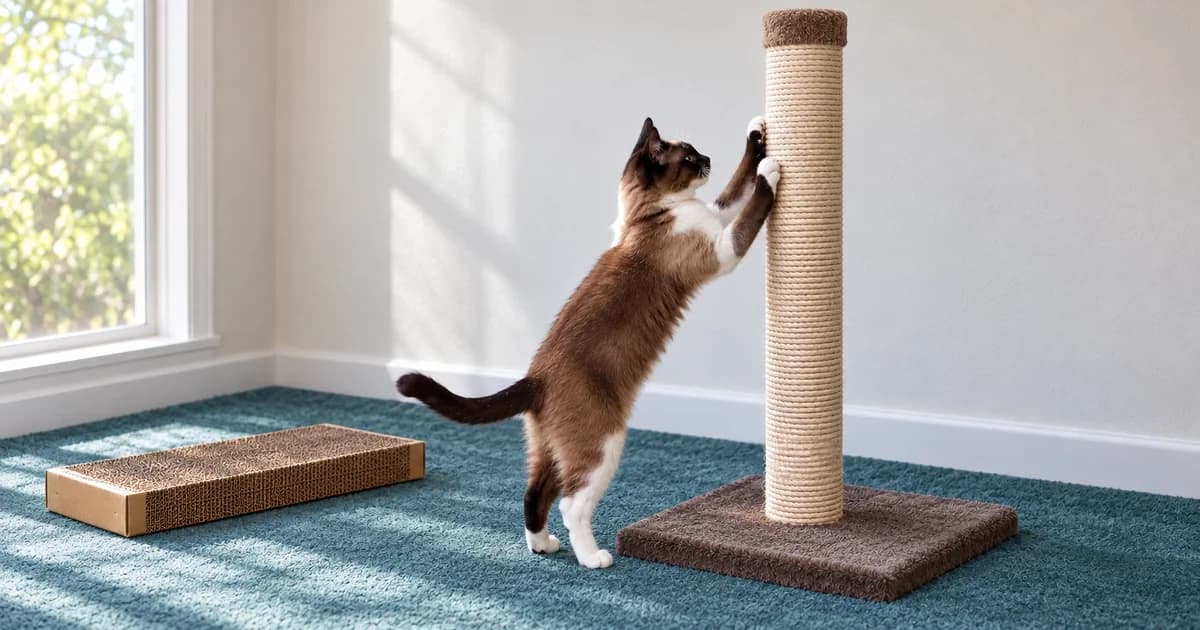
To help your cat use a scratching post, match the scratcher to the way your cat already scratches, make sure it stays stable, and put it where scratching actually happens. Give a vertical scratcher enough usable height for a full stretch; offer a horizontal or angled surface if that is your cat's preference. Invite exploration without holding or dragging paws against the material.
A new post cannot promise to protect every piece of furniture. Scratching is normal behavior, and a cat's choice depends on the surface, position, construction, and surroundings. The useful question is not simply which post is tallest. It is which setup provides an accessible scratching outlet for this cat in this room.
Let existing scratch marks guide the first choice
Watch where and how your cat scratches before buying another item. A sofa arm, a carpeted step, and a doorframe offer different orientations. The ASPCA's scratching guidance describes cats with vertical, horizontal, or slanted preferences and recommends trying different textures. That makes a short observation useful: record the orientation and surface rather than assuming every cat wants an upright rope post.
| What you observe | What to investigate | What still needs checking |
|---|---|---|
| Scratching upright furniture at a stretch | A stable vertical post with uninterrupted reachable scratching material | Usable scratch length, base stability, and placement beside the existing spot |
| Scratching rugs or low horizontal surfaces | A horizontal scratching pad or suitable low scratcher | Whether it stays in place and offers the preferred texture |
| Using an angled surface | An inclined scratcher | Secure support and an angle the cat can approach comfortably |
| Returning to a familiar worn scratcher | Retaining a serviceable familiar outlet while offering another | Condition and stability; worn appearance alone is not the whole decision |
Use this as a buying checklist, not a diagnosis of why your cat scratches. If a previously settled cat changes behavior markedly or seems uncomfortable, seek veterinary or qualified behavior advice rather than assuming the equipment is the only problem.
Check usable scratching height, not just overall height
Humane World for Animals recommends a sturdy post at least 32 inches tall for most cats. Cats Protection emphasizes enough height for a full stretch and a heavy, stable base. Treat those as selection guidance, then check your own cat's reach and the actual scratching surface.
An overall dimension can include a platform, decorative top, or base. It does not necessarily equal the vertical span your cat can rake with its claws. Look for where the scratchable section starts and stops, whether a shelf interrupts access, and whether your cat can stand in a natural position beside it.
For example, Catit's Vesper Box specifications list the Small furniture unit's overall height as 28.54 inches and describe multiple levels, a seagrass post, and a scratching mat. That overall height describes the furniture unit; it is not a published uninterrupted post length. The example shows why a cat tree's headline dimension cannot replace a scratch-surface measurement. Pawlivy has not measured or tested this model.
Compare those features when browsing cat scratching posts. For a cat that scratches flat surfaces, a suitable scratching pad may answer the preference better than a taller vertical design.
Stability belongs in the decision before texture
A surface that shifts as your cat leans against it may discourage use. The welfare sources above consistently favor a sturdy setup. Examine the base footprint, how the upright attaches, and the manufacturer's assembly or fixing instructions. A wide-looking base in a photo does not establish a tested resistance to tipping.
Assemble the product as directed and put it on the intended floor surface. Check for loose connections or obvious wobble before inviting your cat to explore. Use a wall attachment only when the product instructions specify one. Do not improvise a load test with your cat or assume a retailer's “large cat” label establishes a weight rating.
Texture comes next. Sisal, cardboard, carpet, and wood appear in the ASPCA's examples, but cats differ. Compare a new surface with one your cat already uses. Start with a documented material and construction rather than expecting a material name by itself to guarantee acceptance.
Put the outlet beside the current scratching spot
A post hidden in an unused corner may be convenient for people but miss the cat's routine. Humane World recommends placing it beside the couch or other location the cat chooses. Cats Protection also suggests a sleeping area, because cats may scratch and stretch after waking.
Start with a spot that allows a clear approach and enough space for the intended posture. Observe whether other pets or household activity interrupt access. In a home with multiple cats, Cats Protection recommends separate scratching resources in different places; putting every outlet together does not offer the same choice of locations.
Once the cat is using an outlet reliably, Cats Protection suggests moving it gradually if needed. Avoid making several changes at once: keeping the surface familiar while adjusting placement makes it easier to see which change affects use.
Invite interest without forcing the paws
Let the cat investigate at their own pace. Humane World describes playing around the post with a fishing-rod toy as one introduction option. Use that as supervised interaction, with the toy put away afterward; do not leave dangling equipment as a substitute for a stable scratcher.
The ASPCA specifically warns against holding a cat at a post and making them drag their claws over it. Do not lift paws onto the surface to demonstrate the action. The goal is an outlet the cat chooses, not a restraint session.
Cats Protection recommends praising a cat for scratching the post. Offer calm praise when your cat chooses it voluntarily, then let them continue without interruption. Encouragement supports the introduction; it does not make a mismatched or unstable outlet suitable.
If the post remains unused, work back through the checklist: orientation, texture, usable reach, stability, and location. Change one plausible mismatch before buying a similar item again. A horizontal preference will not necessarily be solved by another upright post with a different color.
Separate cosmetic wear from a maintenance problem
The ASPCA notes that a familiar worn scratching surface can remain appealing. Keep an intact, stable favorite available while introducing a replacement when possible. Check the product's condition and instructions rather than discarding it solely because the surface looks used.
A loose upright, exposed hardware, or damaged structure needs attention before further use. Follow the maker's repair or replacement directions. Catit, for instance, offers replacement parts for its Vesper Box posts and mats; that does not establish that unrelated scratchers are designed for the same repairs.
If you also need perches or a resting area, compare cat furniture and trees for those separate functions while still checking the scratching area. This guide is a source-based equipment and setup analysis, not a product test or a promise to resolve a behavior problem. Our editorial policy explains how we research and handle corrections.