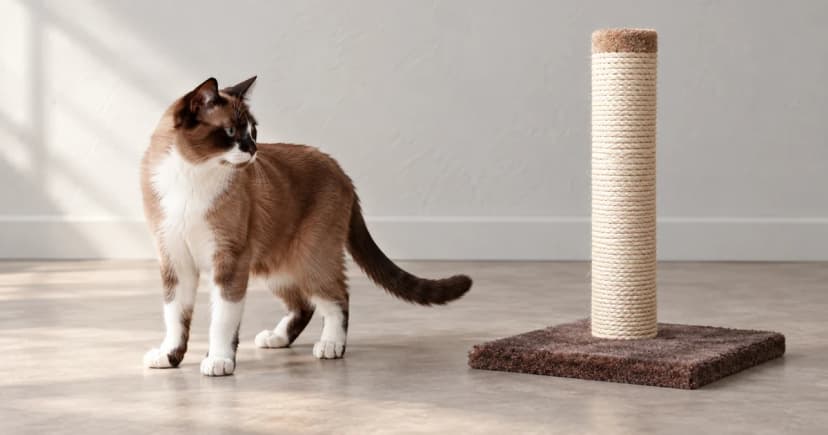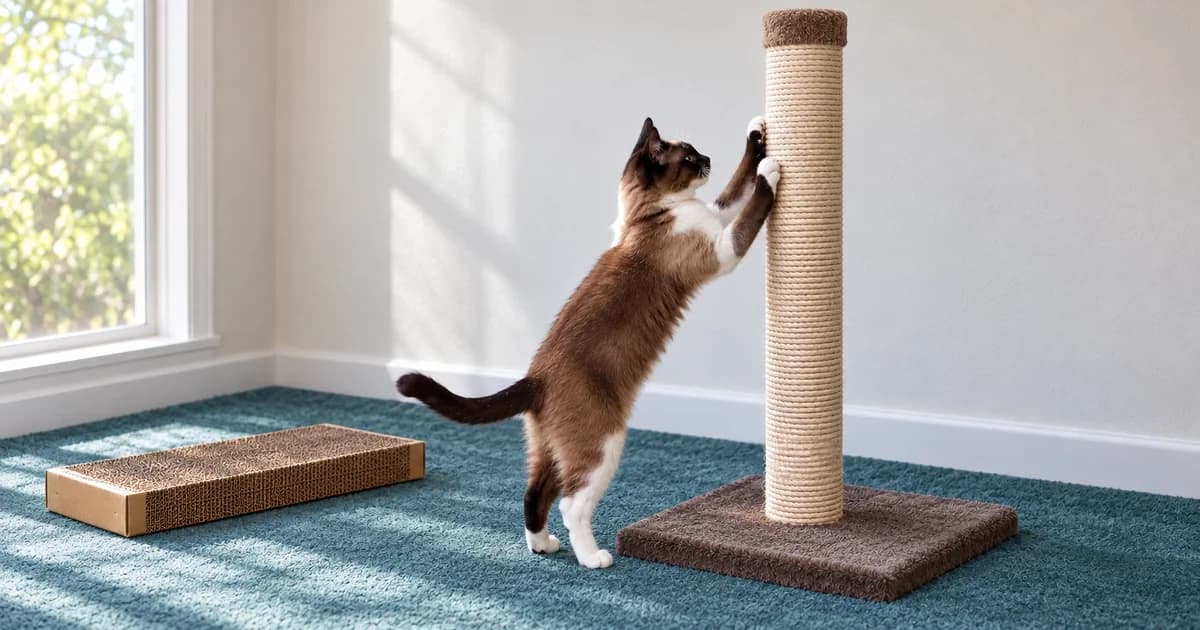
Knowing how to get a cat to use a scratching post depends on three linked decisions: matching the scratcher's orientation and texture to where your cat already scratches, verifying that the post stays rock-steady with enough uninterrupted height for a full body stretch, and placing the post right beside the currently targeted furniture rather than hiding it in a spare corner. Once the setup matches your cat's habits, invite exploration with play or praise—never hold or drag your cat's paws across the post.
1. Let existing scratch marks guide orientation and placement
Understanding why do cats scratch furniture starts with recognizing that scratching is normal territory marking, claw conditioning, and stretching behavior. The ASPCA's destructive-scratching guide notes that individual cats favor vertical, horizontal, or angled surfaces as well as distinct textures like sisal, cardboard, carpet, or wood. Watch where your cat currently scratches and match the setup in the table below:
| Observed scratching pattern | Matching scratcher orientation & feature | Where to place it & what to verify |
|---|---|---|
| Reaching high up on a sofa arm or doorframe to rake vertically | Sturdy vertical cat scratching post with a continuous, uninterrupted sisal or jute column | Place directly beside the scratched sofa arm; verify usable vertical scratch length and a non-wobbling base. |
| Raking floor rugs, carpet edges, or flat mats | Flat horizontal scratching pad (corrugated cardboard, sisal mat, or carpet board) | Lay flat right over or next to the targeted rug edge; check that the pad does not slide across hard floors. |
| Stretching along a sloped surface or stair step | Angled or ramp-style scratcher | Position along the same traffic path with the base braced so the slope cannot tip forward. |
| Stretching immediately after waking up from naps | Vertical post or preferred pad matched to your cat's favorite texture | Place near your cat's primary sleeping area (Cats Protection notes cats frequently stretch and scratch right after waking). |
2. Check uninterrupted scratching height vs. overall furniture height
When deciding how tall should a cat scratching post be, Humane World for Animals recommends a sturdy post at least 32 inches tall so most adult cats can extend their bodies fully, and Cats Protection stresses pairing full-stretch height with a heavy, stable base.
Always separate a furniture unit's overall height from its usable uninterrupted scratching span. A multi-level unit such as the Catit Vesper Box Small lists a 28.54-inch overall furniture height across shelves and box levels—that total figure is not a single uninterrupted vertical post length. Check where the scratchable wrap actually starts and ends, and whether overhanging platforms block a full vertical stretch. To compare specific standalone post footprints, post diameters, and sisal versus jute coverings side by side, see our dedicated guide to compare scratching-post structures.
3. Position the post where your cat already scratches
If your immediate goal is how to stop cats scratching furniture, placement matters as much as height:
- Start right beside the target spot: Humane World advises setting the new post right next to the couch corner or chair your cat is currently scratching so the post intercepts their normal route.
- Keep multi-cat outlets separate: In multi-cat households, Cats Protection recommends placing multiple scratching posts in separate locations rather than clustering them in one corner.
- Move gradually only after regular use: Once your cat uses the post consistently next to the sofa, Cats Protection notes you can inch it gradually toward your preferred spot near the wall—changing only location while keeping the familiar post intact.
- Retain beloved worn posts while still sturdy: The ASPCA notes that cats often prefer a broken-in, shredded surface that holds their scent; keep a structurally sound old post available while introducing a new one alongside it.
4. Encourage voluntary use without forcing your cat's paws
Assemble the post fully and verify on your floor that it does not wobble before inviting your cat over—a single tip or shift can put a cat off using a new post permanently. Then use hands-off invitations:
- Play around the post: Humane World suggests dragging a wand or fishing-rod toy around and up the side of the post during supervised play so your cat naturally hooks their claws into the sisal while pouncing (put corded wand toys away safely after play).
- Never grab or drag paws: The ASPCA explicitly warns against picking up your cat and rubbing their front paws against the post, which can create avoidance rather than interest.
- Praise voluntary scratching: Offer calm verbal praise or a treat after your cat chooses to scratch the post on their own.
If you also want elevated perches or hideaways, browse cat furniture and trees while still checking that at least one post section allows a full vertical stretch. See our editorial policy for how welfare and manufacturer sources are used.