To understand how to choose dog toys—and why asking what are the best toys for dogs or what is the best dog toy always comes back to your individual dog—follow a four-part chain: observe the play motion your dog already enjoys, confirm the candidate toy's stated activity, verify its size chart and any detachable parts, and set a clear supervision and retirement rule before offering the toy. Neither a dog's breed label nor a marketing claim like "indestructible" proves that a toy fits your dog's mouth or play style.
Step 1: Start With an Observed Play Goal, Not a Breed Label
Blue Cross's dog play guide recommends watching how your dog naturally interacts with objects and matching toys to those specific actions—distinguishing shared chasing and retrieving games, tugging games, and nose-work searching or foraging. A toy built for supervised tug or scent foraging is not automatically designed for solo stationary chewing.
Dogs Trust's enrichment guidance adds that every activity should match the individual dog's preferences, health, and physical abilities—watching closely so a puzzle or toy engages the dog without causing frustration or confusion.
Step 2: Use the Dog-Toy Purchase Worksheet (With a Hypothetical Worked Example)
To see how an observed play habit turns into a concrete shopping filter rather than browsing by color or shape, compare the blank worksheet column with the hypothetical worked example in the rightmost column below (an illustrative decision walkthrough rather than a universal ball-size rule):
| Selection Stage | What to Record for Your Dog | When to Pause the Purchase | Hypothetical Worked Example: Dog Enjoys Shared Chase & Fetch |
|---|---|---|---|
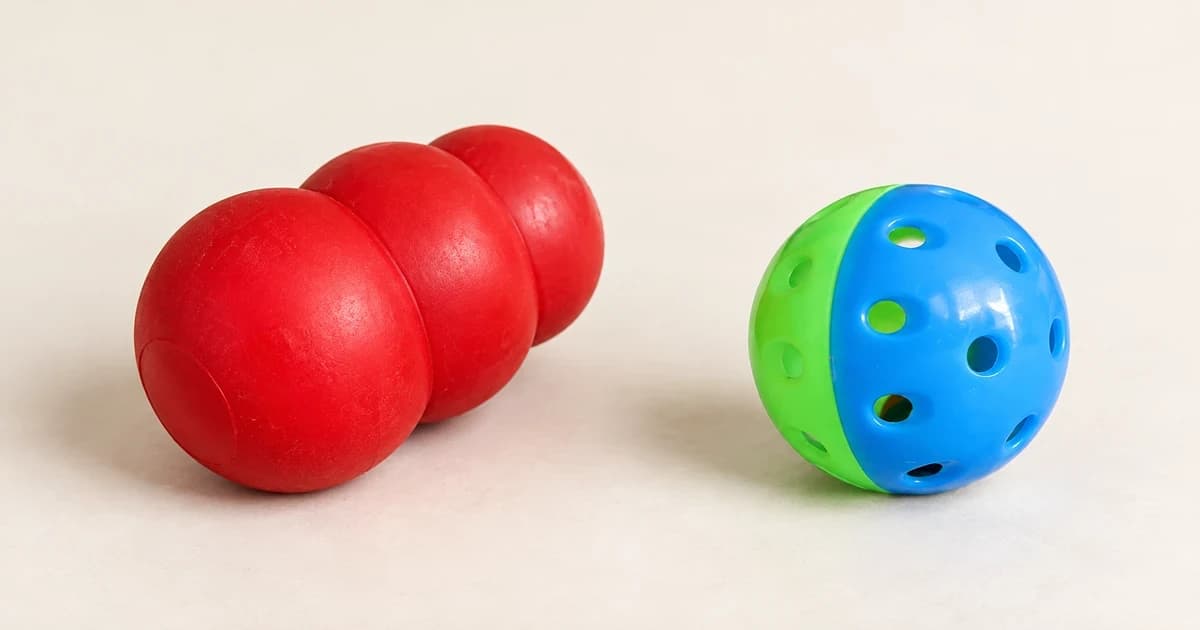
| 1. Observed play goal & stated toy use | Your dog's preferred motion (chase/retrieve, tug, sniff/forage, or chew) matched against the maker's stated purpose | The listing only uses vague slogans ("tough fun") without stating whether the toy is for fetch, tug, or chewing | Observation: Dog loves chasing a rolling object and bringing it back to the handler. Filter: Check that the candidate toy explicitly states fetch/throwing use; pause if a heavy solid chew block only advertises chewing durability without fetch suitability. |
| 2. Model-specific size guidance | The exact size option selected and the manufacturer's jaw/weight sizing instructions for that option | Dimensions or size-selection rules are missing, or the toy could pass behind the premolars and pose a choking risk | Filter: Check the specific ball or flyer model's size chart against the dog's mouth size so it is large enough not to lodge in the throat yet light enough to carry comfortably. |
| 3. Seams, openings & edge parts | Protruding fins, rope knots, fabric seams, squeaker plugs, or cavities that need pre-play inspection | Small attached parts, loose fibers, or exposed stuffing could be bitten off and swallowed during excitement | Filter: Inspect molded seams, whistling holes, or attached throw-ropes before tossing; avoid fetch toys with glued surface decorations that can be nibbled off between throws. |
| 4. Supervision & pacing plan | How you will supervise the session, manage arousal, and put the toy away when the game ends | Your plan relies on leaving a high-arousal chase/tug toy unattended with an unsupervised chewer | Filter: Use the toy for interactive two-ball fetch sessions with calm breaks, then pick the fetch toy up after the game rather than leaving it on the floor for solo chewing. |
| 5. Withdrawal & replacement trigger | Exact signs of wear (split seams, gouged rubber, frayed rope, cracked plastic) that retire the toy | You are counting on a "chew-proof" or "indestructible" claim to skip before-and-after condition checks | Filter: Check the toy as you wipe it down after fetch; retire it immediately if the outer wall cracks, compresses permanently, or starts shedding fragments. |
Step 3: Check Size and Detachable Parts as Two Separate Questions
Both Blue Cross and Dogs Trust highlight two distinct physical checks: choosing a size appropriate for your dog's mouth so the toy cannot be swallowed whole, and inspecting construction for pieces that could be chewed off and ingested as foreign bodies. A large plush or rope toy can pass a whole-object size check while still having an ear, squeaker reed, or frayed tassel that detaches easily.
Step 4: Keep Play Calm, Voluntary, and Supervised
Introduce one new toy at a time in a low-distraction setting. Blue Cross notes that play should never be forced and emphasizes supervising solo toy use where swallowing pieces is a risk, while Battersea's play advice recommends keeping arousal levels manageable and taking breaks before excitement boils over.
Browse by Purpose and Separate Toy Selection from Training
Once your worksheet is filled out, compare specific product descriptions in our dog toys category, including chew toys and puzzle toys. For step-by-step game skills, see our fetch guide; if your dog ignores toys altogether or suddenly stops playing, read our guide to observing play preferences and changes.