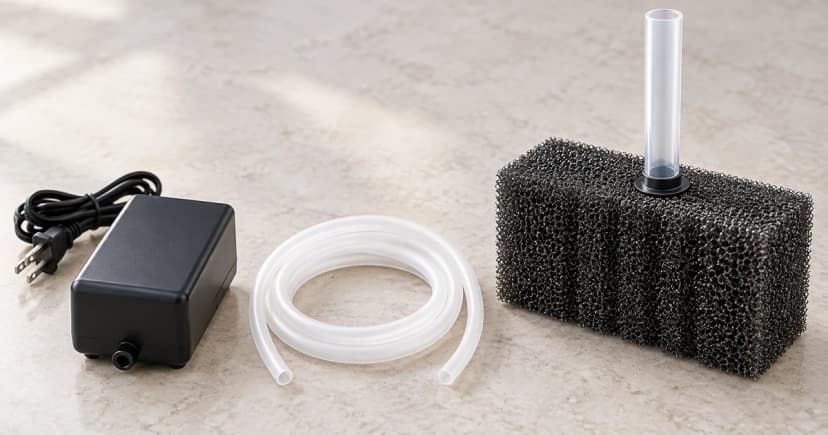
To decide how to clean a sponge filter, identify the exact filter and separate its removable foam from the external air pump. Read the permitted removal, water and reassembly instructions before lifting anything. The useful endpoint is a serviced unit with a record of what changed, rather than an assumption that squeezing any sponge restores filtration.
Identify the parts and the permitted stopping procedure
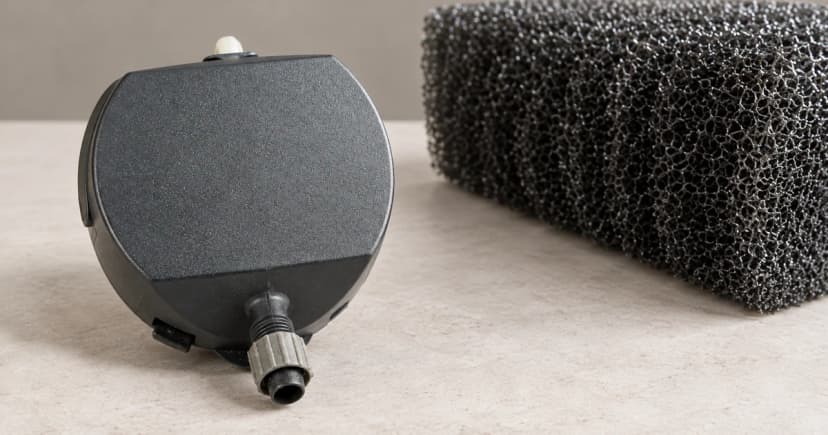
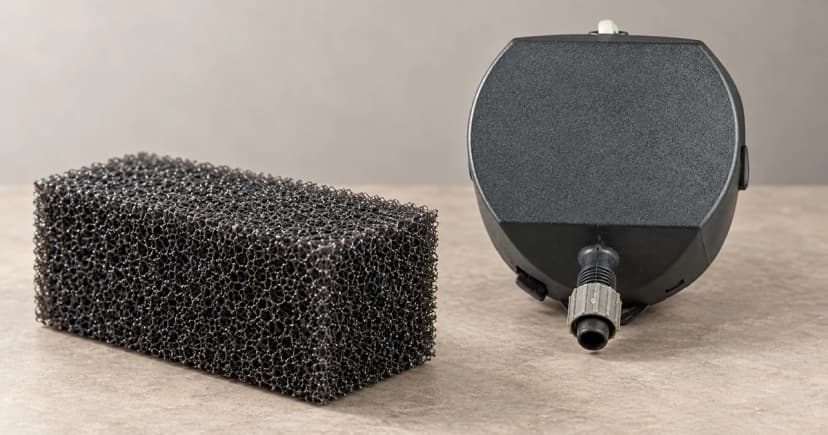
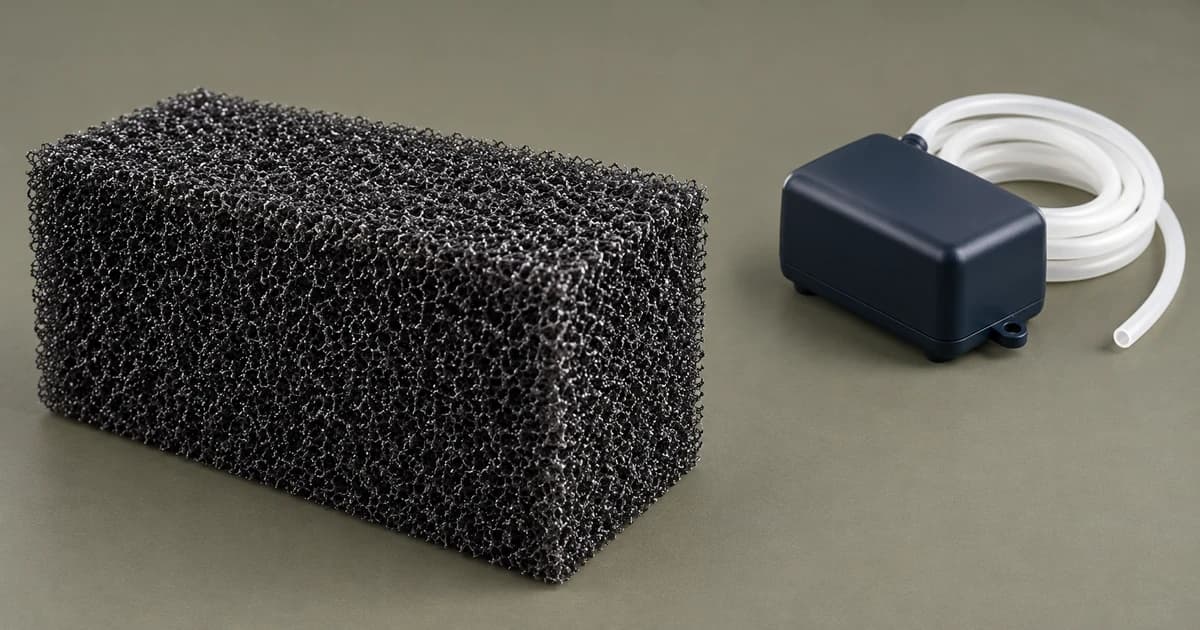
Record the filter model, its pump and any connected accessories. Check the supplied directions for the required power state before removal, disconnection or access, and for returning the equipment to service. Resolve missing directions with the maker before proceeding. An external electrical air pump is not the foam component to rinse or immerse.
New equipment belongs to the air-driven sponge filter setup guide. This guide concerns an already used unit. Do not repeat a new-filter soaking or connection sequence as a substitute for maintenance instructions.
Describe the actual condition before choosing a method
Note visible debris, changes from the unit's ordinary bubbling pattern and the date of its last service. Keep the description literal: debris in foam, debris around an accessible opening, a damaged part or a change you cannot explain. Those observations do not identify a biological problem or determine which component needs replacement.
Aquarium Co-Op's sponge-filter guide recommends monthly cleaning or cleaning when bubbles decrease. That is its guidance, not a timetable for every model.
Check your own model's care directions against that observation. If the instructions do not cover what you found, keep it as a specific manufacturer question instead of adding a stronger cleaner or taking apart an unfamiliar component.
Keep the named foam-cleaning methods separate
For the Hikari Bacto-Surge sponge block, Hikari directs rinsing with water taken from the aquarium and expressly excludes tap or hot faucet water. For reinstallation, it describes submerging the block in aquarium water and gently squeezing out trapped air. These directions concern the block, not the electrical pump.
Its page also gives two replacement statements: a six-month interval and later advice to replace as needed depending on aquarium load and fish kept. Those statements do not resolve one universal replacement date.
Aquarium Co-Op's filter-cleaning article describes surrounding a coarse sponge with a bag filled underwater, lifting the bag and sponge together, then working over a bucket. It removes separable strainer, base and other components before repeatedly squeezing the foam in aquarium water, discarding dirty water and replenishing it until brown debris is no longer released. Use this approach only where your model permits that removal and access.
Arrange the permitted container and water before removal. Follow the model's stopping and access requirements first; the debris-catching method does not authorize handling an energized system or submerging its external pump. Do not move the pump into the cleaning container along with the sponge.
Clean accessible components without inventing a teardown
For its own design, Co-Op removes the air collar and bullseye from the strainer to release the foam. It also calls for clearing debris or algae from the air-collar holes, then reassembling and returning the filter. Those parts and that separation sequence are not Hikari instructions.
Use the actual component names and access allowed by your manual. An opening that remains obstructed, an attachment that will not seat or an unidentified part needs clarification. Do not drill holes, cut tubing, force a collar or open the electrical pump to complete a guessed cleaning procedure.
Co-Op's sink-rinsing discussion describes its founder's low-chlorine tap-water circumstances. That conditional personal example does not override Hikari's explicit prohibition or establish permission for your own water supply.
Reassemble, resume as instructed and keep a service record
Return only the permitted parts, in the model's specified arrangement. Follow its instructions for replacing the unit and resuming the pump. Compare the visible behavior with the directions and your earlier observation. Do not translate bubbles, a different appearance or a completed wash into a claim about water quality, biological readiness or animal suitability.
Record the model, date, observed condition, water and method used, components accessed, reassembly checks and visible result. Keep unresolved behavior and the exact maker question alongside that record. A continuing unexplained change calls for model-specific advice rather than repeated aggressive cleaning.
When a replacement is actually required, check the exact part specification in sponge and internal filters. A category listing does not confirm a matching block or current stock, and a different-looking foam is not evidence of an equivalent replacement.