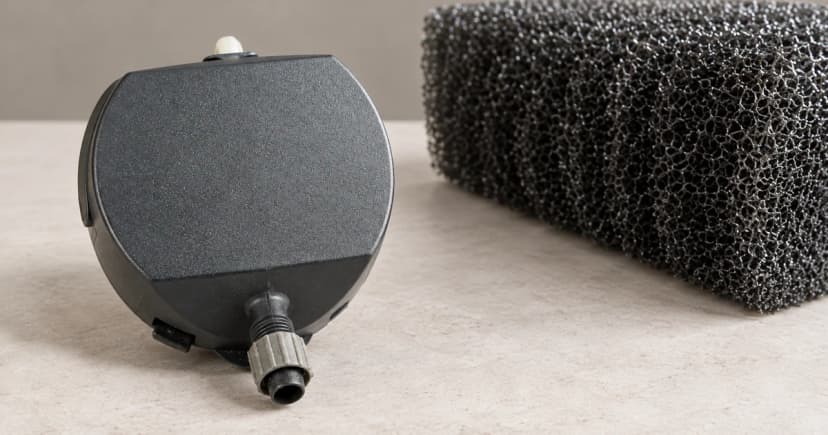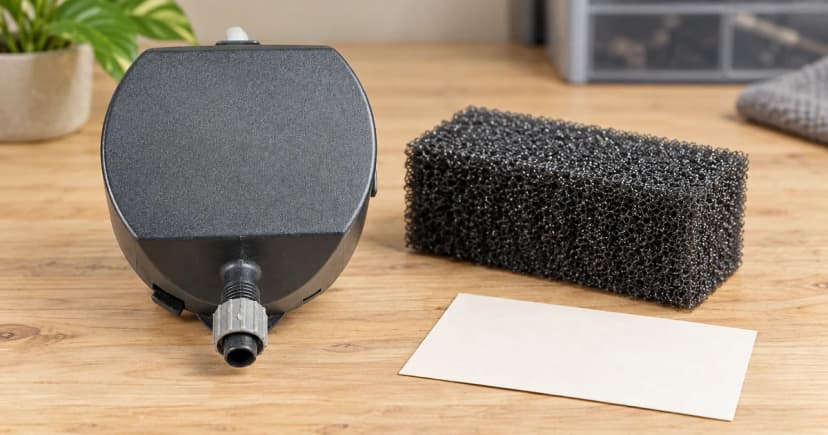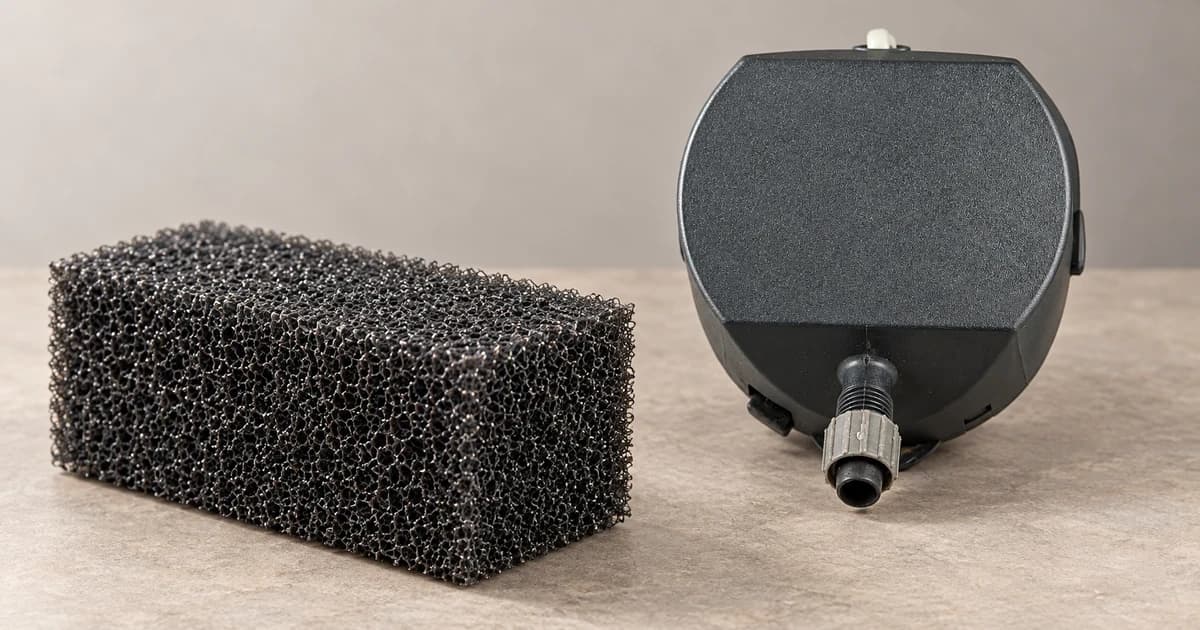
The best aquarium filter for a 10 gallon tank depends on more than the gallon number on the package. Compare where the equipment sits, what powers it, which media it uses and what access you will need to service it. Three maker-documented candidates illustrate different commitments; none is a tested overall winner.
Start with your aquarium's actual arrangement: available room inside and outside the tank, the intended equipment route and the exact model instructions. A manufacturer's capacity range or flow specification is not a measurement of your installed system, a stocking recommendation or proof that an aquarium is biologically ready.
Compare the complete equipment commitment
| Named candidate | Maker's capacity wording | Construction and purchase question |
|---|---|---|
| Hikari Bacto-Surge Mini #96038 | Up to 10 gallons | Air-driven sponge assembly. A separate air pump is not included. |
| hygger HG959 dual | 6–10 gallons | Air-driven cartridge design. Confirm the pump, airline and accessory contents of the exact offer. |
| Zoo Med NANO 10, TCN-30 | 2–10 gallons | External canister with a spray bar and several media types. Plan for the external unit and tubing route. |
Keep the tank rating attached to the named variant. “Mini,” “dual” and “10” do not mean the same thing across these ranges. Before ordering through aquarium filtration equipment, obtain the exact unit and accessory specifications rather than treating a category match as a complete package or an inventory promise.
Hikari Mini: a sponge assembly plus a separate air supply
Hikari's Bacto-Surge page identifies these as air-driven filters and explicitly excludes the air pump. For Mini #96038, its size table gives “1.77” H x 2.17” R.” Retain those labels when checking the model; do not silently convert R into a diameter or treat that figure as the complete installed footprint.
The described construction uses a sponge with an uplift tube and diffuser. The page does not provide a measured filtered-water GPH value or a required pump-output figure for this comparison. Its six-month sponge-replacement paragraph and later as-needed wording are different statements. Hikari limits the product to ornamental-fish aquarium use.
This candidate puts the separate air supply on your purchase checklist. Record the actual pump and required connection accessories, along with room for the assembled filter. The air-driven sponge-filter setup guide covers the separate installation task; this comparison does not certify a mixed set of components.
hygger dual: check the variant and recurring cartridge
The HG959 product page distinguishes a single 2–5 gallon version from a dual 6–10 gallon version. The dual is listed as 7 x 0.8 x 7.6 inches. Those are the maker's unit dimensions, not confirmation of the space needed around your installed equipment.
Its written description identifies an air-pump-driven design with a mechanical pre-filter sponge and a cartridge containing carbon and a white pad. The assembly directions include an airline and check valve; confirm the contents and matching accessories of the exact purchase. A menu option for ten replacement cartridges is not evidence that ten come with the filter.
The maker gives cartridge replacement as every two to four weeks or as needed. That is a cartridge commitment for this product, not a washing rule for all its components.
If you prefer a cartridge format, check replacement identification and permitted care before choosing the unit. Do not substitute another product's foam-cleaning instructions just because both filters use an air pump.
Zoo Med NANO 10: leave room for the external route
Zoo Med lists TCN-30 NANO 10 as an external canister for 2–10 gallons, previously called the Nano 501. Its 80 GPH figure is a manufacturer specification, not our measurement after hoses and media are installed. The supplied-media description includes a mechanical sponge, ceramic media and carbon, plus a spray-bar system.
The FAQ lists two tubes at 10 7/8 inches and two hoses at two feet, with a 3/8-inch diameter. It does not define that diameter as internal or external here. Do not infer connector interchangeability. Body dimensions are also unanswered in the page.
Carbon, ceramic media and sponges have different care and replacement wording. Keep those entries separate. The FAQ's cleaning example for one turtle is not a schedule for your fish aquarium.
For each candidate, record its exact variant, documented capacity, unit dimensions and any missing clearance information. Add the external equipment and connections, included media, replacement identifiers and component-care instructions.
Leave measured installed flow blank unless you actually have it. An air pump's output and a canister's stated water-flow figure are different quantities; the available numbers do not support a fair performance ranking. Use the separate filter maintenance-record guide when arranging later care. A useful shortlist tells you what you would be buying and maintaining, while leaving stocking, water treatment and biological readiness outside this equipment comparison.