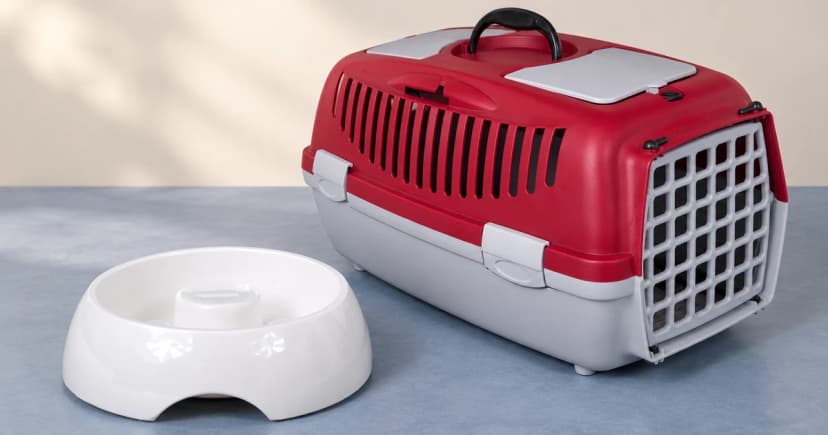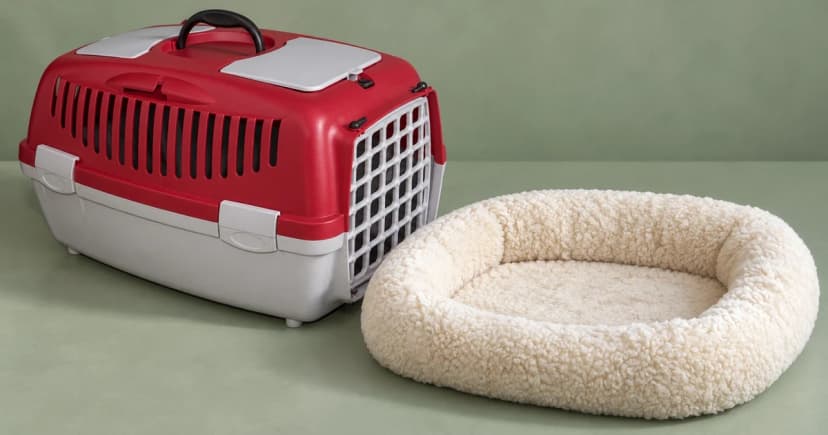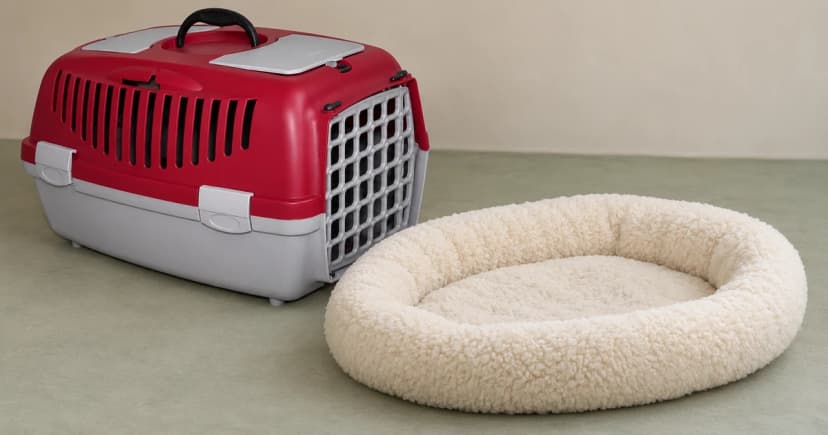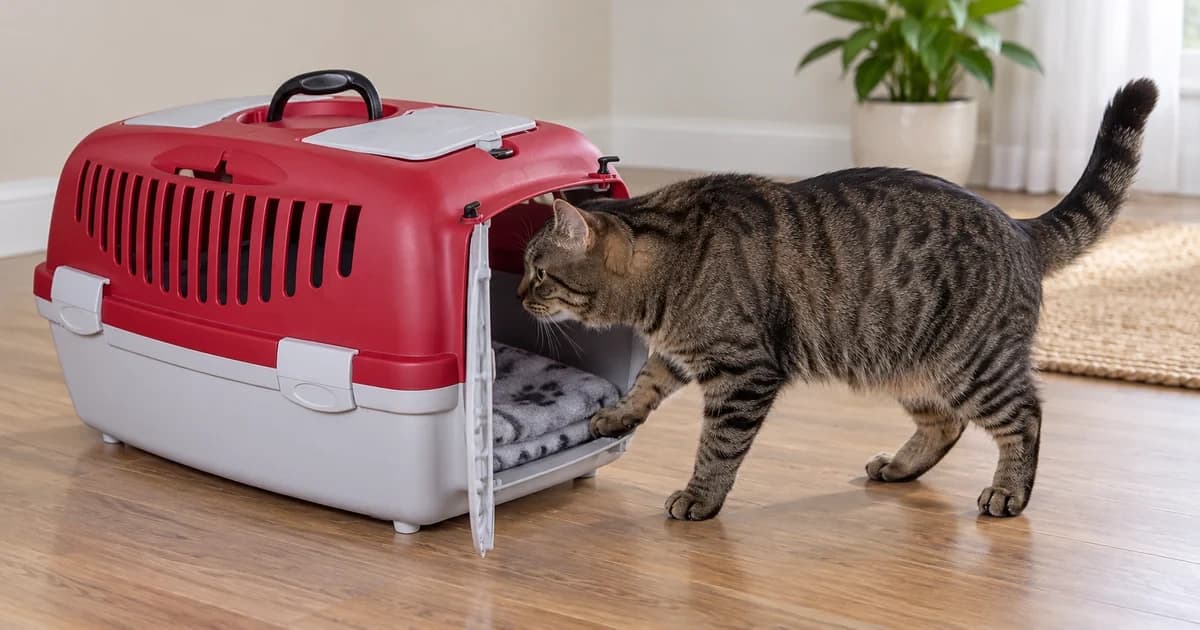
To get a cat into a carrier voluntarily, make the open carrier familiar before you need to leave. Start with a step your cat already accepts, such as approaching the carrier or standing on its bedding. Reward that step, then gradually work toward full entry. Introduce the roof, moving door and short closed-door periods separately, rather than closing the door as soon as the cat investigates.
Cat carrier training is a sequence of separate decisions: approach the open carrier, choose to enter, accept the roof or moving door, and only later accept brief closed-door periods or lifting. If you are helping a cat get used to a carrier, work from the step it already accepts rather than closing the door after its first investigation. This is advance practice, not a forced-loading method for an urgent journey.
This guide is for practice ahead of a planned journey. It does not provide a forced-loading method. If you need to leave urgently and your cat will not enter, contact your veterinarian for advice suited to that situation; a gradual practice routine cannot solve every immediate loading problem.
Make the entrance easy to investigate
Put the carrier on a stable, level floor in a quiet part of your home where your cat can reach it. Add familiar bedding that lies flat without blocking the entrance. Keep the carrier available between sessions, instead of producing it only when a trip is imminent. Cats Protection's carrier guide recommends leaving an open carrier accessible and introducing familiar bedding gradually when a cat is reluctant to approach.
Check the actual model's instructions before removing anything. A door that swings outward should stay clear of the entry path. If the maker allows you to remove it for practice, keep the door and its fittings together. If it stays attached, use the model's intended open position. Avoid improvising a tie or small loose object where the cat will step.
Look into the empty carrier from floor level. Is the opening clear? Is a blanket bunched against the threshold? Does the floor shift when touched? Fix the setup before asking the cat to explore. The point is to remove an equipment obstacle, not to compensate for it by pushing the cat through.
A top door and a removable roof are different features
A carrier may have a front entrance, a hatch in the roof, an entire detachable upper shell, or a combination of openings. Opening a top hatch does not turn the carrier into an open bed. A soft carrier with a zippered flap may also have no detachable shell at all.
If the manufacturer's instructions permit removing the upper half, you can begin with the lower tray and familiar bedding, then reintroduce the roof later. Battersea's carrier advice describes this progression. If your model does not separate, leave it assembled and begin with its front entrance open. Do not pry at clips or seams to imitate another carrier's tutorial.
Before any later lifting, restore the complete carrier and every required fastener according to its instructions. A practice tray with the roof removed is not a carrying configuration.
Reward approach before asking for full entry
Pick an easy starting point. If your cat avoids the carrier, that might be looking toward it or approaching bedding nearby. If they already walk up and sniff the entrance, start there. Battersea's training guide explains how to build voluntary entry through smaller rewarded actions, such as looking, approaching and sniffing, with rewards delivered promptly.
Use something your cat actually responds to. A familiar reward can be placed near the accepted starting point, then nearer the entrance as the cat becomes comfortable. For a cat interested in play, a supervised toy interaction near the carrier may encourage exploration. Stop the interaction if it becomes a chase that sends the cat away from the setup.
Give the cat room to choose. Sit to the side rather than filling the entrance with your body or reaching around them. During this open-door stage, let them leave again. A nose inside or two front paws on the bedding is progress, but it is not full entry and does not mean the door is ready to close.
Once the cat willingly goes all the way in, reward that action while keeping the exit available. Repeat the familiar step before adding another change. Do not turn the first visit into a surprise capture or use punishment when the cat walks away.
Add the roof and door as separate changes
For a removable-top carrier, replace the upper shell while the cat is outside. Assemble it correctly, initially leaving the front door off or open as the model permits. Let the cat investigate the changed shape again. The Catit carrier-training guide introduces the upper half and door in separate stages, with the door fully open before brief closure.
For a carrier that has remained assembled, the next change may simply be attaching the previously removed door or allowing the cat to observe it move. Keep your fingers and the cat's body clear of the mechanism. Do not close across a paw, tail or bedding caught in the opening.
When the cat is comfortable fully inside, try a brief closure, then reopen and reward. Keep this first change short; lengthening the closed period comes later. If the cat tries to leave as the door moves, return to open-door practice instead of repeatedly attempting to shut it faster.
| What you observe | Keep practicing | Change to postpone |
|---|---|---|
| The cat stays away from the carrier. | Reward an accepted approach point with the entrance open. | Placing them inside or closing the door. |
| The cat investigates the threshold, then leaves. | The same clear entrance and voluntary approach. | Demanding a long stay. |
| The cat enters an open lower tray comfortably. | That familiar tray and bedding. | Adding the roof and door at the same time. |
| The cat enters the assembled carrier with its door open. | Full entry with the exit available. | Closing and lifting in one attempt. |
| The cat remains comfortable through a short closure and reopening. | The same closure sequence. | A longer closed period plus movement together. |
These are observation checkpoints, not a timetable or a record of a completed training trial. Move back to the last comfortable step if your cat repeatedly retreats, hides or resists the changed setup. Staying motionless alone is not enough to decide that the cat welcomes the next step.
Keep lifting separate from entry practice
Only consider a brief lift after comfortable entry and closure, with the carrier fully assembled and secured as its maker directs. Follow the actual carrying instructions, then put it down gently. Do not lift an open tray, leave an access flap unsecured or assume that every handle has the same construction.
Keep a short note: carrier model, opening configuration, bedding used, last step accepted and the change to try next. For example, a blank record might have fields for “full entry with door open” and “brief closure followed by reopening.” Fill them from your own observations; there is no fixed number of sessions that establishes readiness.
When choosing from Pawlivy's cat carrier category, check the individual model's openings and assembly instructions. Our cat walking and travel categories cover other equipment, but those accessories do not establish how a particular carrier opens. Entry practice also does not verify dimensions, transport performance or airline acceptance. Our editorial policy explains how researched guidance is presented.