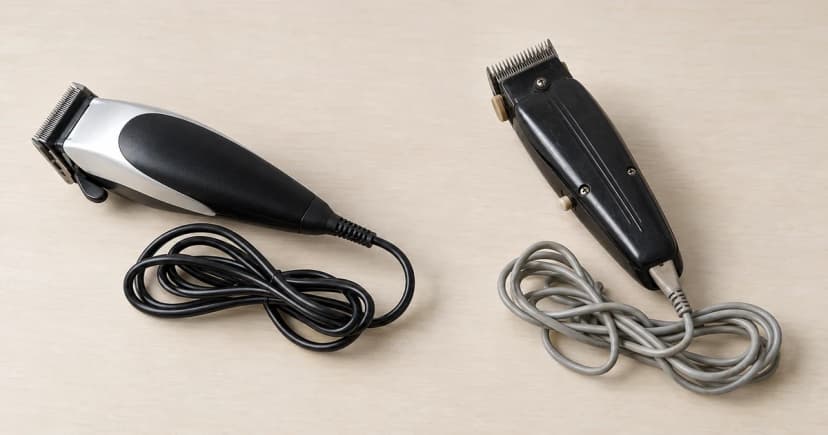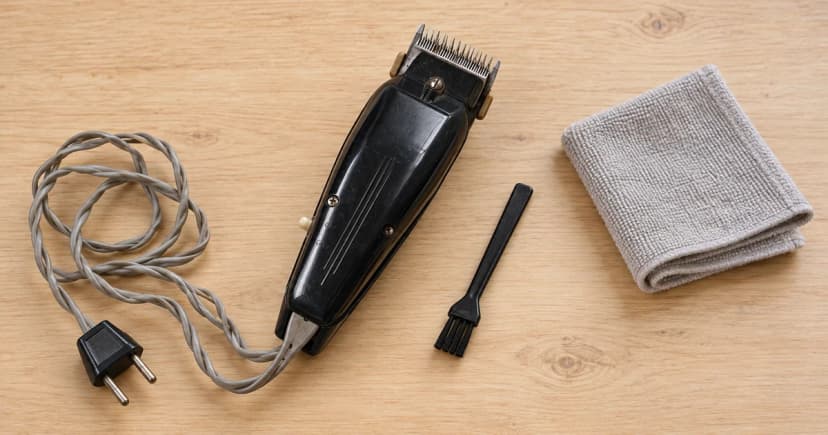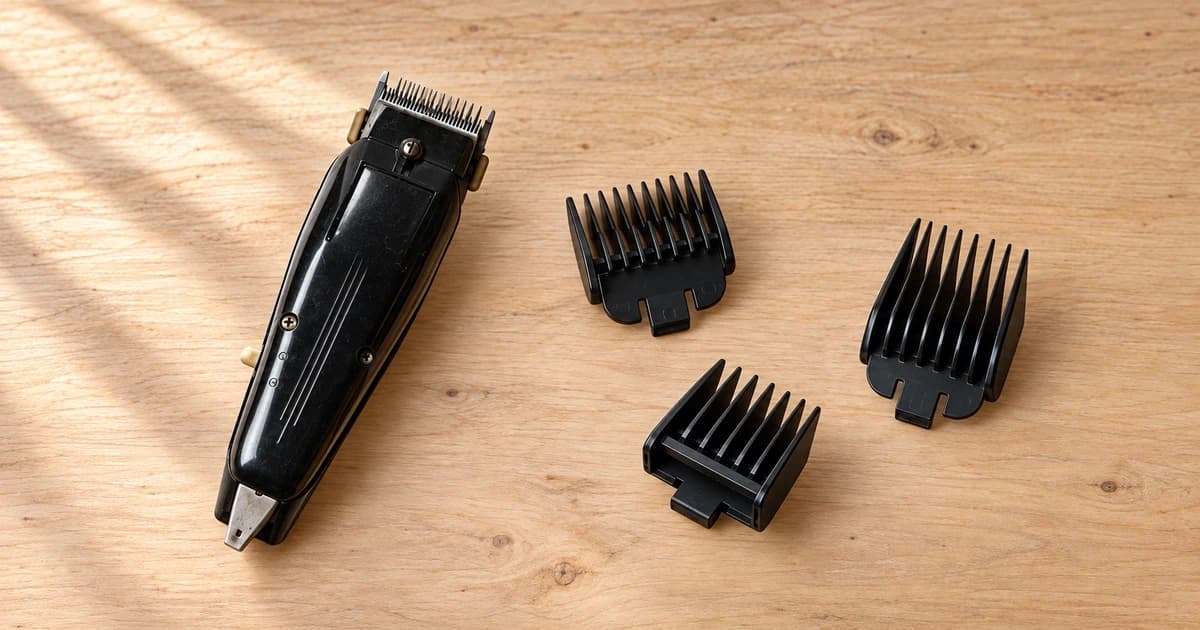
Match a guard comb by checking three things together: the exact clipper model, the blade installed on it, and the guard's part number or named attachment family. Find a manufacturer instruction or compatibility list that covers that combination before fitting it. A familiar brand, the same color or a printed cutting length does not establish a match.
This is an equipment-identification task. It is worth completing with the clipper off, away from your pet, before choosing a haircut length or buying another loose attachment. If one component cannot be identified, keep the pairing unresolved rather than testing it on an animal.
Record three identities before choosing a length
Start with the clipper's model label and its manual. Copy the complete model designation, including any suffix, rather than writing only the brand. Then identify the blade currently installed. A replacement blade may differ from the one originally supplied with the clipper.
Finally, identify the guard. Look for its part number, set number, packaging or the original instructions. A loose comb marked only with a length may not contain enough information to establish which attachment system it belongs to.
| Component | Useful identification | What it does not establish alone |
|---|---|---|
| Clipper | Exact model and relevant manual | That every comb from the same brand fits |
| Installed blade | Blade family, part number and any adjustable setting | That a guard for another head attaches correctly |
| Guard comb | Part or set number and documented compatible blade family | Compatibility based only on color or cutting-length label |
Photograph the labels and keep the packaging with the parts while you check. When a number is missing or illegible, a clear equipment photograph is useful for asking the manufacturer a question. It is not proof that a visually similar replacement will fit.
Identify the blade system without relying on one label
The Andis written FAQ describes its adjustable blades as screw-attached heads that change length with a lever, and its detachable blades as heads that attach through a hinge system. Those descriptions help identify what to investigate, but they are not a universal guard compatibility chart.
Ask two separate questions: how does this head attach to the clipper, and how does its cutting length change? Then look for the manufacturer's actual blade-family name. A description such as “adjustable,” “detachable” or “five-in-one” should lead you to the right documentation, rather than replace the part number.
Do not remove screws simply to find out which category a head belongs to. Read the manual and inspect the available labels first. Instructions for one hinge, release or attachment cannot establish how an unidentified head comes apart.
Use a documented pairing, not a brand-wide assumption
Wahl's current attachment-comb FAQ gives a useful example of why the family matters. It lists two separate stainless steel guide-comb sets, with different clipper-model lists. The following are selected examples from that page, not a complete chart for other equipment.
| Wahl set in the FAQ | Named family | One listed clipper example |
|---|---|---|
| 3390-100 | Detachable-style blades and clippers | KM10 |
| 3379 | Five-in-one-style blades and clippers | Bravura |
For those named stainless steel comb families, Wahl specifies a #10, #15 or #30 blade or blade setting, and recommends #30. Its five-in-one comb instructions specifically recommend the #30 setting before attachment to the described Wahl Fine, Pro, Diamond or Coarse five-in-one blades.
Keep that recommendation attached to its source. It does not mean every comb needs a #30 blade, that every blade carrying that number has the same interface, or that a third-party replacement is confirmed genuine or compatible. Check the documentation for the components you actually own.
The current family FAQ also contains an inconsistent-looking written length range. Do not repair an ambiguous chart from memory and use the correction as purchasing evidence.
Colors and cutting-length labels cannot prove a match
Wahl's two original 2018 family sheets make this distinction concrete. The detachable-blade comb sheet lists an orange #1, 1/2-inch comb as part 3374-100. The five-in-one comb sheet lists an orange #1, 1/2-inch comb as part 3335.
The color, number and stated length look alike, while the documented part numbers and families differ. These are historical identification examples, not a claim about current inventory or a measured grooming result. The sheets identify the detachable set as 3390-100 and the five-in-one set as 3379.
Use a printed length to select an option only after the attachment family is confirmed. Keep a blade number, a guard number and a labeled length in separate fields in your notes. Treating them as one interchangeable number makes it harder to explain what you own or what a compatibility instruction actually requires.
Resolve missing or conflicting information before fitting
A product listing may mention several clipper families without explaining the required blade. Compare that statement with the original maker's instructions and the actual attachment's part number. If the documents disagree, do not choose the broader claim simply because it covers more models.
Keep the answer with the equipment rather than relying on an unrecorded recollection.
Once the pairing is documented, follow its specific fitting sequence and the clipper's power-isolation instructions. Wahl's written five-in-one example describes sliding the named attachment on until it reaches the blade teeth, then gently sliding it off. That is not an instruction to bend a different guard, alter its catch or force it onto an unrelated head.
Pause if the attachment will not seat as described, a retaining part is missing, or the blade or guard appears damaged. An attachment that can be pushed into place has not thereby passed a compatibility or secure-fit test.
Keep a compatibility record with the equipment
Fill in this record from the actual components and documentation.
| Check | Owner's record |
|---|---|
| Clipper maker and complete model | ________________ |
| Installed blade family and part number | ________________ |
| Guard individual part number or set | ________________ |
| Manufacturer document or written confirmation | ________________ |
| Specified base blade or adjustable setting | ________________ |
| Exact fitting/removal instructions located | ________________ |
| ________________ |
Review the record when a blade or comb is replaced, even if the clipper body is unchanged. Store unidentified loose guards separately from the documented set so that similar-looking pieces do not become an assumed combination.
Our clipper and trimmer category and blade and accessory category organize equipment to compare.
This guide organizes published manufacturer information into a practical identification process. Our editorial policy explains the distinction between a sourced example and a product test.