
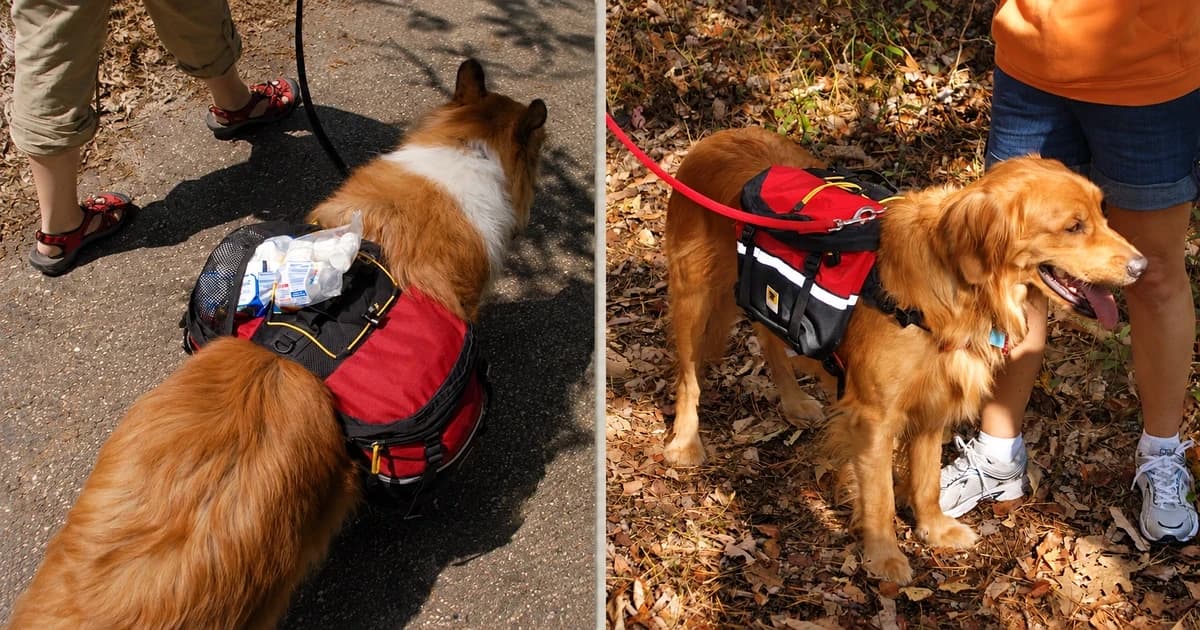
Learning how to use a dog backpack involves three separate decisions: whether carrying a pack suits your dog, how that model fits, and what you will put in it.
Check before fitting
Discuss your dog's individual suitability for carrying a pack with your veterinarian. There is no single load allowance for every dog. If capacity remains unresolved, carry the items yourself.
Identify the exact pack and its fitting instructions before putting it on. Find the closures, strap routes and designated leash attachment; another pack's arrangement may differ.
Our dog backpacks category covers packs worn by dogs. A carrier in which a person carries a dog serves a different purpose.
Fit the actual design
For the named Denver Urban Pack, Outward Hound opens the body buckles and Velcro tabs, extends the straps and unthreads the center belly strap. Its sequence positions the pack near the neck base, passes the right front leg through its loop, then secures the chest and rear belly panels. The center belly strap goes through the appropriate sternum loop. Center the panels and secure loose strap ends with the provided tabs.
Those steps belong to that design. Use your own model's fit allowances and attachment instructions. Ask its maker if the routing or fit is unclear.
Start empty
Begin with an empty pack and short, familiar walks. Watch your dog's movement and participation before adding another demand. If your dog avoids the pack or seems uncomfortable, stop and revisit the introduction or fit.
Balance approved contents
Once your dog is ready for an individually appropriate load, distribute weight evenly between the sides. A collapsible bowl and waste bags are possible ordinary items; they are not a required packing list.
Ruffwear's packing guide emphasizes side-to-side balance. Recheck it as contents change, rather than assuming the starting arrangement stays balanced.
Weigh the complete pack and contents to record their actual mass. That measurement does not approve the load for your dog.
Recheck and finish
If panels shift, straps rub or your dog becomes uncomfortable, pause use and reconsider the fit or load. Do not tighten unfamiliar straps simply to keep going.
At the end, unload the contents and remove the pack using its own instructions. Note what your dog accepted, any shifting and the question to resolve before another outing.
Keep the outing plan separate: our dog hiking guide covers route decisions, while the camping guide covers care during an overnight stay.