Start a cat food puzzle with food your cat can see and reach easily, then add one access challenge after you have seen the cat retrieve it. Keep ordinary feeding available. A first lesson should help your cat discover what the equipment does, without making eating depend on solving an unfamiliar mechanism.
The useful question is specific: can your cat reach this piece through this opening, and what movement would release the next one? An open channel, a deep cup and a covered compartment can sit on the same board while asking for different actions. Treat them as separate steps.
Look at the access route, not the difficulty badge
Before loading the puzzle, inspect it empty and read its instructions. Find the areas that hold food and the parts the maker permits you to move. Check whether covers are fixed, removable or connected to a track. Do not pull out a part simply because it looks detachable.
A review of cat food puzzles distinguishes rolling devices from stationary puzzles with cups and channels. It also describes cats differing in whether they use paws or noses and favor moving or stationary equipment. That makes the access geometry more useful than assuming every cat should begin with the same toy.
| What you see | What the cat needs to do | A possible easier start |
|---|---|---|
| Open shallow channel | Reach visible food and move it toward an accessible edge | Use an exposed section without another barrier |
| Deeper cup or narrow opening | Reach into the space and draw food out | Begin in a shallower section, if the board offers one |
| Covered cup | Move the cover before reaching food | Leave the cover open in the maker's permitted starting position |
| Peg or adjustable outlet | Operate the specified release motion | Use that model's easier setting and demonstrate its movement |
This is an access comparison, rather than a universal ranking. A cat may readily fish a piece out of a cup yet have no reason to move a peg. Check the actual action before increasing the puzzle's complexity.
Set up an easy choice beside the normal routine
Choose a quiet place with a stable surface and room for the cat to approach or leave. Avoid a busy doorway or a spot where another animal can reach over the cat. Put the puzzle within comfortable reach rather than on a high perch chosen only to keep it out of the way.
Use food your cat already eats that is suitable for this device. Cats Protection's puzzle guidance recommends accounting for puzzle food within the cat's existing daily allowance and starting with an easy arrangement. Follow the maker's guidance on compatible food; a device intended for dry pieces should not automatically receive wet food.
For an introductory attempt, keep food visible in an accessible area instead of filling every deep well. The journal review includes offering the puzzle as a choice beside the usual feeding container with the cat's usual food. Keep that familiar option. Do not delay ordinary feeding or leave a difficult board as the only way to eat.
Separate finding food from moving a part
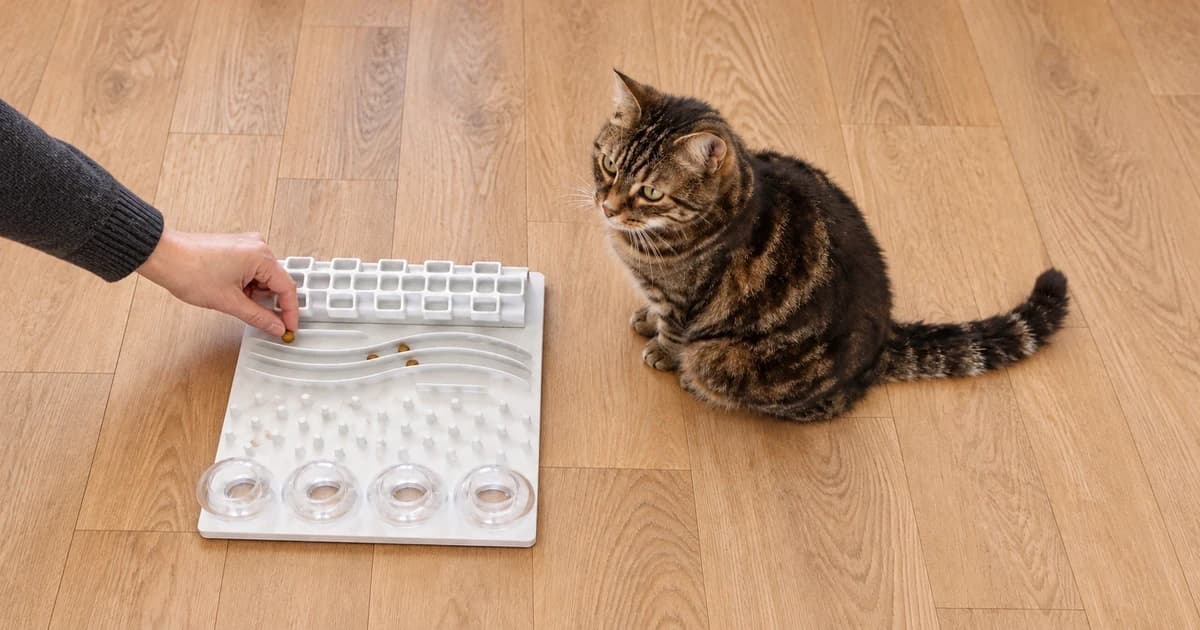
Let your cat inspect the open puzzle. You can place a piece in an easy section while the cat watches, then move your hand aside. If the piece disappears behind a wall or falls into a narrow gap, reset it where access is obvious. Do not push the cat's face toward it or hold a paw against the mechanism.
Watch what actually happens. Looking at the board shows attention. Sniffing shows investigation. Eating an exposed piece shows retrieval. None of those observations, on its own, shows that the cat understands a cover or peg.
If your cat takes the visible food and leaves, keep the next attempt similarly easy. If it retrieves from a shallow channel but repeatedly misses food in a deep cup, use the shallow area again. You can learn something useful about access without turning every session into a harder task.
Change one access barrier, using your model instructions
A specific example is Nina Ottosson's Rainy Day Puzzle & Play. Its beginner instructions use open cups with the raindrop covers moved off the tracks. Later configurations put covers over cups or load food through a peg opening, with the peg moved over cups and back. Those are stages for that board, not directions for every cat puzzle.
Start with the open configuration. After observing easy retrieval, add one permitted cover challenge while leaving other access easy. Show the cover's movement once with your hand, then give the cat space. Do not cover everything and change the peg loading at the same time; you would lose track of which change caused the difficulty.
Other equipment changes access differently. The Catit Senses Food Tree uses an adjustable disc to alter outlet openings. That is a tower-specific control, not an instruction to twist a flat board or remove its covers. Check the instructions for your exact version before adjusting it.
Make a short note after each attempt: the opening used, whether it was covered, what the cat moved, and whether food came out. For example, “open channel: retrieved; covered cup: sniffed and walked away” suggests reopening the cup next time. It does not establish a learning speed, intelligence score or dislike of all puzzles.
Read the pause before increasing the challenge
If the cat approaches but cannot retrieve food, examine access first. Is a cover still blocking it? Has the piece fallen beyond reach? Did the puzzle slide when touched? Reset the maker-supported easy arrangement on a stable surface.
If the cat avoids the whole setup, simplify the setting as well as the puzzle. Move away from household traffic, give it more space, or put the device away and offer it later. Repeatedly presenting food under its nose or taking away the ordinary bowl does not explain the mechanism.
End the attempt if the cat begins chewing the puzzle, pulls at a part that should stay attached, or you notice damage. A manufacturer's difficulty label does not override those observations. There is no required progression calendar: staying with an accessible section, trying a different design or declining this activity are all useful outcomes.
Keep the lesson individual and finish with an empty puzzle
In a home with several cats, provide separate puzzles and enough separation for each cat to approach without competition. The journal review recommends individual puzzle resources. Another cat's quick retrieval should not set the pace for the one you are introducing.
When the session ends, account for the components, remove remaining food and follow the device's cleaning directions. Rainy Day's maker calls for supervision, damage checks and putting the toy away after it is emptied. A stationary puzzle is still equipment that needs inspection, rather than an unattended chew toy.
Compare access before choosing a puzzle
When browsing Pawlivy's cat puzzle category, compare the open starting position, food-access depth, permitted adjustments and cleaning instructions. Check whether the listing describes a food puzzle at all: a ball hidden in a scratcher box asks for a different interaction and should not be filled with food by assumption.
If food retrieval does not interest your cat, use its observed play style to consider other cat toys. Our guide to choosing cat toys from watching, chasing and batting offers a separate selection approach. These are ways to choose and introduce equipment, not claims that a puzzle treats a health or behavior problem. Our editorial policy explains the source and review approach behind the guidance.