Clean a litter box in two separate routines: remove waste every day, and periodically empty and wash the tray. For an ordinary tray, Cats Protection recommends scooping twice daily and washing at least weekly. A powered box needs its own model-specific schedule and part-by-part instructions. An automatic cleaning cycle does not replace cleaning the equipment.
To replace cat litter at home, distinguish scooping waste, replacing some litter, replacing all litter and washing the empty tray. Check the litter and box instructions for the replacement and disposal tasks; then record which job was actually completed. Refilling a tray does not mean its floor and walls have been washed, and an automatic cleaning cycle does not replace its model-specific maintenance.
The useful question is therefore not just “How often?” It is “Which task, on which part, following which instructions?” A weekly reminder can be a reasonable starting point for an ordinary tray, but it should never tell you to soak an entire electronic unit or delay removing visible waste.
Separate daily waste removal from a full wash
During a waste-removal visit, lift out waste and clumps appropriate to the litter you use, collect loose debris around the tray, and check the remaining litter against its directions. A litter scoop helps with this task; it does not wash the floor or walls of the box. Replacing some litter, replacing all litter, and washing the empty tray are also different jobs.
Cats Protection’s toileting guidance specifies twice-daily scooping and at least weekly washing with hot soapy water or a cat-safe cleaning product. International Cat Care’s kitten-care booklet describes at least daily waste removal and at least weekly tray cleaning, more often when necessary. Those recommendations distinguish routine waste removal from cleaning the box itself.
The AAFP/ISFM house-soiling guideline’s equipment section gives minimum daily scooping and a broader one-to-four-week washing interval. These sources do not establish one universal full-wash interval for every litter, household and product. Use a named source’s routine as a starting point, check the actual tray and litter instructions, and clean sooner when the box is visibly soiled.
Use a checklist for an ordinary removable tray
Before starting, identify whether you have a simple pan, a detachable lid or insert, or components connected to power. The following steps describe an ordinary removable tray. They are not disassembly instructions for an automatic box.
- Gather the instructions and supplies. Check the tray and litter directions for approved cleaners, washing methods and disposal. Have a waste bag, suitable cloth or brush, and a place for the empty tray to drain. Keep the cat away from the work area and any open cleaning product.
- Remove the used litter. Follow its disposal directions. Emptying is a separate task from scooping; do not label the visit a full wash while used litter still covers the tray floor.
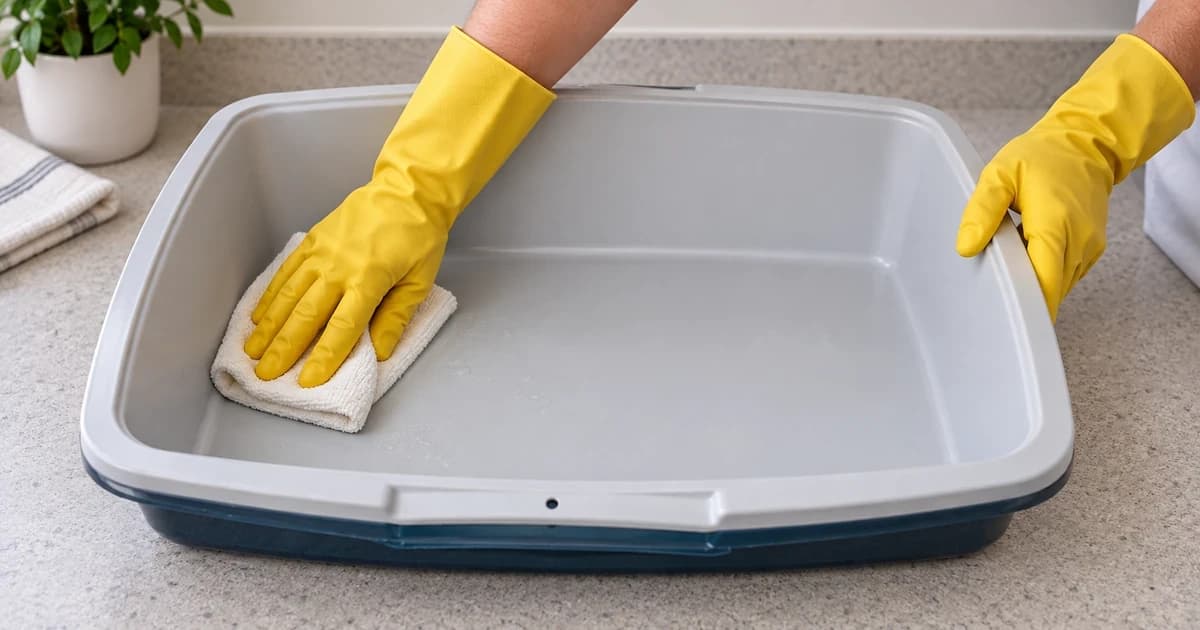
- Wash the accessible surfaces. Clean the floor, corners, walls and rim, plus detachable parts whose instructions permit washing. Cats Protection describes hot soapy water or a cat-safe product; check that the chosen product and method also suit your particular tray.
- Rinse and check the corners. Follow the cleaning product’s rinse directions. Look for remaining waste and cleaner residue rather than treating fragrance as evidence of cleanliness. Do not mix cleaning products or substitute an improvised disinfectant recipe.
- Dry and put the box back together. Dry the tray before adding fresh litter. Check that lids, inserts and clips are seated, the opening remains usable, and the litter level follows the litter or box instructions.
A smooth-looking tray is not proof that its coating, clips or other parts tolerate that treatment. This routine is ordinary equipment cleaning; it does not establish a disinfection result or treat a health problem.
For a powered box, identify the model and the part
Do not transfer an ordinary pan’s wash routine to a self-cleaning litter box. Record the exact model, then follow its emptying, power-disconnection and disassembly sequence. Two manufacturers illustrate why the component names matter:
| Named equipment | Maker’s cleaning guidance | Important boundary |
|---|---|---|
| Litter-Robot 4 | Whisker describes basic globe cleaning every one to three months and deep cleaning at least every three months. | Its base and control panel must not be submerged, sprayed or soaked. Globe-cleaning permission does not apply to the complete unit. |
| PetSafe ScoopFree Clumping Self-Cleaning Litter Box | PetSafe describes regular monthly cleaning. For this model, the tray, waste bin and bin cover may be hand-washed or placed in a dishwasher. | The rake is not dishwasher-safe and must be hand-washed. Its sensors have their own cleaning instructions, and all parts must dry before reassembly. |
These details come from Whisker’s Litter-Robot 4 use-and-care instructions and PetSafe’s ScoopFree Clumping cleaning instructions. They are examples for those named products, not permissions for every automatic box or every ScoopFree model.
PetSafe’s sequence begins by unplugging the unit from the wall and disconnecting its power connection. Its instructions include cleaning all six sensors, even when they look clean. Do not improvise a sensor solvent or copy that model’s sensor treatment to another unit. Check the correct manual for the rake, sensor, globe, drawer, base and any electrical contacts instead of calling all of them “the box.”
Automatic waste separation, emptying a waste drawer and washing removable parts remain separate tasks. Set reminders for the tasks your model actually needs. A globe-cleaning interval is not permission to leave a waste drawer unattended for that same period.
Make a maintenance card that records the completed task
Use four fields: equipment and part; task; last completed; next check. For an ordinary tray, keep “scooped” and “emptied, washed, rinsed and dried” on separate lines. For a powered model, add the specific components and follow the maker’s interval for each.
For example, an illustrative card might say “morning scoop completed; full tray wash still due.” It should not say “box cleaned” and hide the unfinished wash. This is a suggested record format, not a report of a tested household schedule.
Ease of cleaning is a useful selection question, but a product title or material name cannot verify washability, odor control or current availability. Our editorial policy explains the distinction between source-based guidance, illustrations and product testing.