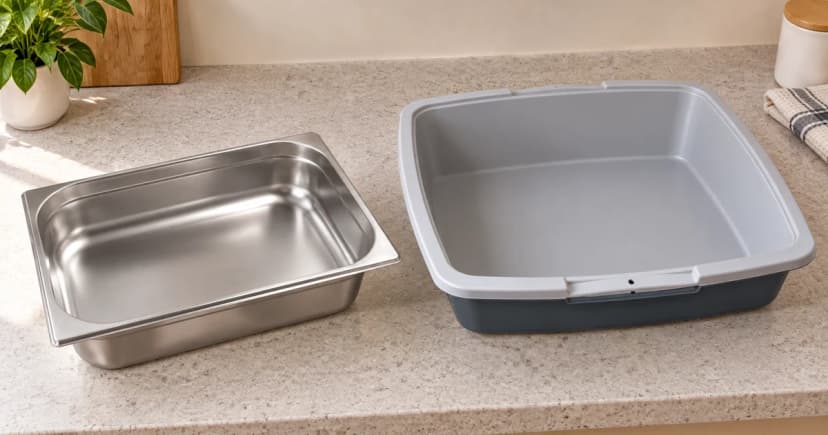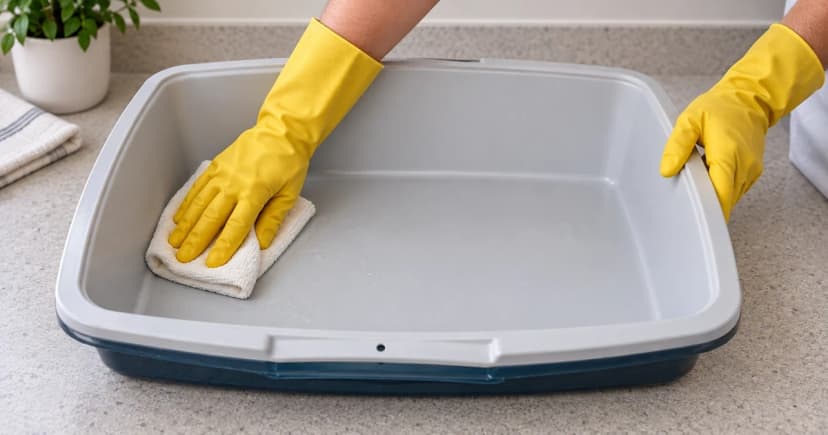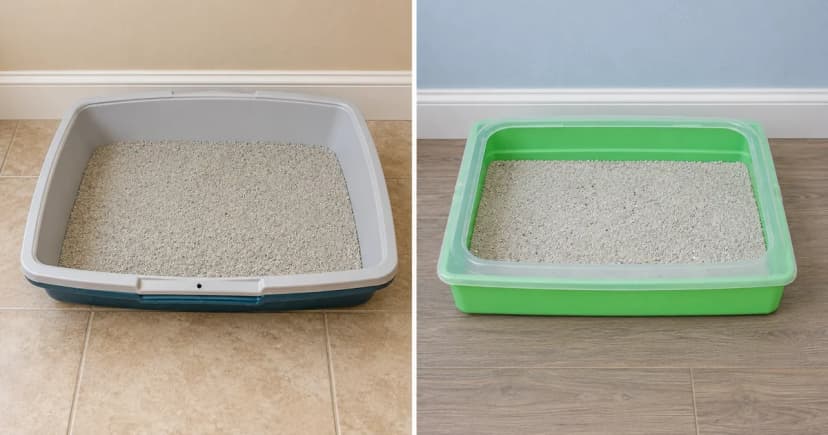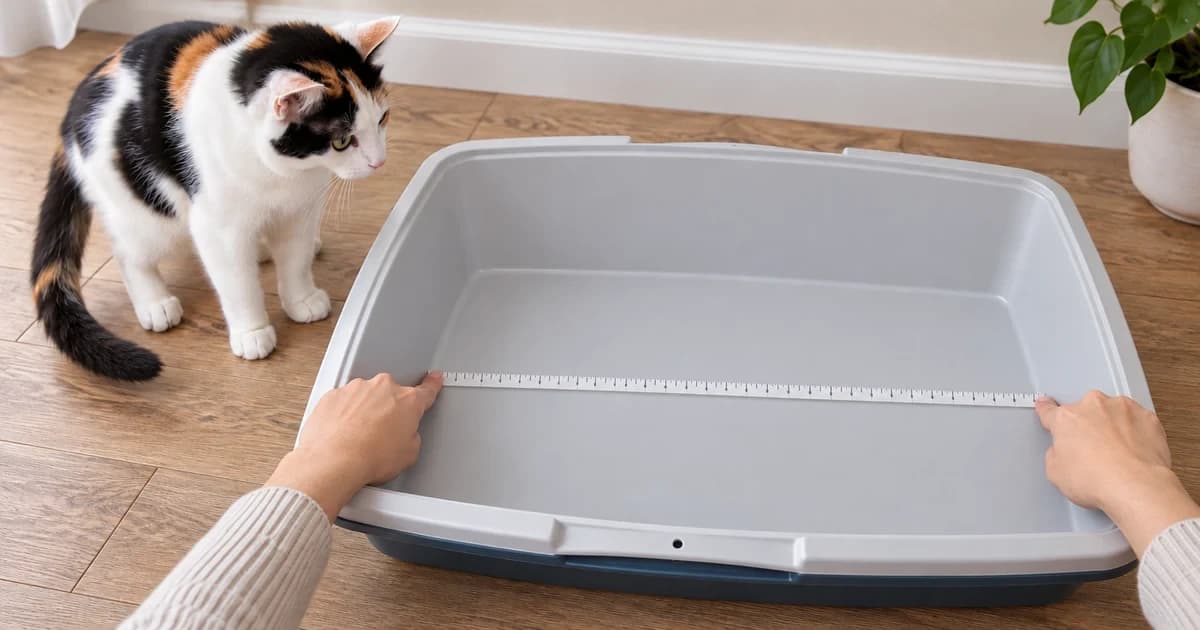
A litter box should give your cat room to turn and use it without being squeezed against the walls. A useful starting point is a rectangular box about 1.5 times your cat’s length from nose to the base of the tail, as recommended in the amended AAFP/ISFM house-soiling guidelines. Compare that target with the box’s usable interior, then check the entrance and the space where you will put it.
Size and placement work together. A roomy box behind a door that is often shut is difficult to reach; a convenient corner does not make a cramped hood larger. Use the checks below before choosing a box or rearranging an existing one.
Measure the cat, and be clear about the tail endpoint
When your cat is standing comfortably with the body reasonably straight, estimate the length from the nose to where the tail joins the body. Keep the tape beside the cat rather than wrapping it around the torso. There is no need to hold the cat in place for an exact photograph; wait for a relaxed opportunity and repeat an uncertain reading.
Multiply that body length by 1.5 to make an initial box-length target. For example, an illustrative 18-inch nose-to-tail-base measurement gives a 27-inch target. These are arithmetic example values, not measurements of a cat or box we tested. Width, entry and headroom still require separate checks.
The tail endpoint needs explicit attribution because published guidance differs. The 2018 AAFP/ISFM corrigendum specifies nose to base of tail, and that wording appears in the current publisher version of the guidelines. The 2021 AAHA general litter-box page instead says nose to tip of tail. This guide uses the amended AAFP/ISFM nose-to-base method; it does not average the two measurements.
The corrigendum also mentions a study in which adult cats preferred a 34-by-15-inch box over a smaller one. That comparison does not establish a universal 34-inch minimum for every cat. Start with your individual cat’s dimensions and check the actual design.
Check the space inside, not just the size on the listing
“Large” and “XL” are labels, not measurements. A listing’s length may describe the outer rim, a hood or the shipping package. Before comparing options in the litter-box collection, find out which dimensions the manufacturer provides.
For an existing rectangular pan, measure the clear floor length between its inside ends and the width between its inside sides. Note sloping walls, curved corners and any internal partition. An outside rim can be wider than the floor beneath it.
Do not apply the 1.5 multiplier to width as though the cited guideline supplies a second formula. Instead, consider whether the interior allows your cat to enter, turn and adopt a normal toileting posture. The length target is a starting point, rather than a guarantee that every box with that length will work.
Keep three measurements separate:
- Usable interior: the floor area the cat can occupy, plus unobstructed headroom if covered.
- Entrance: the opening’s width, height and step-over edge, including any flap.
- Installation footprint: the outside dimensions and the additional space needed to approach, remove the lid and scoop.
A box can pass one check and fail another. A long exterior with a small internal compartment is not equivalent to a long open pan. Likewise, a spacious chamber may be inconvenient if its entrance is hard for this cat to negotiate.
Choose an entrance the cat can use comfortably
With open litter boxes, inspect the lowest entry edge separately from the taller sides. High walls and an easy entrance can coexist, depending on the design. International Cat Care’s kitten-care booklet explains that kittens may initially need a lower-sided tray and a larger one as they grow.
For covered litter boxes, look beyond the hood’s outside height. Check the opening, the clear space above the litter and whether the roof narrows over the area where the cat turns. The amended AAFP/ISFM guidance notes that a small covered box can restrict a larger cat’s posture. It also describes differing preferences for covered and open designs, so a cover is not automatically better for every cat.
Watch ordinary entry and exit without repeatedly placing the cat inside. Difficulty stepping over the edge calls for reconsidering access; do not assume it proves a medical condition or that buying a different box will treat one.
Where should I put the litter box? Check quiet and dependable access
Cats Protection’s toileting guidance recommends a quiet location away from busy doorways and noisy appliances, with litter facilities separate from food, water and sleeping areas. Quiet should still mean accessible.
Walk the route at the times your cat normally uses the room. Is the bathroom door routinely closed? Does a washing machine start next to the box? Can another animal wait at the entrance and block the way out? AAHA’s placement advice emphasizes access and escape routes. A hidden nook deserves a closer look if it creates a narrow, easily blocked approach.
Check the arrangement with the box in place rather than judging an empty corner. Open the nearby door fully. Remove the hood if it has one. Reach every part of the pan with the scoop. If furniture surrounds the box, inspect both the furniture opening and the box entrance; a generous cabinet exterior says little about the usable chamber inside.
These are planning checks, not a fixed clearance standard in inches. The necessary working space depends on the actual box and the room.
Make a short size-and-location record
Before buying, write down the date, nose-to-tail-base length, calculated starting target, usable interior measurements and entrance details. Keep the brand and model alongside those figures so that measurements from different listings do not get mixed together.
After setup, note what you actually observe: straightforward entry, room to turn, an unobstructed exit and access for cleaning. A kitten’s growth or a change in access may make a new check useful. New toileting problems deserve veterinary advice rather than an assumption that dimensions explain everything.
This guide is based on published equipment guidance and practical measurement planning, not Pawlivy product tests. Our editorial policy explains how sources and corrections are handled.