When owners ask are rubber toys safe for dogs, the answer depends on four product-specific checks rather than the word “rubber” on a tag: (1) the exact rubber formula and hardness, (2) whether the toy is built for stationary chewing or supervised fetch/tug, (3) sizing that prevents the toy from slipping behind the premolars, and (4) retiring the toy as soon as cracks, tears, or missing chunks appear. Even a natural, nontoxic rubber compound is non-edible and can cause a gut blockage or tooth fracture if the size or hardness is wrong for your dog.
Why rubber formulas, colors, and labels are not universal
A generic listing that says “durable rubber dog toy” leaves out the compound, hardness, and testing scope. Use these published sources to separate brand-specific rules from broad marketing words:
| Label or product detail | What the published source establishes | What it does NOT guarantee |
|---|---|---|
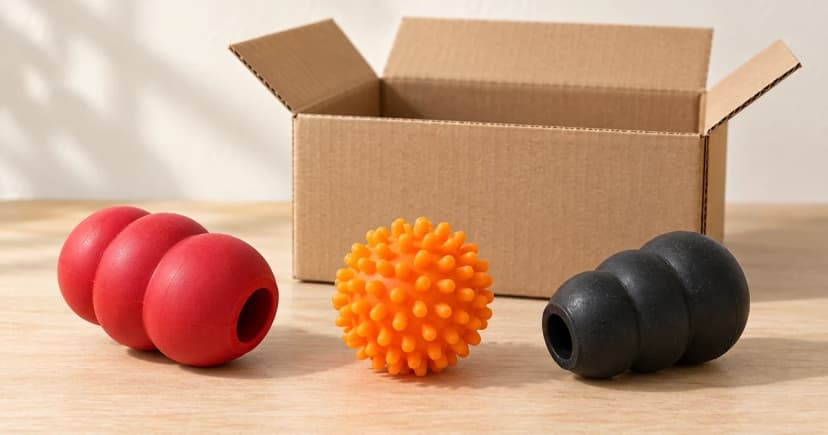
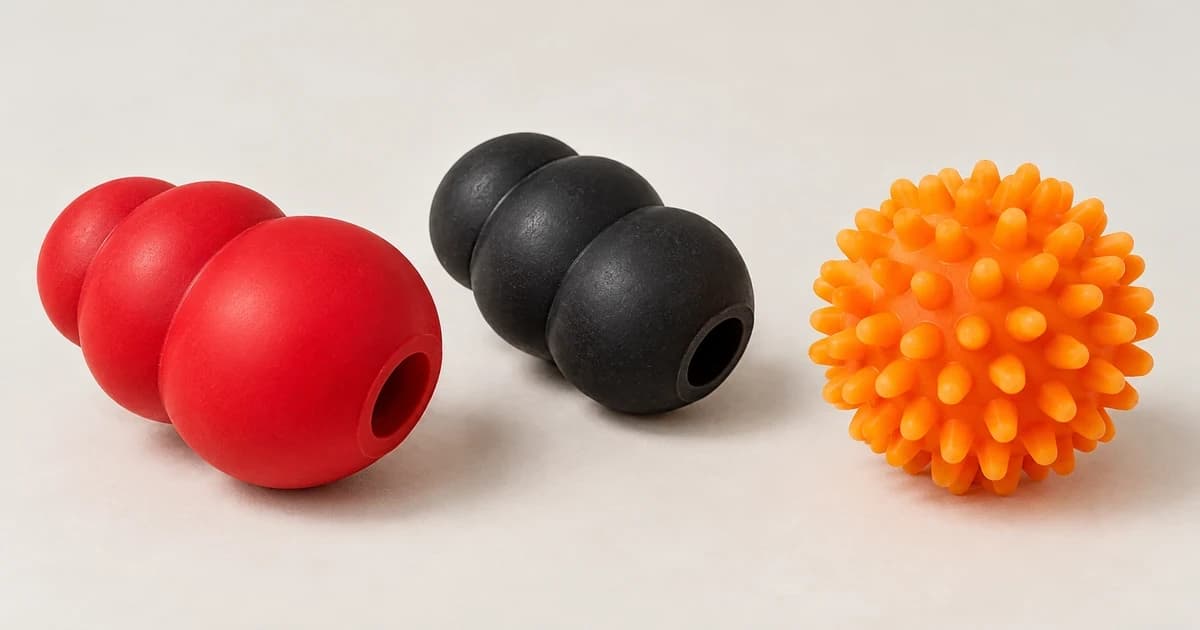
| KONG color-coded rubber lines (KONG durability guide & KONG FAQ) | Within KONG's own natural-rubber range, red Classic is formulated for average chewers, black Extreme for power chewers, and pastel Puppy / Senior lines use softer rubber. | Does not create a universal industry color code—a black or red toy from another brand does not share KONG's rubber compound or tear strength. |
| “BPA-free,” “phthalate-free,” or “nontoxic” labels (PetMD 2018 label report) | Identifies specific chemical-absence claims that owners can verify against the brand's published material specifications. | Does not make the rubber digestible if swallowed, prove resistance to power chewing, or certify that an overly rigid toy is safe for tooth enamel. |
| Interactive vs. dedicated chew shapes (KONG FAQ & Blue Cross play guide) | Separates fetch, tug, and treat-dispensing play from sustained stationary gnawing. | A rubbery ball or tug ring designed for active retrieval is not automatically rated to survive unattended molar chewing. |
Checklist 1: Five checks before buying rubber dog chew toys
When comparing rubber dog chew toys or looking for good toys for dogs that enjoy gnawing, run through these five pre-purchase checks before handing the toy over:
- Verify the brand and named rubber line: Look for a named product line with published chewing-style guidance rather than an unbranded mold identified only by color or shape.
- Match rubber give to your dog's teeth and jaw strength: Harder is not always safer. In PetMD's 2018 reporting, veterinarian Dr. Rory Lubold notes that overly rigid chew objects can fracture teeth, while softer puppy or senior rubber can be shredded quickly by an adult power chewer.
- Check the intended activity mode: Decide first whether you are shopping for a stationary chew, a retrieve ball, or a two-way tug toy. As Blue Cross advises, match the toy to the specific game—and for shared tugging rules and voluntary drop cues, follow our tug-game guide.
- Size up if your dog is between weight brackets: Follow the manufacturer's weight and jaw-size chart, and make sure the toy's narrowest cross-section is too wide to pass behind your dog's back teeth or block the throat.
- Inspect openings and hollow cavities: If the rubber toy has a hollow center or treat hole, verify that there are vent holes to prevent tongue or jaw suction and that your dog's lower jaw cannot wedge inside the opening.
Checklist 2: In-use supervision and when to retire a rubber toy immediately
As KONG states explicitly, no dog toy is completely indestructible. Inspect every rubber toy before and after each play session and act immediately on these retirement signs:
- Retire and discard the toy immediately if: you see deep tooth-puncture cracks, torn seams, stretched thin bridges, sticky or crumbling rubber degradation, or any bitten-off chunk.
- Step up size or toughness formula if: your dog compresses a hollow rubber toy flat between its molars on day one or begins pinching off rim fragments.
- Contact your veterinarian straight away if: a piece of rubber is missing and may have been swallowed, or your dog shows vomiting, gagging, lethargy, or loss of appetite after chewing (KONG FAQ). Never assume “natural rubber” or “nontoxic” means a swallowed chunk will pass safely on its own.
When browsing our chew toys collection, use these two checklists to compare published formula descriptions, size charts, and activity ratings for your individual dog.